



Höegh Autoliners unveils new ammonia-ready dual-fuel hybrid PCTC
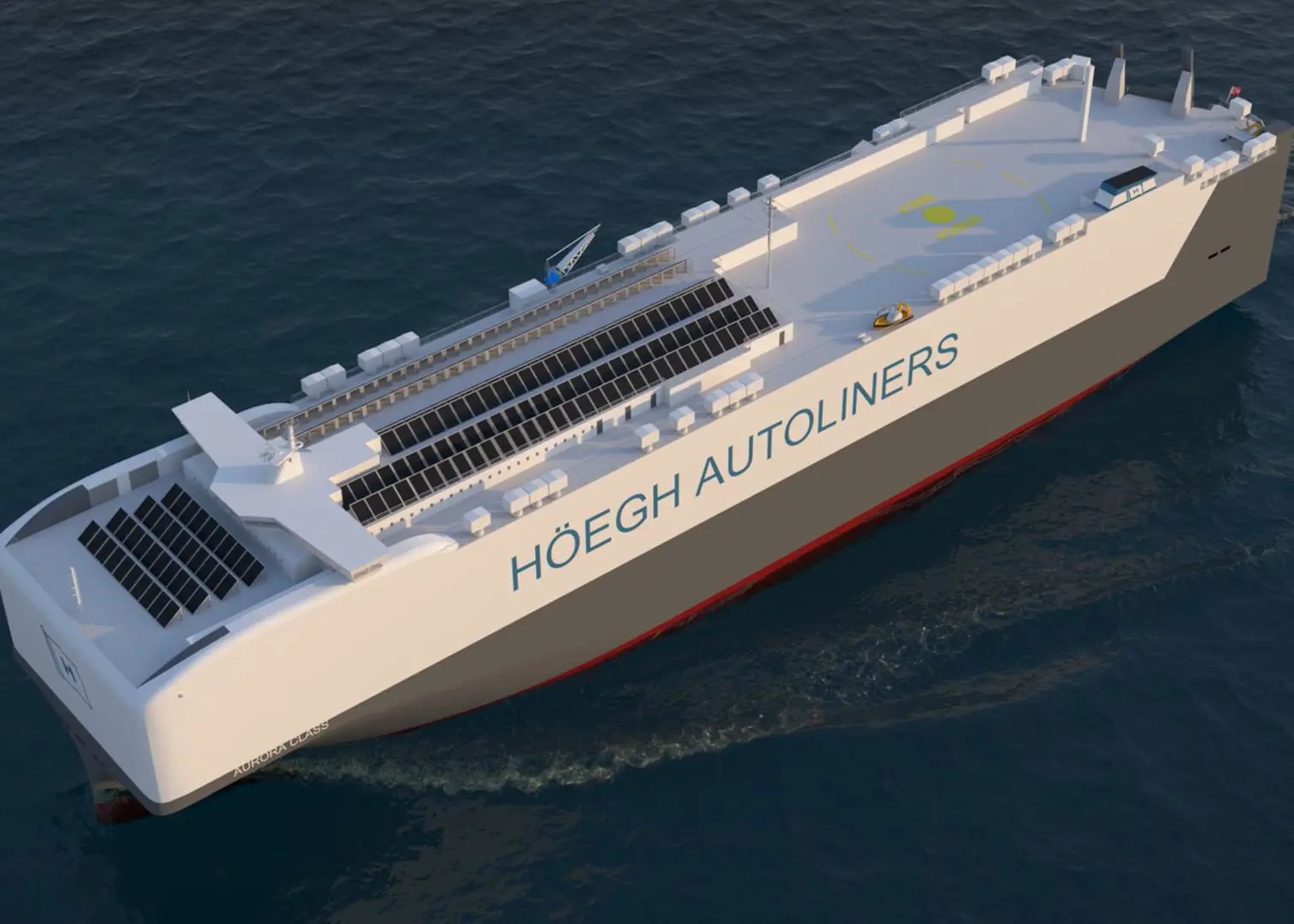
The shipowner announced that it had signed a Memorandum of Understanding (MoU) for the vessel, which is intended to be the first of a new 9100 ceu capacity Aurora Class series, with Xiamen Shipbuilding Industry.
The project also involves naval architects Deltamarin, classification society DNV and engine builder MAN Energy Solutions.
While Höegh Autoliners refused to provide more details about the vessel’s design, the new Aurora Class design is likely to exceed the length of Höegh Autoliners’ largest 8500 ceu Horizon Class vessels, which measure 200 metres in length, with a beam of 36 metres.
The vessel’s LNG fuel tanks have been designed with an eye on the requirements of future fuels, including ammonia. Deltamarin’s CEO Janne Uotila noted that the “[ability] to take future carbon neutral fuels, such as ammonia, …has been considered, for example, in the fuel storage design.”
The vessel is expected to enter service by the end of 2023. The vessel will be the first of its type to receive DNV’s ammonia-ready notation. The engine, tank and fuel gas supply system will be suitable for subsequent conversion to operation on ammonia and other future zero-carbon fuels.
The conversion to operate on ammonia will require modifications to the vessel’s MAN B&W dual-fuel engine, its fuel tank and auxiliary systems, MAN ES’s Kjeld Aabo, Director New Technologies at MAN Energy Solutions confirmed.
In addition to the design’s ammonia-ready dual-fuel engine, the vessel will include a number of other emissions reduction technologies. These include the installation of shorepower connections, as well as the inclusion of an energy management system featuring a battery pack aboard the vessel.
Related Articles
 ALTERNATIVE FUELS & LUBRICANTS
 ALTERNATIVE FUELS & LUBRICANTS
 ALTERNATIVE FUELS & LUBRICANTS