



DREDGERS CRAFTED TO GIVE COMPETITIVE EDGE
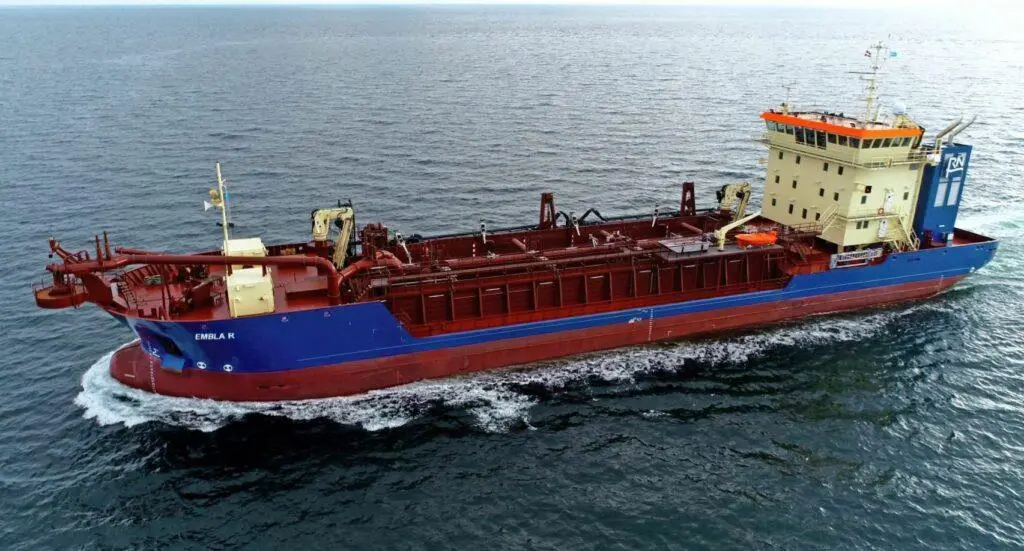
The 2,700m3 hopper-capacity trailing suction dredgers ordered by Rohde Nielsen blend a high degree of flexibility as to work assignments, discharge options and energy use with an exacting environmental standard. The design combines a remarkably shallow draught with dynamic positioning to offer capability across a range of deployments, and gives extra operational scope to the ‘trailer’ fleet through the adoption of a split-hull construction.
The 85m sisters Ask R and Embla R employ a diesel-electric power and propulsion arrangement with variable-speed gensets, supplemented by a 600kW battery installation, comprehensively overseen by a Siemens system that precisely matches engine usage and settings to energy requirements at any point in the operating profile.
While the most circumspect use of power and the flexibility in the system produces fewer emissions as well as competitive advantage through increased efficiency, direct measures applied in the new dredgers to combat atmospheric pollution include tailored diesel particulate filters (DPF) and selective catalytic reduction (SCR) technology. The vessels’ high-speed engines have been prepared to allow running on second-generation biofuel, to markedly curb carbon footprint, while onboard lighting throughout is of the energy-saving LED type.
A high degree of self-reliance is a characteristic of dredging companies, born out of operating equipment-intensive, relatively complex vessels in often difficult or remote deployments under demanding contractual and timescale obligations. In the case of Rohde Nielsen, a policy of being as self-sufficient as practicalities allow extends to the ownership of a repair yard and logistics centre at Grenaa, on the Kattegat shore of eastern Jutland.
The Grenaa operation supports the fleet around-the-clock, and also functions as the control point for monitoring newbuild projects. The scope of the facility and the capabilities of the workforce have been underscored through the yard’s role as shipbuilding contractor for the Ask R and Embla R programme. While hull fabrication was assigned to the Lithuanian company Western Baltija Shipyard, at Klaipeda, the outfitting, equipment integration and completion of the newbuilds was entrusted to the Grenaa yard. Ask R was handed over in March this year, and commissioning of Embla R was imminent after trials in May.
An innovative design allows the vessels to operate on an even keel while loaded at a draught of only 3.8m. Maximum full-load draught is 5.0m, and the dredgers draw 2.9m in an unladen state. The emphasis on seakeeping attributes in all circumstances is keyed to productivity goals intended, along with efficiency levels, environmental status and the working precision afforded by a DP2 standard of dynamic positioning, to give Rohde Nielsen a competitive edge.
The technical level encapsulated by the Danish dredgers is graphically expressed in the adoption of a SISHIP BlueDrive Plus C system developed by Siemens. Individual speed control is exercised over the three gensets across the full engine speed range. The system dynamically and continuously controls the engines to achieve optimal speed setting points based on torque capability and the lowest specific fuel oil consumption (SFOC), and scrutinises engine performance to avoid overload. An ‘intelligent’ load controller linked to the bus-tie breaker monitors power demand and determines the number of gensets that need to be in operation at any given time.
All-in-all, the arrangements benefit efficiency, economy and availability, and also long-term maintained condition, since optimised operation places less strain on engines, reducing wear and tear. When in DP mode, the advantages of BlueDrive Plus C are substantial, because power production and spinning reserve can be realised with limited consumption and emissions.
The three aggregates are based on Caterpillar 3516-series high-speed diesels. The engines are in 16-cylinder, vee-form configuration and use electronic fuel injection. Each set has a mechanical rating of 2,350kW, making for a power concentration of 7,050kW. The gensets, designed to ISO 8528-5 transient response requirements and to accept 100% rated load in one step, feed power to two azimuthing propulsion thrusters. The engine installation incorporates DPF and SCR solutions, and fulfils stringent European Emission Standard Stage V criteria.
Electrical power emanating from the energy storage system (ESS) will be harnessed primarily for ensuing emission-free port stays.
The drag arm, or trailing pipe, is deployed over the starboard side and consists of a suction bend, main and extension suction pipes, and the draghead. The drag arm is hoisted outboard and lowered to the requisite dredging depth using the three gantries located along the starboard side of the main deck. As the pipe goes outboard, the uppermost part of the assembly enters the trunnion guide on the hull side.
By means of the extension dredge pipe, in conjunction with the adoption of a submerged dredge pump (closer to the seabed than a traditional dredge pump housed in the hull), the new vessels can draw material from a maximum depth of 52m. When dredging has been completed, the trailing pipe is brought back aboard, lifting being carried out through coordinated control of the trunnion, intermediate and draghead gantries.
So as to render a very high degree of flexibility to meet the demands of disparate dredging assignments and spoil delivery or disposal requirements, a range of unloading options are available. The split hull, hinged at the deck, can be opened to effect bottom discharge from the single hopper hold. This is the fastest of all the unloading modes, regardless of the nature of the material involved, and is also the most precise in terms of delivery, achieving the highest degree of compaction.
Alternatively, the hopper load can be ‘rainbowed’ over the bow to a distance of approximately 100m, or can be despatched through the bow connection to a pipeline ashore for distances up to about 2.5km. A further possibility is to send material back through the suction pipe, in order to fill an offshore trench, for instance.
Rohde Nielsen has looked to Bureau Veritas to class its latest tonnage, drawing on the society’s particular expertise and prominent market standing in the sector, with about one-third of the world’s existing dredgers on its books.
While authorised for unrestricted navigation, the notations applied to the new vessels specify dredging limits as within 15 miles of the shore or within 20 miles of port. The environmental standard achieved is confirmed through BV’s Green Passport EU and Cleanship Super accreditations.
Supporting the wider uptake of energy storage systems (ESS) promising both operational and environmental benefits, BV issued a new chapter in its rules a few years ago to provide a framework for electric and hybrid power solutions. The initiative brought forth a clutch of new class notations, including Electric Hybrid power management (PM), power back-up (PB), and zero emission (ZE). Both Ask R and Embla R have been certified to Electric Hybrid PM, PB and ZE criteria.
Based in the historic Nyhavn quarter of Copenhagen, Rohde Nielsen deploys a mixed fleet of about 40 vessels and craft, including 15 hopper and grab dredgers. The company is engaged worldwide in beach nourishment, land reclamation, harbour maintenance, capital dredging and port construction projects, and also offshore work such as landfall dredging, trenching and backfilling.
PRINCIPAL PARTICULARS – Ask R/Embla R
|
Length overall |
85.40m |
|
Length bp |
80.36m |
|
Breadth |
17.40m |
|
Depth |
5.40m |
|
Draught |
4.30m |
|
Freeboard |
960mm |
|
Gross tonnage |
2,975t |
|
Hopper capacity |
2,700m3 |
|
Dredging depth |
32/52m |
|
Main genset power |
3 x 2,350kW |
|
Speed, laden |
11.2kts |
|
Bow thruster |
2 x 315kW |
|
Pump ashore power |
3,360 |
|
Class |
Bureau Veritas |
|
Class notations |
1+ Hull +Mach, Split hopper dredger, Unrestricted navigation, Dredging within 15 miles from shore or within 20 miles from port with Hs <2.5m; Green Passport EU, Electric Hybrid(PM, PB, ZE), +AUT-UMS, Cleanship Super(GWT, NDO-5 days, OWS-10ppm), Dynapos AM/AT R |
|
Flag |
Danish |
Related Articles
 PROPULSION
 GENERAL NEWS
 HYDROGEN