



MORE DATA AND MORE INTEGRATION ENABLES BIG-PICTURE MAINTENANCE STRATEGIES
“The standards are very few, and the variations in data are endless,” says Knut Erik Knutsen, Principal Researcher at DNV. It’s a challenge that the class society is working on. “The manufacturers are the best experts on their equipment, but the exchange of data can be a problem due to the different data types, standards and structures used by equipment and sensors onboard. So, we have been looking at standardisation and into the concept of health indicators such as remaining useful life to create a more efficient basis for condition-based maintenance,” says Knutsen. He envisages system integration and amalgamation that will accumulate data streams so that there may be just one or two interfaces that will give crew and operators the information they need at a ship level. Once in place, it shouldn’t be guesswork or a decision on whether or not to take action when an anomaly is identified. The data and analysis should be robust enough that it is acted upon.
With these developments in place, class oversight could become a more continuous process, rather than being based on regularly-timed surveys. “An annual survey is essentially a spot check, where moving towards a more continuous and predictive approach could give a more comprehensive picture of the state of the ship and therefore its safety,” Knutsen says.
The approach would bring positive outcomes for crews and operators, says Thomas Knödlseder, Principal Engineer, Hull, Materials & Machinery, working in technical support at DNV. It would not lead to more “condition of class” notices, he says. Rather, DNV could assist in maintenance issues earlier and be able to prevent complications such as non-standard parts being used inadvertently and then needing to be replaced once the problem was identified during an annual survey.
New CBM guidance from DNV
Knödlseder is working on a new class guidance on condition-based maintenance that is expected to be published later this year. His aim is to support ship operators as they assess the most cost-effective ways of implementing new maintenance strategies for their ships or fleets, rather than just focusing on what class would expect to verify once a system is in place. The guidance will help operators determine what standards they themselves want to achieve. “Often people want to know what steps they have to take for class, but this should not be the first question they ask. They should undertake their own analytics, determine what they want to achieve, what they want to monitor and what the cost benefit is.”
Data driven maintenance is enabling Wärtsilä to move forward with continuous monitoring rather than spot checks of machinery performance. “In very simple terms data driven maintenance involves the engine control system, secure connectivity to send the data it generates and intelligent rule and AI-based analytics and expertise to make recommendations based on that data,” explains Frank Velthuis, Director, Digital Product Development, Wärtsilä Marine Power. “In the past we checked historical data against rules about once a month; now we are able to collaborate with a vessel’s chief engineer at the same time as the results from our analytics are being generated.”
Data driven maintenance lightens the maintenance process but still gives a complete picture of the engine’s actual condition based on real-time data. “This lighter approach adds flexibility and means less downtime and, ultimately, reduced costs to the customer,” says Velthuis. “Major overhauls where we’re pulling out pistons and examining cylinder heads and turbochargers are costly and time consuming, so anything we can do to safely reduce their frequency is a huge benefit to owners and operators.”
The cost of data transfer has been a limiting factor in the past, but that is changing now. The increased use of onboard data has allowed time between overhauls to be tripled from around 8,000 hours in the 1990s to around 24,000 hours today, with the approval of classification societies and insurers. “An engine might generate 20–30MB of data per day, and in 2009 it cost about 12 USD to send 1MB of data, whereas today there are flat-fee plans that make data transfer far more cost effective. The entire technology ecosystem around data driven maintenance is now more available, accessible and cheaper than it was a few years ago.”
Lubrication oil pressure insights
Velthuis says today’s predictive maintenance service offerings are far more advanced and able to detect anomalies in engine parameters far more quickly and accurately. This early detection capability is where data driven maintenance really comes into its own – spotting the smallest of anomalies. For example, by detecting a small deviation in the lubrication oil pressure at turbocharger inlet of an engine, it is possible to catch a failed turbocharger compressor bearing; replacing this inexpensive part in time avoids potentially catastrophic consequences.
The analysis of engine data is done according to a set of rules based on Wärtsilä’s vast installed base and deep OEM engineering knowledge. Wärtsilä also employs artificial intelligence to model engine behaviour and automate the detection of anomalies. Velthuis notes: you can have all the engine data in the world, but without the right software and expertise to make sense of it all and draw conclusions, it’s essentially a worthless asset.
Anders Welin, Business Engineer at SKF, says that much of the low hanging fruit relating to fuel optimisation has mostly been realised, so operators are using the developments in digitalisation to understand the condition of both critical and auxiliary machinery. This understanding is coming at fleet level, enabling condition-based monitoring strategies to become more sophisticated. He says that chief engineers are looking at the same data as superintendents and fleet managers, but that data is rolled up into different key performance indicators, so engineers are being supported on board while action is taken more broadly to mitigate risk.
With experience from a bearing company, SKF provides condition monitoring data on a variety of rotating equipment, including pumps and compressors, with wireless sensors easily meshed in to existing networks to provide more data, particularly as a retrofit option for existing ships. The company can also assist ship operators to source quality bearings, a service that is being taken up by their clients.
Benefits of fibre optic bearings
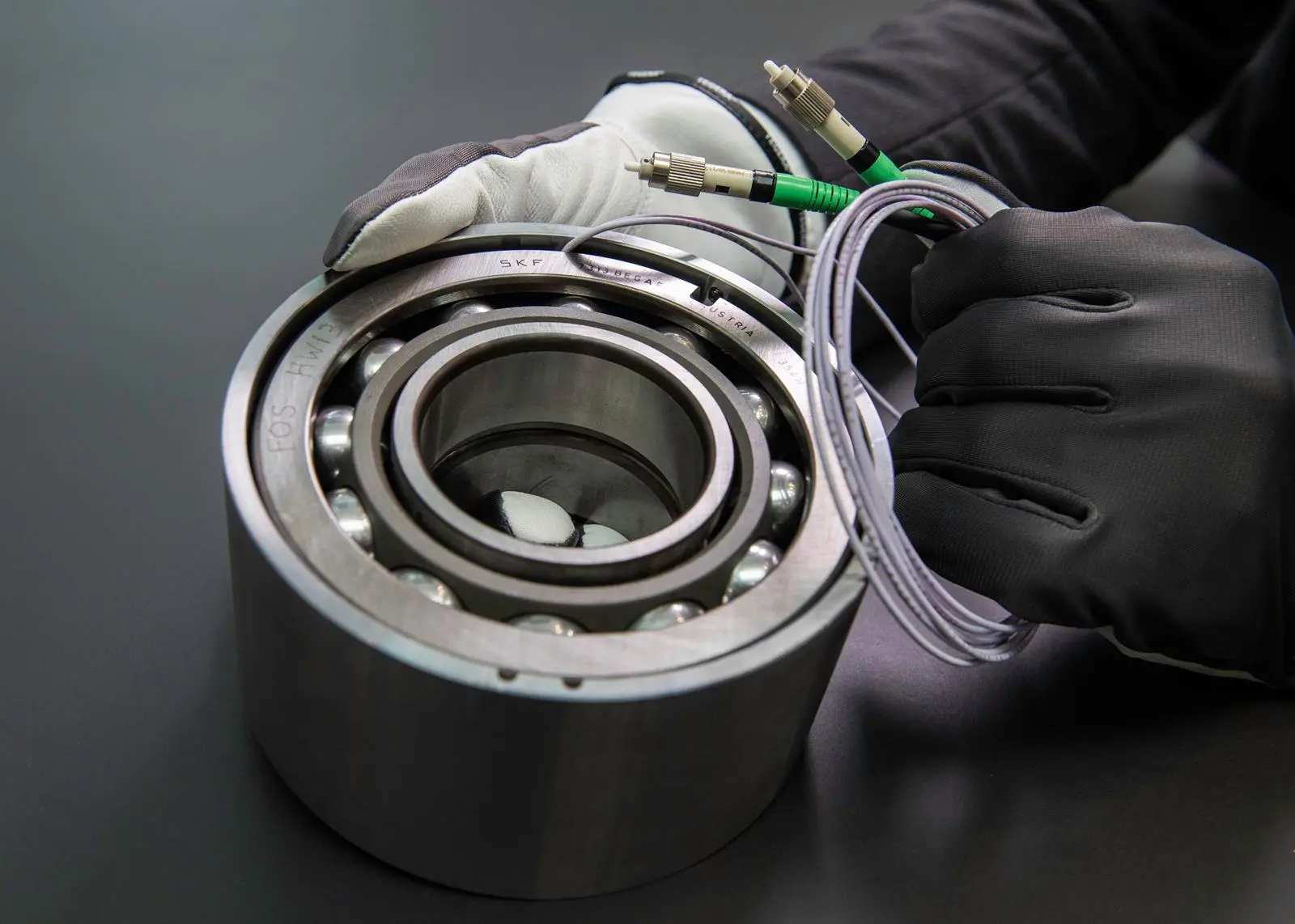
Already available to equipment manufacturers, and now coming to ship operators, is the company’s fibre optic bearings. “Using them, we can understand vibrations, but more importantly, we can also measure the loads on the bearings and can actually understand what is happening inside the machine. There might, for example, be loads that weren’t even considered during the design phase.”
The data that can be obtained includes axial versus radial loads, polar lots of the bearing´s internal strain field, strain spectra, load directions, speed of rotations and temperature. The bearings are interchangeable with conventional bearings, and OEMs and end-users can design them in when testing and installing new equipment to validate that the correct load and lubrication requirements have been defined and are not exceeded in the real installation.
GTT has brought the benefits of digitalisation to LNG tank maintenance. The company has obtained Approval in Principle from Bureau Veritas for the use of a digital solution for sloshing activity assessment in the Framework of Class Survey to optimise LNG membrane tank maintenance frequency. The digital solution is based on GTT’s “Sloshing Virtual Sensor” technology, using a tank digital twin, also designed by GTT, and real-time operational data to monitor the evolution of critical parameters. Combined with an appropriate risk analysis, the solution can support Alternative Survey Plans aimed at optimising tank maintenance while complying with strict safety standards.
Condition-based and predictive maintenance strategies are combined in the Sloshing Virtual Sensor technology. “The past and current motions of the ship are used to evaluate the cumulative fatigue of critical components in the tank, and fatigue is not directly measured but derived from our algorithms,” says Anouar Kiassi, Digital Vice President at GTT. “By using weather forecasts, we can evaluate the future evolution of fatigue. It gives us a very useful method for studying trends and scenarios depending on the accuracy of the operational profile and weather forecasts. This predictive approach is coupled with the condition-based monitoring. In fact, the critical parameters of the tank are monitored in real-time to detect any sudden deviation requiring an immediate intervention.
“The role of the digital twin is to adjust the algorithm response to the particularities of the ship. In fact, the same motions experienced by two different ships can lead to different fatigue results. The digital twin is built by using machine learning technics over our unique hydrodynamic database. We use ‘grey AI’ – a combination of physical modelling and AI machine learning,” he says. “The digital twin is built progressively with cycles of learning and verification against our hydrodynamic database. The power of AI is that after this time-demanding process, the algorithm can give answers in real-time in operation with high accuracy.”
Matthieu de Tugny, Executive Vice President Marine & Offshore at Bureau Veritas, concludes: “Digitalization combined with artificial intelligence is a major transformation for the shipping industry bringing new challenges and opportunities.”
Related Articles
 ENERGY SAVING DEVICES
 LNG
LNG
 ALTERNATIVE FUELS & LUBRICANTS