



OSHIMA SHIPBUILDING ADAPTS BULKER DESIGNS TO EEDI PHASE 3
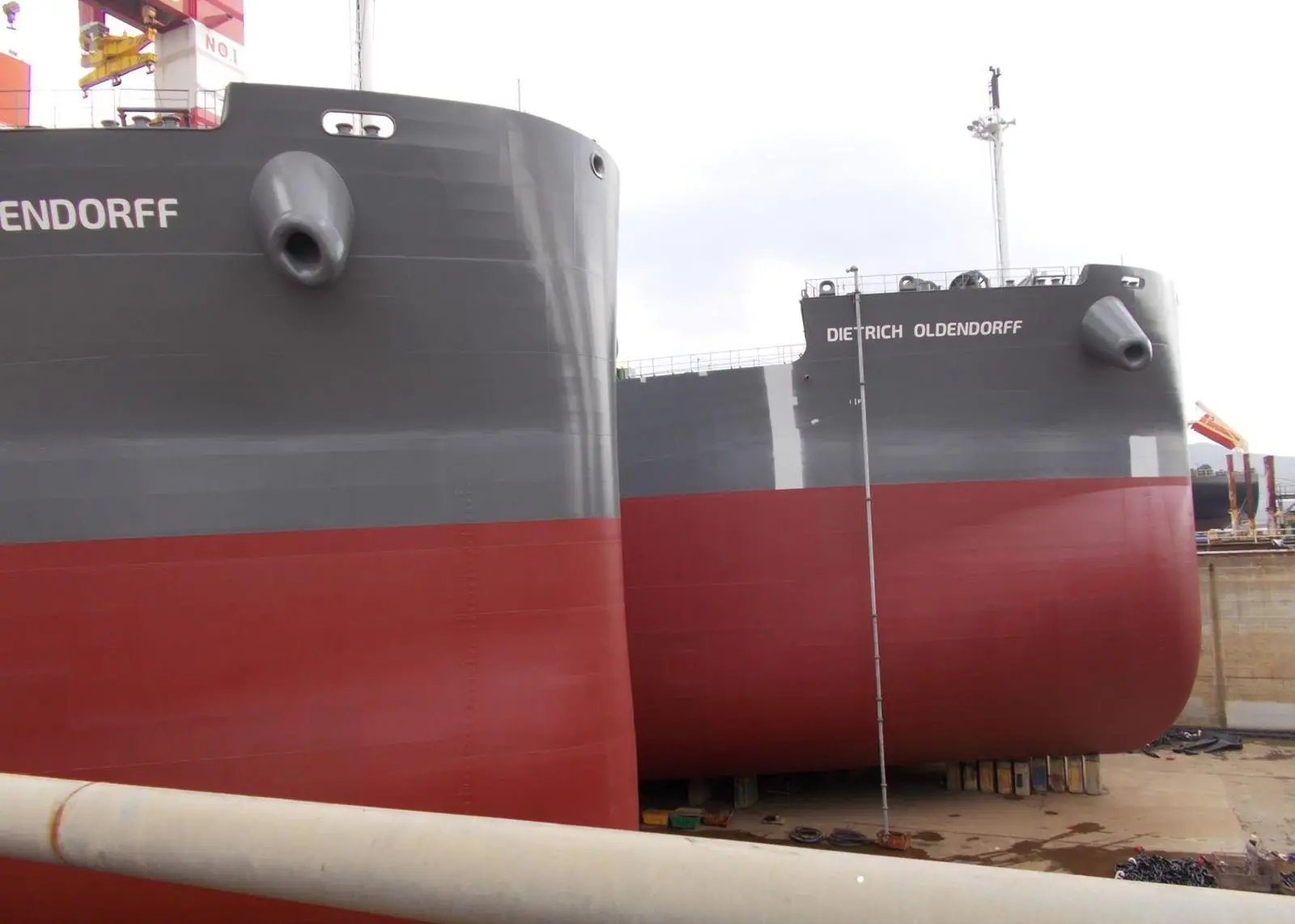
While 30 recent bulker deliveries from the yard at Saikai City in Nagasaki Prefecture already satisfy the impending, tighter requirements, a Phase 3 rating has now been applied across 13 Oshima designs conceived for standardised or serial production. The revised offering spans handysize to post-Panamax tonnage.
Significantly, the enhanced EEDI level that will become mandatory for bulker newbuilds in 2025 has been achieved without departing from conventional, oil-fuelled propulsion. Although adaptation to alternative fuels has been considered by the shipbuilder as a means of Phase 3 compliance, Oshima has instead chosen the path of hull form optimisation and energy saving appendages together with studied selection of propeller and main engine.
According to Oshima, the attainment of the new standard, denoting a 30% reduction in CO2 emissions relative to the original baseline, does not involve any penalisation of ship speed compared to Phase 2-compliant ships. Scope for reducing service speed is in any case limited in the bulker sector on both commercial and safety grounds, as these ocean carriers of agricultural and industrial commodities are relatively slow vessels.
The overarching aim of the Japanese yard is newbuild competitiveness in terms not only of capital cost for shipowners but also asset value over the vessel lifetime, while ensuring the retention of sufficient propulsion power for navigation and manoeuvring in adverse weather.
The Phase 3 portfolio spans five types of handysize bulker and three handymax designs, one Panamax type and four designs in the post-Panamax category. The 30 completed newbuilds that meet the next EEDI level have included ultramax units in the 60,000-65,000dwt band, 55,000dwt open-hatch and 100,000dwt bulkers, and dedicated woodchip carriers of some 50,000dwt.
Among the various proprietary energy saving devices incorporated in Oshima-constructed bulkers are Advanced Flipper Fins, Rudder Fin and Seaworthy Bow.
Mandated by IMO, the EEDI provides a specific figure for an individual ship design, expressed in grams of CO2 per vessel’s capacity-mile, and is calculated using a formula based on the technical design parameters for the given ship. The Index is a non-prescriptive, performance-based mechanism that leaves the choice of technologies to employ in any specific application to the industry. As long as the requisite efficiency level is reached, designers and builders are free to use the most cost-effective solutions to comply with the regulations.
Phase 1 ran from 2015 to the end of 2019, with a 10% CO2 reduction requirement, Phase 2 and its 20% is applicable from 2020 to 2024, while Phase 3 starts from 2025 onwards, when a 30% reduction is called for. This is calculated from a reference line representing the average efficiency for ships built between 1999 and 2009.
Related Articles
 PROPULSION
 GENERAL NEWS
 HYDROGEN