



SAILS FOR PACIFIC INTER-ISLAND TRADER
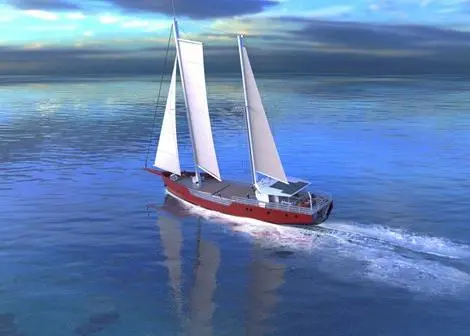
The newbuild is intended to serve communities and trading points among island micro nations lacking in both financial capacity and cargo handling infrastructure, and which are directly impacted by climate change.
Swire Shipping, part of China Navigation Co (CNCo), has an extensive fleet and service network covering the Pacific region. It has been involved for several years in the Project Cerulean initiative, aimed at developing low-carbon, low-cost, inter-island traders.
A contract for the pilot vessel is expected to be signed by the end of this month (June), for delivery 12 months later.
Although details of the planned newbuild have yet to be released, Project Cerulean envisaged a compact, two-masted freight carrier of around 40m length, capable of undertaking regular, dependable and safe delivery of basic goods, while achieving a reduction of at least 50% in operational costs relative to conventional shipping arrangements.
Swire’s parent organisation CNCo linked with Fiji’s University of the South Pacific in 2018 to research options for small general cargo vessels producing fewer emissions that would be within the economic reach of island nations in Melanesia, Micronesia and Polynesia. The University is funded by 12 Pacific island countries. These areas have very limited infrastructure and are almost totally reliant on sea transport for essential imports and other vital transfers of people and goods.
Project Cerulean represents a novel public-private partnership for Oceania. Work on the development of the project ship is being carried out in partnership with the University’s Micronesian Centre for Sustainable Transport, which will also monitor the vessel in service over a two-year trial period. The advocates of the scheme anticipated ‘local’ construction of the prototype vessel so as to benefit the regional economy.
Swire’s commitment of resources to the endeavour is said to have empowered a design review team supported by Kiribati National Shipping Line, Island Ventures and Germany’s University of Applied Sciences Emden/Leer. The French naval architecture firm VPLP has subsequently worked with Lloyd’s Register to ensure that the envisaged vessel would meet the requisite design standards to operate in-class, offering a precedent for sustainable domestic shipping in the Pacific.
For CNCo and its Swire shipping interests, the move to build a novel type of small trading vessel constitutes one element of a comprehensive corporate strategy geared to the objective of driving down the group’s greenhouse gas(GHG) footprint, with the eventual goal of net zero performance by 2050 at the latest.
“Whilst we have already invested US$650 million over the last seven years to renew our fleet to be more carbon efficient, further reductions in our GHG footprint will require more technical and operational measures to be adopted,” stated James Woodrow, CNCo’s managing director. “Ultimately, though, we will not be able to reduce sufficiently our contribution to global warming until a sustainable alternative—low or zero carbon fuel—becomes technically and financially viable,” he added.
The scheme to introduce a new-generation inter-island vessel of the type proposed directly reflects Swire Shipping’s support for the proposal submitted by the Marshall Islands and the Solomon Islands to the IMO for the introduction of a GHG levy on international shipping. The carbon levy will be discussed at IMO’s Marine Environment Protection Committee (MEPC) meeting later this month.
Related Articles
 PROPULSION
 GENERAL NEWS
 HYDROGEN