



AUSTRALIAN RESEARCH SHIP BOOSTS POLAR PRESENCE
The PC3 ice class vessel will form an integral part of the Australian Antarctic Division (AAD) programme for the next 30 years, and has been powered and strengthened to break ice up to 1.65m thick while maintaining a speed of three knots. She will become the main lifeline for the country’s Antarctic and sub-Antarctic research stations and the central platform for climate research and the study of both terrestrial and marine eco-systems, exercising regional stewardship in the process.
Nuyina affords greater icebreaking and transport capacity, increased endurance and operational flexibility, and an advanced environmental standard relative to the outgoing, much smaller (95m) Aurora Australis, dating from 1989 and owned by P&O Maritime.
The diesel propulsion system provides the potency for icebreaking and is complemented by alternative provision for ‘silent’ running on electric power. The design features a moonpool, drop keel, multi-beam bathymetric and scientific echosounders, fisheries sonar system, hydrophones and underwater cameras to support manifold scientific research functions in the extremely harsh Southern Ocean and Antarctic conditions, plus disparate means of transferring equipment, consumables and personnel to the various research bases.
Hobart-based AAD, a division of the Australian Government’s Department of the Environment and Energy, awarded Serco the contract to procure, operate and maintain the new ship. Serco Group subsidiary DMS Maritime, as prime contractor, entrusted the complex newbuild to Damen Schelde Naval Shipbuilding. Actual construction and outfitting was assigned to Damen Shipyards Galati in Romania, with Damen Schelde at Vlissingen providing engineering and project management services and undertaking trials and final commissioning.
Concept and tender design was undertaken by Copenhagen consultancy Knud E. Hansen, with the UK’s BMT Group contributing engineering know-how to the project. The design development, engineering and project management functions rested with the Dutch shipbuilder.
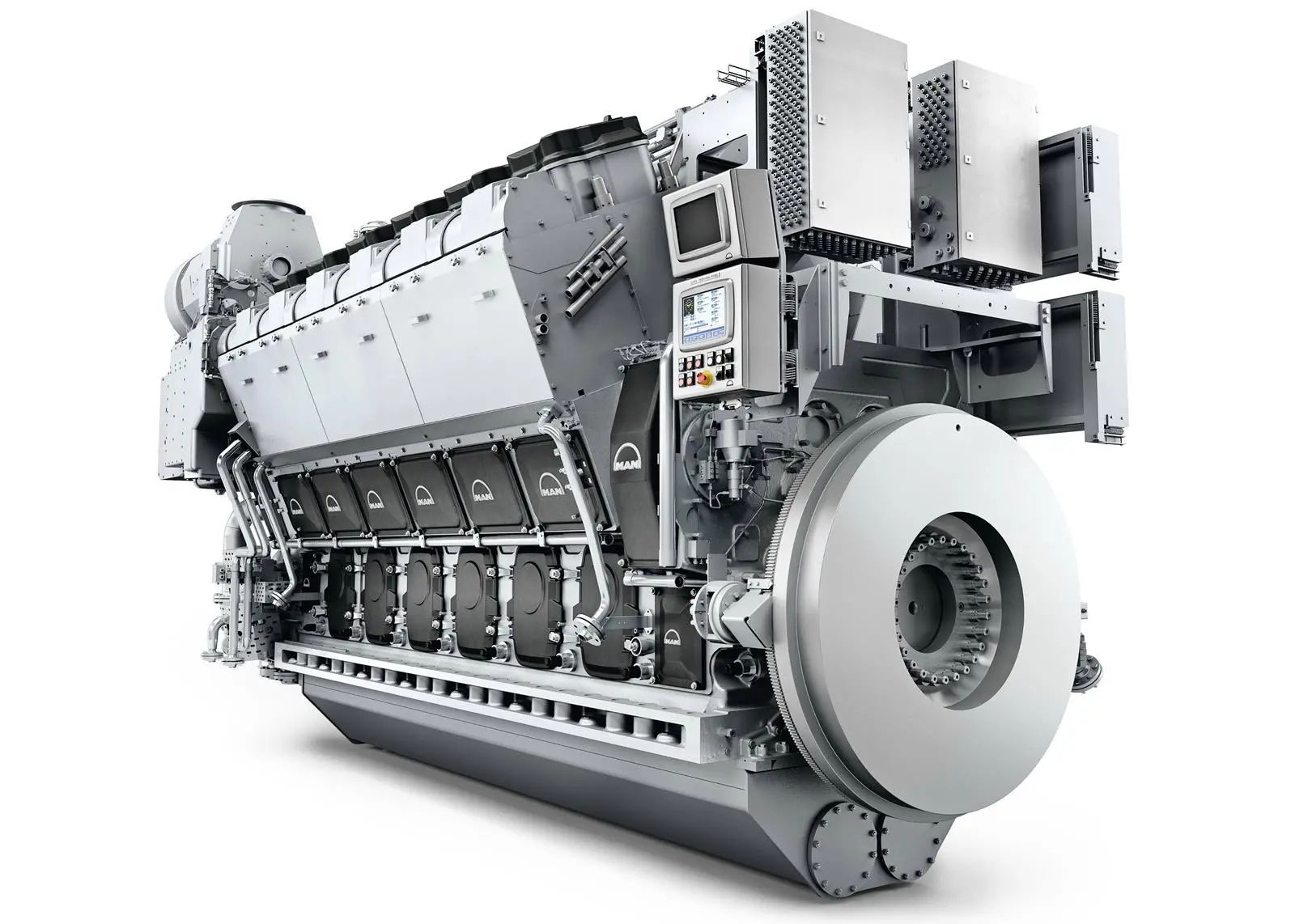
Nuyina is distinguished by a diesel-hybrid propulsion system, based on two drive trains, whereby diesel direct drive is augmented or replaced using a power take-in (PTI) arrangement.
A well-proven, widely employed class of medium-speed machinery from MAN’s Augsburg stable delivers the primary power in Australia’s prestigious new polar ship. Each driveline consists of a 9,600kW, non-reversible 32/44CR common-rail engine in 16-cylinder vee-form layout, plus gearbox, coupling, shaft and controllable pitch propeller.
The hybrid nature of the installation derives from the adoption of a generator-cum-electric motor coupled to each shaft, conferring a PTI (power take-in) capability. The PTI shaft motors are fed by the diesel generators through medium-voltage switchboards. The four gensets are arranged in pairs in the two main engine rooms.
While the PTO generator function is exercised in transit to economically supply power to the vessel’s electrical grid, PTI is engaged to augment diesel-mechanical power during icebreaking and ramming. Maximum shaft speed is then combined with minimum propeller pitch, as opposed to running at maximum rotational speed and maximum pitch at design speed in open water.
The technical configuration enables many permutations of thrust and speed, controlled by the diesel, propeller and power management systems to achieve energy efficiency across the load range and varying operating conditions, alongside the primary goals of ship performance and safety. So as to run in ‘silent’ mode, at up to about eight knots, the main engine and gearbox in use can be decoupled, and switchover made to diesel-electric operation with the shaft motor engaged. In the event of a diesel failure, the related shaftline can be driven by its PTI device, receiving power from the onboard electric grid.
The ship is equipped with selective catalytic reduction (SCR) technology. A special feature of the plant in the Nuyina is the communication with the engine control system, optimising the temperature for the SCR at individual load points.
A very high degree of manoeuvrability is the requisite accompaniment to raw power for Antarctic duties. Working into the various research station transfer points and station-keeping in the drifting ice sheets calls for exacting handling characteristics, as does navigation through thick ice and ramming at ice ridges, when the practice of star manoeuvring is achieved through erudite use of powerful thrusters fore and aft in conjunction with main propulsion. Having the wherewithal to negotiate extreme ice conditions and obviate ice trapping is, of course, elemental to safety and service dependability.
Accordingly, Nuyina has an array of three 1,300kW tunnel thrusters in the foreship skeg and an identical trio in the stern skeg. The outfit will assist the vessel in station keeping up to sea state 4. The redundancy which permeates the entire power arrangements extends to the dual arrangement of switchboards. When the ship is dynamic-positioning, one switchboard will feed two bow thrusters and one stern thruster, while the other board supplies two stern thrusters and a single bow unit.
Free-hanging, full spade rudders engineered by Damen Marine Components under its Van der Velden brand offer optimised hydrodynamic properties while subject to the high forces imposed by ice navigation. Working to DMC’s specification, MacGregor Hatlapa manufactured and supplied the steering gear assemblies and hydraulic power systems. The stresses that will be imposed on the hull and its appendages by the ship’s operating diagram in the polar latitudes are said to be equivalent to those encountered by a conventional, ocean-going vessel of 300m-plus, about twice the length of the Nuyina.
The PC3 certification confirms the LR-classed vessel’s suitability for year-round operation in second year ice with multi-year inclusions. The bow is designed to bend and break the ice layers ahead, rather than simply crush the ice, so forcing the sheet downward. The shape of the hull bottom is such that broken and submerged pieces of ice will tend to slide aside rather than travel the length of the hull, imposing extra hull resistance and propeller ice interaction.
In the stern section, the design waterline curves towards the centreline to assist reverse icebreaking and manoeuvring in ice. Ice cutting knives are fitted at the stern and rudders for protection, and long skegs below both the bow and the stern limit riding up on the ice when navigating thicker cover and ramming ridges. Gondolas around the shafts and bearings give added protection, preventing ice blockage.
Whereas the long-serving Aurora Australia was limited to single-station round voyages, Nuyina can visit two stations in one round-trip, an overall sailing distance of approximately 9,000 nautical miles. The endurance level built into the specification also had to take into account 30 days of icebreaking and 30 days on station in conditions down to minus 30degC.
In her primary role of support and resupply of AAD’s four research stations, the new ship will provide the bases at Casey, Davis and Mawson on the Antarctic continent, and Macquarie Island in the Southern Ocean, with consumables, equipment and personnel. To that end, given the differing challenges of operating at the various sites, she is equipped to deploy a wide-ranging complement of craft and vehicles, including up to four helicopters, two 45t-capacity landing barges, tenders and amphibious trucks.
In the forward hold, the vessel can stow 1,200t of solid cargo, consisting primarily of containers and breakbulk goods, including large items of plant and equipment, worked by the ship’s own gear that includes heavy-duty, 55t deck cranes. Cargo tanks in the fore part of the hull allow the transport of 1.9m litres of Special Arctic Blend (SAB) fuel used at the research stations.
Scope for multidisciplinary and concurrent studies has been considerably enhanced by Nuyina, enabling tasks and campaigns involving sampling, data collection and analysis embracing sea floor, sea ice, sea life and atmospheric research. Accommodation has been provided for 117 scientific personnel besides the ship’s complement of 32.
The sea trials and system testing programme began last winter in the North Sea following transfer of the vessel from Romania to Damen Schelde’s Vlissingen premises in the Netherlands. The final stage before the vessel’s imminent departure to Hobart, in preparation for opening service in the southern polar season, entails ice trials in the Arctic region.
PRINCIPAL PARTICULARS – Nuyina
|
Length overall |
160.3m |
|
Length bp |
152.0m |
|
Breadth, moulded |
25.6m |
|
Depth, to main deck |
19.2m |
|
Draught, maximum |
9.3m |
|
Cargo capacity, solid |
1,200t/5,300m3 |
|
Cargo capacity, liquid |
1,900m3 |
|
Propulsion system |
Diesel-hybrid |
|
Main diesel engines |
2 x 19,200kW |
|
PTI electric motors |
2 x 3,700kW |
|
Diesel generators |
3 x 3,000kW + 1 x 2,000kW |
|
Main propellers(CPP) |
2 x 13,300kW |
|
Manoeuvring thrusters, bow |
3 x 1,300kW |
|
Manoeuvring thrusters, stern |
3 x 1,300kW |
|
Speed, maximum |
16kn+ |
|
Speed, economical |
12kn |
|
Range |
16,000nm |
|
Endurance |
90days |
|
Scientists/passengers |
117 |
|
Crew |
32 |
|
Class |
Lloyd’s Register |
|
Polar ice class |
PC3 |
|
Flag |
Australia |
Related Articles
 PROPULSION
 GENERAL NEWS
 HYDROGEN