



NEW THERMOCHEMICAL REACTOR TECHNOLOGY BOOSTS AMMONIA COMBUSTION
Working in the Thomas E. Murphy Engine Research Lab at the University of Minnesota, Professor Will Northrop and Dr Seamus Kane have built a full-scale catalytic thermochemical recuperation reactor and demonstrated its ability to improve the efficiency of dual-fuel diesel-ammonia compression ignition engines. The novel system decomposes ammonia into a hydrogen-containing mixture to allow high diesel fuel replacement ratios, and it also oxidises unburned ammonia emissions in the exhaust.
The technology was initially developed to facilitate the use of ammonia in farm machinery. A world-first green ammonia production facility using wind power was established in 2013 to provide fertiliser to a Minnesota farm. The production of green ammonia is of interest in farming, as currently, 1% of global GHG emissions are attributed to ammonia and nitrogen fertilizer production.
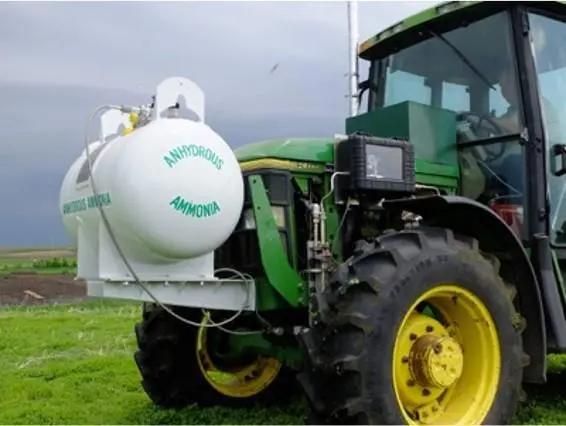
However, fertiliser is not required year-round, and meeting the requirement for fertiliser production on the farm left the question of what to do with the rest of the ammonia produced. The solution was to use it as fuel for farm machinery including tractors and irrigators, so a John Deere four-stroke diesel engine on a tractor was converted to burn ammonia as fuel, and the thermochemical recuperation reactor was added to partially convert ammonia to hydrogen and nitrogen to improve engine performance and efficiency.
Northrop and Kane are now working to apply the system to stationary power spark ignited and diesel gensets, and they see marine power as another major application for the reactor technology, especially as the shipping industry is increasingly focused on ammonia as a new fuel in the medium term.
Ammonia combustion poses some technical challenges for engine designers, as it has a relatively low heat of combustion, high auto-ignition temperature, high heat of vaporisation and a narrow flammability range. To auto-ignite ammonia alone takes compression ratios of around 35:1 – “impractical,” says Northrop. Burning ammonia poses a challenge for spark ignition engines as well due to its very low flame speed.
The benefits of adding the thermochemical recuperation reactor to the aftertreatment system of an engine are two-fold, says Northrop, because it is simultaneously reclaiming energy and increasing the efficiency of the engine. Waste heat from the engine’s exhaust is used in conjunction with a catalyst to partially decompose the ammonia fuel to a mixture of hydrogen, nitrogen and ammonia. This is then burnt in gaseous form by the engine, along with the diesel pilot.
“The reactor upgrades the ammonia, because if you decompose the ammonia, you get more energy out. The hydrogen and ammonia mix produced has a higher calorific value than the ammonia coming into the reactor,” says Northrop. “That’s why we call it thermochemical recuperation. We’re taking thermal energy, converting it to chemical energy and then using it in the engine.”
To date, the researchers have tested up to 50% hydrogen in the mixture and have achieved up to 55% diesel pilot replacement. Energy efficiency was boosted over the range of engine loads tested, and they achieved an improvement in overall thermal efficiency of approximately 2.4%. Northrop says this could be increased further if more waste heat is utilised.
The tests confirmed that the hydrogen-nitrogen-ammonia mixture burnt much faster than just ammonia and resulted in lower ammonia and hydrocarbon emissions. Emissions remained fairly constant across different engine loads tested. NOx emissions were reduced, as the presence of additional nitrogen lowers combustion chamber temperature, counteracting NOx produced directly from ammonia, a large challenge for ammonia powered engines.
Soot and N2O (nitrous oxide) emissions remain a concern that will need to be managed. N2O has a global warming potential nearly 300 times that of CO2, making it a particular concern, but Northrop says that more work can be done to address the issue, and currently, these emissions are on par with what is expected from a dual-fuel engine without the reactor.
The size of the reactor is less than half of that of a selective catalytic reduction (SCR) system but would need to be matched with an SCR to reclaim heat and control NOx and ammonia emissions. The amount of ammonia left in the exhaust can be tuned so that it matches the requirements of the SCR, saving operating costs, as ammonia can replace the urea often used when an engine is burning traditional fuels.
Northrop and Kane presented the results of their research at the NH3 Event 2021 in Rotterdam in June and are keen to continue optimisation research and to commercialise the technology.
Related Articles
 ALTERNATIVE FUELS & LUBRICANTS
 ALTERNATIVE FUELS & LUBRICANTS
 ALTERNATIVE FUELS & LUBRICANTS