



OPTIMISED NEW OPTION FOR WINDFARM SCHEMES
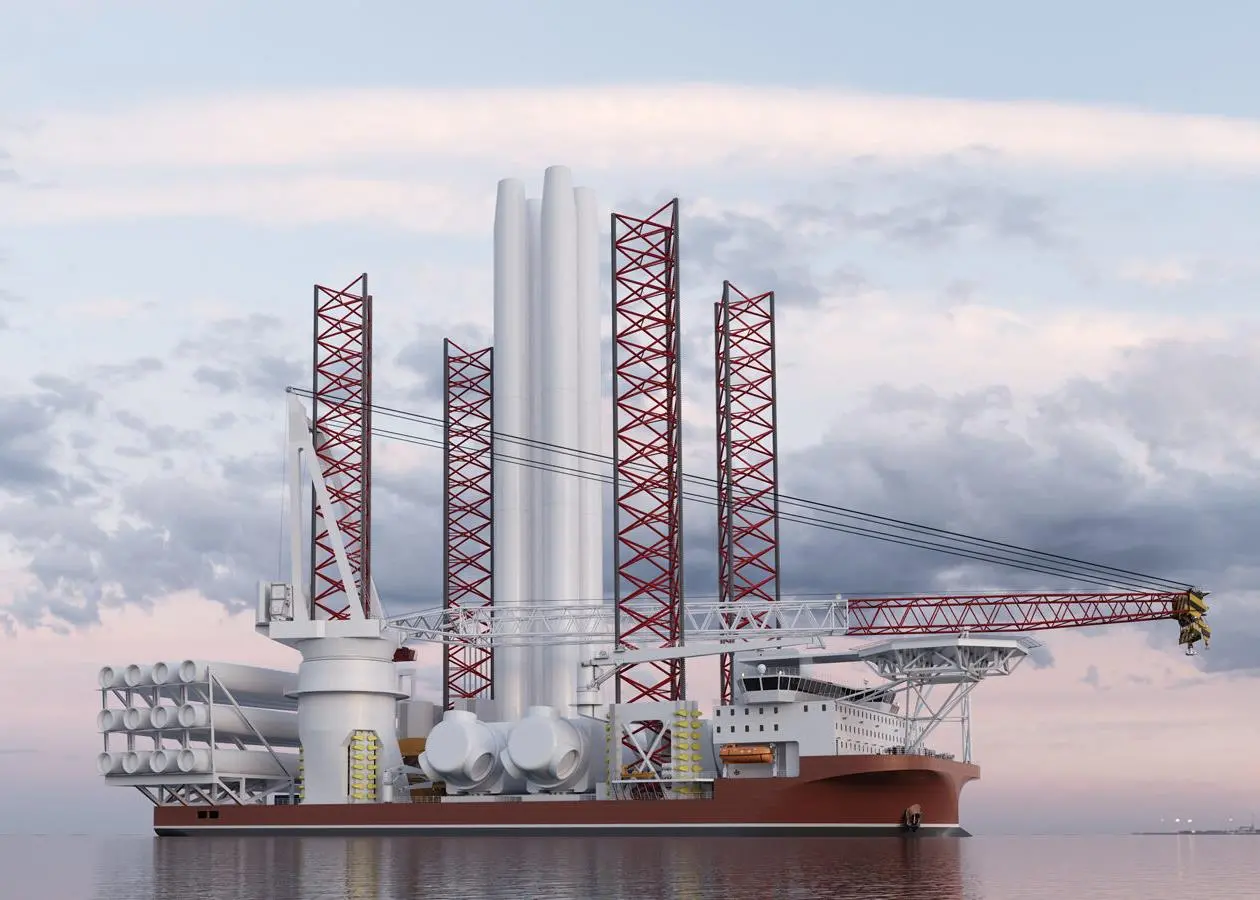
The newly-unveiled Atlas A-class jack-up is a smaller variant of the Atlas C type launched at the beginning of this year, and applies the same concept of a design platform that lends itself to both operational flexibility and customisation.
The overarching goal with the new diesel-electric generation is high productivity and efficiency so as to meet offshore wind farm developers’ drive to realise field construction projects more cost-effectively while catering to the advancing pieceweights of wind turbine elements and deeper water assignments.
Whereas the Atlas C-class offers the capability not only for transporting and placing the turbines but also monopole and transition pieces, the A-type has been specifically dimensioned for carrying and assembling wind turbines on top of pre-installed foundations.
KEH thereby anticipates increased opportunities for greater specialisation in the vessel market as the offshore wind sector expands and evolves. Since the increasingly heavy foundations do not necessarily require jacking for installation, and can be efficiently handled and positioned by means of heavy-lift vessel, the Atlas A-class has been optimised in terms of the jacking operation and associated system weight for offshore placement of the turbines.
The A-type is laid out and fitted to carry four new-generation wind turbines of 14MW, deployed using a crane of at least 1,600t capacity, and potentially a unit of up to 2,500t. By comparison the C design provides for six turbines in the 14-16MW range or four related, extra-large monopole/transition parts, handled by a 3,000t crane.
Main dimensions of 155.4m length overall (excluding the helideck), 57.4m breadth and 6.5m draught at 14,000dwt, whereas the C-class is of 170.0m x 60.2m, drawing 6.7m on 18,000dwt.
The multiplicity of generators embraced by the C-type is retained for the A-class, whereby eight aggregates are connect to a direct-current (DC) grid and a battery pack. As well as securing the closest matching of sets to actual power needs at any one time, the arrangements enable engines to be run at variable speed for fuel efficiency. Azimuthing stern thrusters provide for main propulsion, to achieve laden transits at speeds up to 12 knots, supplemented by an array of manoeuvring thrusters.
The batteries can achieve load levelling and peak shaving and provide instant power availability, obviating the need to have spinning reserve from the generators. In addition, the battery system makes it possible to recover approximately 60% of the energy used in jacking reversal.
The high-speed electrical rack-and-pinion jacking system has been engineered for 5,000 load cycles, so that the legs and components should last the whole lifetime of the vessel.
The principle of customisation encompasses all key items of the technical specification, including cranes, thrusters, generators and jacking systems, providing for client preferences and equipment availability.
Copenhagen-headquartered KEH is a leading light in the sphere of WTIV design, going back to the 2004-completed Mayflower Resolution (now MPI Resolution), the first-ever purpose-built, self-elevating turbine installation ship.
Related Articles
 PROPULSION
 GENERAL NEWS
 HYDROGEN