



CH2 CARRIER PROTOTYPE DESIGN WILL TRANSITION TO ZERO-CARBON FUELS
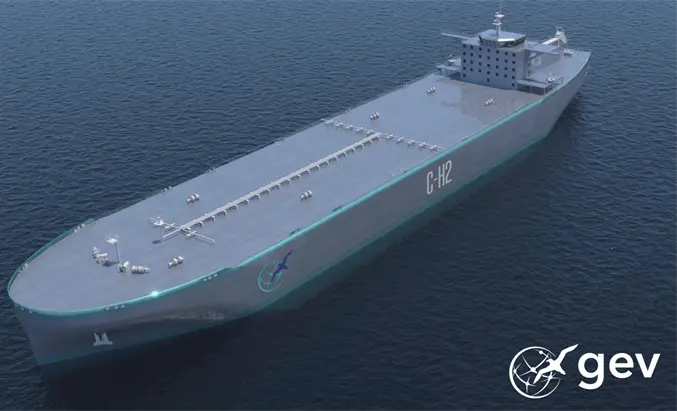
In June, GEV signed a Memorandum of Understanding with Wärtsilä Australia to develop the ship’s propulsion system as it moves to gain Approval in Principle (AiP) for the design from ABS. Details of the propulsion system are still to be confirmed, but Martin Carolan, CEO of GEV, anticipates a twin screw design with dynamic positioning for rapid connect and disconnect of near-shore buoys during cargo operations. GEV and Wärtsilä will review various low emission propulsion solutions, including the use of alternate fuels, and plan to take advantage of rapid advances in hydrogen blended generation and fuel cells from Ballard Power Systems so that the vessels can ultimately be fuelled by hydrogen.
The 430-ton hydrogen containment system fits within a Handymax sized vessel envelope which GEV says reduces the development time and cost and maintains a practical ship draft of 9 metres. GEV has also developed a 2,000-ton version of the vessel which received AiP in March 2021, and the company’s proprietary design for the hydrogen cargo containment system is made up of two large circular 12-metre diameter tanks, contained within the hull of the ship, that will store ambient temperature hydrogen at an operating pressure of 250 bar. The cargo tanks will be constructed with a liner of stainless steel surrounded by multiple high-strength steel layers.
Carolan says compression delivers a proven, simple and efficient method for transporting green hydrogen that is often overlooked due to its lower volumetric energy density. He says that GEV’s design and development strategy for a 2,000-tonne ship proved that large commercial scale C-H2 ships are possible and paved the way for the development of the pilot-scale version. “We have shown that C-H2 shipping is ideally suited for exporting green hydrogen with a lower delivered cost, and having a technology leader such as Wärtsilä with us, we can deliver a shipping solution that is completely sustainable.”
The pilot-scale ship will capable of voyages of 2,000-4000 nautical miles making it suitable for shipments from, for example, Northern Australia to Singapore. GEV has a 1.5GW renewable energy project to produce green hydrogen underway in Northern Australia and plans to develop a fully integrated green hydrogen supply chain from there.
The downstream market application for 430-ton volumes includes customers wanting to inject green hydrogen into existing natural gas pipelines. Carolan says this blending is an attractive source of near-term demand for hydrogen due to low incremental costs, and it aligns with the company’s modular approach for production scale-up.
Carolan sees opportunities in Europe as well as the Asia Pacific. In May 2021, GEV executed a Memorandum of Understanding with German engineering company ILF for the identification and development of green hydrogen projects in Europe and Australia that will include a compressed hydrogen shipping solution.
Up to 85% of the world’s proposed green hydrogen projects are in Europe, with a pipeline of over 9GW in Germany, 6W in the Netherlands and 4GW in the UK, all scheduled to be operational by 2030.
Related Articles
 ALTERNATIVE FUELS & LUBRICANTS
 ALTERNATIVE FUELS & LUBRICANTS
 ALTERNATIVE FUELS & LUBRICANTS