



BIDS RE-OPENED FOR UK SUPPORT SHIPS
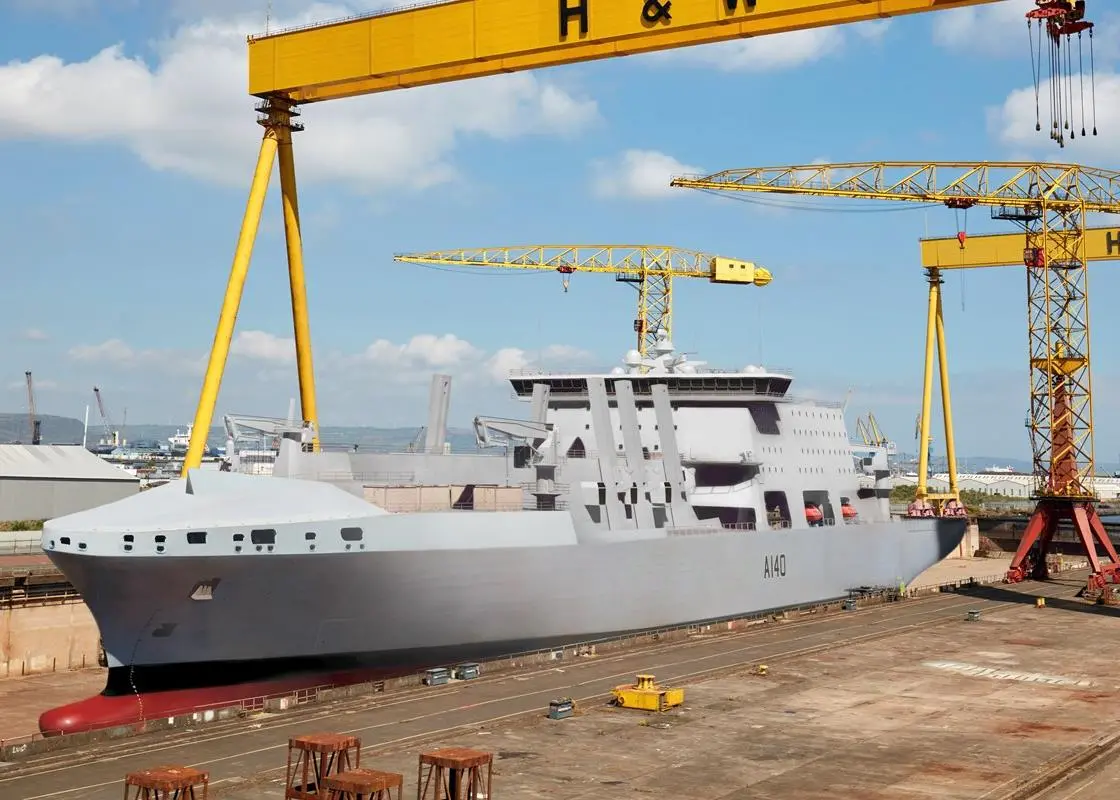
A competition has been launched to construct a trio of Fleet Solid Support (FSS) ships designed to deliver munitions, stores, provisions and equipment to warships and task groups on active duty across the world, making direct transfers at sea. The vessels are intended to supersede two Fort-class vessels dating from the end of the 1970s and the larger, 1990-built auxiliary oiler and replenishment ship Fort Victoria.
Although the successful bidder will be permitted to work in partnership with international companies, the ships themselves must be assembled in a UK yard. As a consequence of domestic pressure, this denotes a departure from previous policy whereby government was conducive to fully open global competition for RFA tonnage. This had led to the new generation of Tide-class fleet tankers being built in South Korea, albeit to UK design, and to the original plan for the FSS tonnage being based on international bids.
The re-categorisation of the planned newbuilds as “warships” signals a home production-orientation for the scheme as part of the much-vaunted National Shipbuilding Strategy. While a welcome development for the country’s remnant large-ship construction sector, the dilatory approach to the programme has drawn criticism.
The FSS renewal scheme was proposed in 2015, leading to the first competition in 2018, attracting bids from the UK, Italy, Spain, Japan and South Korea. However, the initial attempt to take the work forward was suspended in November 2019, reportedly due to concerns over value for money. In October 2020, the UK defence department re-classified the vessels as “warships”, effectively confirming that they would be built in the UK. But while the earlier plans had envisaged deliveries by around 2025, it is understood that completion of the series is now envisaged by 2032. In fact, construction contracts may not be awarded for another two years, following approvals.
The new vessels will harness next-generation technology and be powered to sustain a laden speed of at least 18 knots, incorporating the wherewithal for replenishing recipient ships while underway at 12 knots.
Announcing the new tender, the government said “Building on the commitment made in the recent Defence Command Paper to create a shipbuilding renaissance, the competition will help revitalise British shipbuilding by requiring a significant proportion of the build and assembly work to be carried out in the UK”.
Last year, re-emergent Belfast shipyard Harland & Wolff entered into a partnership with Spanish shipbuilding and defence group Navantia to bid for a range of contract opportunities, including the FSS programme. Navantia and UK technology group BMT had earlier linked in a design proposal for the new breed of RFA vessels, and BMT would participate in the Navantia/H&W teaming agreement as design contractor in the FSS project.
It has been indicated that Navantia’s experience in developing a digitally-enhanced shipbuilding production approach, known as Shipyard 4.0, would be shared with H&W and the downstream UK supply chain to help improve efficiency by up to 20%.
The RFA is a Merchant Navy organisation made up of civilian-crewed ships operated by the Ministry of Defence. The fleet provides vital logistical and operational support to the Royal Navy and Royal Marines worldwide, and also undertakes humanitarian missions and certain types of patrol duties.
Related Articles
 PROPULSION
 GENERAL NEWS
 HYDROGEN