



Game Changers For Dover/Calais Run
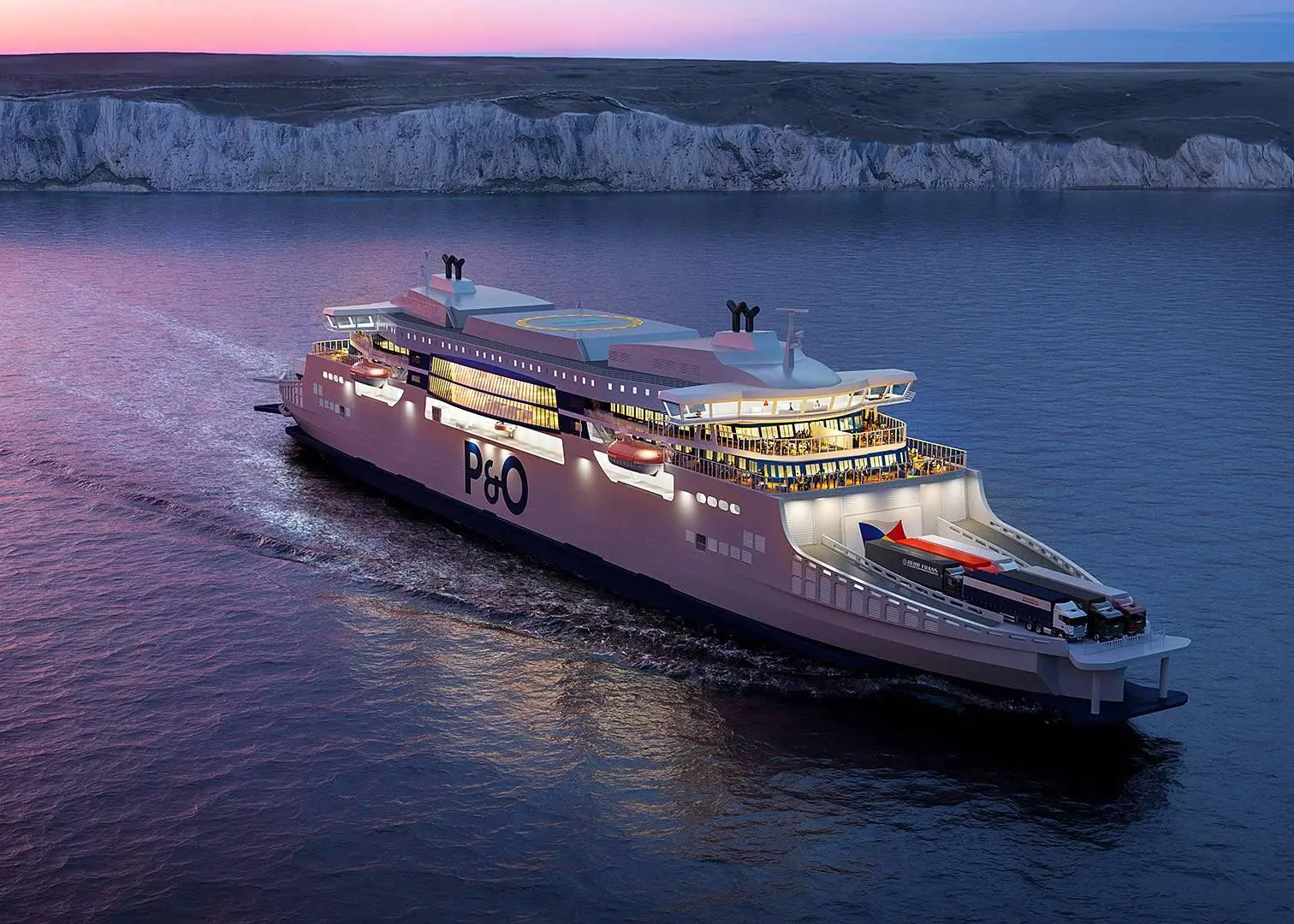
As well as being the biggest ships to sail the Dover/Calais route, and the world’s largest double-ended ferries, the two newbuilds in China have the distinction of marrying a diesel-electric power and propulsion system with one of most extensive battery installations ever specified for sea-going use.
Every system and element nominated has been scrutinised over the course of the technical project with the aim of securing long-term viability and asset value not only as regards net earning power but also from the standpoint of legislative, commercial and societal environmental demands and expectations.
Competition in the eastern cross-Channel freight and passenger markets continues to intensify, calling for a studied approach to scale, productivity and energy efficiency so as to ensure eventual, realistic payback on the huge capital expenditure entailed. The pair of 230m P&O vessels commanded a total price of EUR260 million (currently equating to US$300m) when ordered from Guangzhou Shipyard International in September 2019. The ferries are scheduled to begin duty during 2023, and the owner has options on two further representatives of the class.
Danish consultancy OSK-ShipTech provided the concept design, and the final result, incorporating P&O’s experience of running ro-pax and freight ferries on the North Sea and Irish Sea as well as the Channel, is innovative in its blend of technologies, hydrodynamic form and configuration. The vessels will have the initial capability for near zero-emission operation when manoeuvring and berthed, with the scope for eventual adaptation to carbon-free passage-making.
Nordic technology is central to the P&O project, in the shape of the latest class of Wartsila medium-speed prime movers and Azipod azimuthing electric propulsion thrusters.
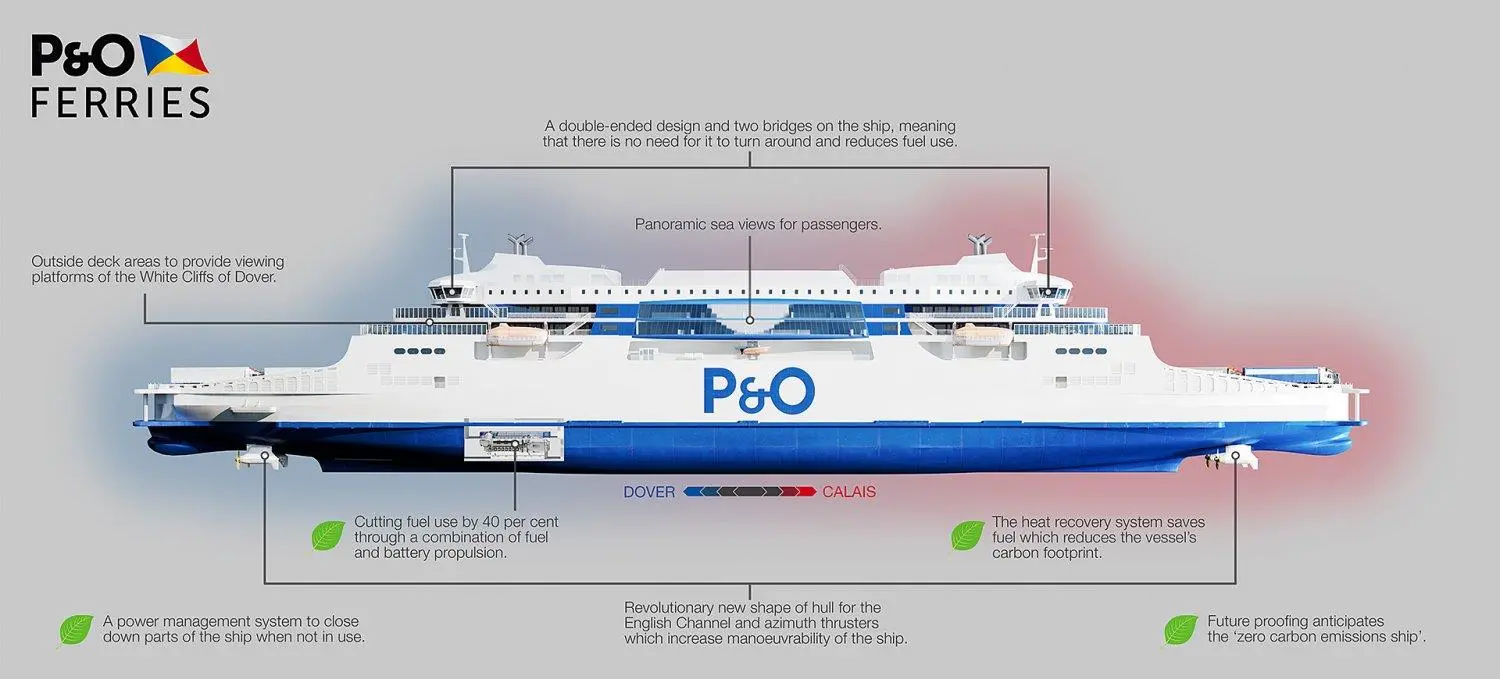
While on a par in beam than the company’s 2011-built Spirit-class, the new vessels will be substantial broader(by some 3m) than the ferries to be replaced, which will be about 30 years old come 2023. The width of the newbuilds facilitates the adoption of two azimuth main thrusters at each end of the hull, increasing manoeuvrability and transit directional stability.
The underwater hull lines have been specifically drawn in keeping with the podded propulsor arrangement and to maximise hydrodynamic performance on the narrowest stretch of the English Channel, where the ships must constantly run across a strong tidal current. The power, maximised thrust and responsiveness of the system also takes into account the ability of the ship to work independently on and off the berth in very strong wind conditions without having to call on tug assistance.
The ferries have each been laid out to carry a maximum 1,500 passengers during peak periods, while the freight payload capacity corresponding to about 2,800 lane-metres can be expected to be well utilised throughout the year, given the vital seabridge role of the Dover/Calais run in trade flows between the British Isles and continental Europe. Commercial vehicles will be transported on main and upper ro-ro decks, augmented by dedicated provision for some 200 cars and vans on a separate deck. P&O Ferries’ sister company and logistics specialist P&O Ferrymasters undertakes through-transport operations to and from European countries and also the onward movement of goods to Britain from Asia.
ABB Marine’s scope of supply encompasses the complete, integrated power and propulsion installation, including energy storage, the latter entailing batteries from the Freudenberg Group company XALT Energy. The power and energy management system (PEMS) supplied by ABB is closely integrated with the electrical network and makes optimal use of the vessel’s total power resources by improving information flow across shipboard systems. The digital package also embraces ABB Ability Marine Pilot Control, ‘intelligent’ manoeuvring and control software that automates some navigational tasks, giving support to the bridge officers.
Through the nomination of Wartsila 31-series engines as the main generator drives, P&O’s ro-pax newbuild project provides a further endorsement of a medium-speed design which has been independently recognised as the most efficient four-stroke in its class. While available in dual-fuel and also purely gas-fired variants, the selected, 16-cylinder engines are diesel-fuelled versions. These will be arranged in pairs at each end of the hull as diesel generator aggregates of 10,625kVA, feeding electrical energy to the motors integral with the Azipod propulsion units.
In its diesel version, the maximum continuous rating of the 16V31 is 610kW per cylinder at 750rpm, affording a nominal MCR output of 9,760kW, which would make for a total mechanical power concentration of 39,040kW, from 64 cylinders. Two-stage turbocharging, by way of ABB’s Power2 system, is an integral feature of the machinery. This aspect alone will make a significant contribution to overall performance, helping to reduce 60% of NOx emissions and achieving up to 5% in fuel savings.
The engines have been specified with Wartsila data communication units, which utilise artificial intelligence (AI) and are supported by the proprietary Expert Insight condition monitoring platform, an advanced tool of predictive maintenance.
Although tried-and-tested over three decades in a wide range of scenarios, including ro-pax ferry applications, Azipod technology has so far not been a feature of cross-Channel fleets. The P&O ships will each be equipped with four 7.5MW-rated Azipod DO1600 units. The open-water DO design is a second-generation, compact size series, serving applications requiring speeds up to 22 knots, and which melds best features of the original Azipod C type and the high-power XO range. The hybrid cooling of the propulsion motor combines direct cooling to the surrounding sea water and an active air cooling system.
The energy storage system, comprising approximately 1,200 batteries installed in four battery rooms throughout the ship, will provide an output capacity of 8,816kW per vessel. The lithium-ion batteries, supplied by XALT Energy, will be encapsulated in multiple cabinets forming part of the proprietary XRS-2 configurable rack system. The racks meet the strictest regulatory criteria and have been designed to minimise weight and size and ensure the requisite protection against the corrosive marine environment.
Based in Midland, Michigan, XALT Energy was acquired in December 2018 by the German company Freudenberg Sealing Technologies.
All surplus energy generated by the main power plant will be stored in the batteries, imbuing a charging function, with discharge taking place when the ship requires peak power or battery-only manoeuvring power. Load-levelling has long-term technical as well as economic benefits, by allowing the generator engines to be consistently run at the optimum level. The combination of fuel and battery propulsion over the operating profile is expected to cut fuel usage by 40%.
The ships have been conceived to be carbon-neutral at some stage in the future, assuming the development of electric shore charging stations in ports and further investment in battery technology.
Heat recovery arrangements will help to further reduce fuel consumption and lessen the vessels’ carbon footprint. A steam system will render heating for the ultra-low sulphur fuel oil heaters, fuel tanks, purifiers and HVAC (heating, ventilation and air conditioning) system pre-heating, domestic hot water, machinery rooms and technical spaces.
In addition to optimising the use of engines, batteries and energy recovered from waste heat, the ‘intelligent’ power management system will be able to switch off lighting and ventilation in empty or temporarily unused passenger areas. The specific nature of the vessel’s interior layout and setup will allow as much as two-thirds of the public spaces to be closed during off-peak and out-of-season sailings on the 24/7 Dover/Calais timetable.
The double-ended configuration, symmetrical in side elevation, affording drive-through ro-ro access and egress, coupled with a navigation bridge at each end of the ship, will obviate the need for going about in port. This will save seven minutes on both the outbound and return voyages and, if operating on the engines rather than battery power when docking, will yield a one-ton saving in fuel, a sixth of the amount required for the entire 21-mile crossing.
To enhance the travel experience across the Strait of Dover, including viewing one of the most famous coastal landmarks, the White Cliffs of Dover, the ships will have 1,550m2 of outside deck space for passengers and double-height windows running around the entirety of the middle of each vessel on decks 8 and 9.
P&O’s previous stage of newbuild investment was realised in 2011, when the 49,000gt sisters Spirit of Britain and Spirit of France were introduced to the Dover/Calais conduit. Built at Rauma, in Finland, by the former STX Europe, the vessels ushered in a new scale, offering nearly twice the payload of their predecessors on the run but maintaining the same 45-minute port turnaround time.
The ships had the distinction of being the first passenger-carrying ro-ros worldwide to comply with IMO’s Safe Return to Port (SRtP) requirements, and were fitted with four MAN 7L48/60CR, medium-speed main engines of common-rail type. At 213m in length overall, they were at the limit for using the facilities then existing at Dover and Calais, and were the first on the Channel able to manoeuvre under own power in 50-knot winds.
Spirit of Britain and Spirit of Calais superseded the 26,400gt Pride of Dover and Pride of Calais, which had also been regarded as trailblazers when brought into service during 1987 after delivery from the erstwhile, renowned ferry builder Schichau Unterweser at Bremerhaven.
The nascent tonnage from China again raises the bar for the company and for a link which plays such an important role in the short-sea business. The project is also further testament to Guangzhou Shipyard International’s growing role in ro-pax ferry construction, and to the Chinese shipbuilding industry’s dominant global position in the market sector.
Related Articles
 BATTERIES, SUPERCAPACITORS, FUEL CELLS AND OTHER ENERGY STORAGE TECHNOLOGY
 BATTERY HYBRIDS & FULL-ELECTRIC VESSELS
 BATTERY HYBRIDS & FULL-ELECTRIC VESSELS