



FAST RO-PAX FERRIES FOR JAPANESE COAST
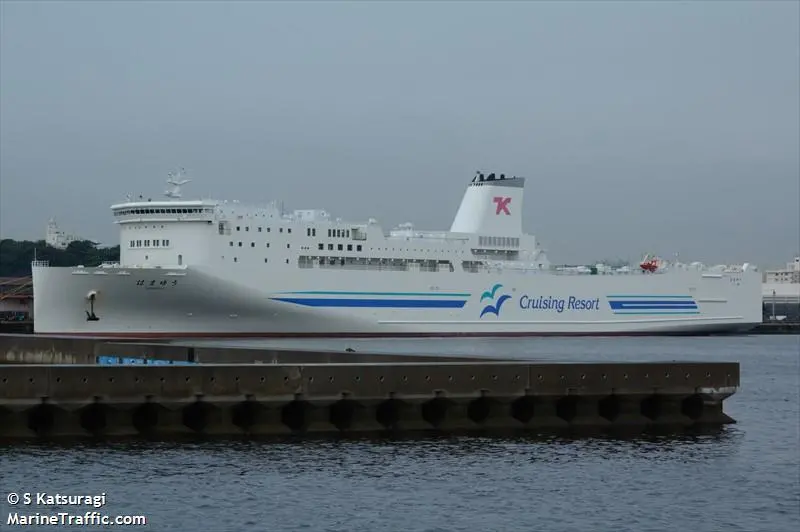
The 223m sisters Hamayu and Soreiyu have been assigned to Tokyo Kyushu Ferry, a new venture of the SHK Group, raising competition in the traffic between the Kanto region, with Tokyo at its heart, and the south west island of Kyushu.
Constructed by Mitsubishi Shipbuilding, the 28-knot, fine-lined ferries offer a transit time of 21 hours on the 976km route between Yokosuka, at the southern end of Tokyo Bay, and Shinmoji, at the northern tip of Kyushu.
The 154-truck or trailer capacity, speed capability and service schedule address the demands of freight carriers and shippers in both directions, be it for time-sensitive fresh produce deliveries to the Tokyo market or southbound cargo flows to industrial and consumer businesses on Kyushu.
The investment is a further expression of the drive to foster a modal shift in domestic transportation. Initially founded on environmental and efficiency objectives, this has been given extra impetus by the shortage of long-haul truck drivers. Unaccompanied freight units can be expected to predominate on the route.
In addition, facilities have been provided on each of the new ships for 268 passengers, to accommodate a relatively limited but steady all-year requirement for travel arising in part from the various resorts located around Kyushu. The raised standard of passenger accommodation, by comparison with that which characterises the Japanese coastal ferry fleet at large, plus the ‘Cruising Resort’ wording borne on the hull sides, signifies the bid by SHK/Tokyo Kyushu Ferry to develop a parallel income to that yielded by the primary commercial transportation function.
Closely following the lines adopted by the 2017-, Mitsubishi-built SHK ferries Lavender and Azalea, the Hamayu type has a vertical stem, low block coefficient and a twin propeller arrangement affording improved loading and reduced cavitation. However, although the latest ships do not incorporate the energy-saving Mitsubishi Air Lubrication System (MALS) of the preceding, Wartsila 38-engined generation, the adoption of the state-of-the-art Wartsila 31 machinery in conjunction with the nature of the hull form ensures a leading fuel consumption performance. The use of 31-series power and the optimised form is claimed to render a 6% gain in energy efficiency relative to vessels of even comparatively young age.
While the 25-knot Lavender and Azalea each have two 38-series diesels producing a total 17,400kW, the potent propulsion installation in the Hamayu is based on four 14-cylinder vee models of the Wartsila 31 design, yielding a total power output of 34,160kW and the capability to ensure schedules at 27-28 knots. Once the province of the Pielstick medium-speed marque, the coastwise long-run ro-pax segment of Japanese shipping, a field that attracts sustained, vigorous investment, is proving especially receptive to the versatile Wartsila 31 machinery.
Exhaust gas cleaning systems have been specified for each of the new ferries, entailing shipsets of seven Wartsila open-loop scrubbers for the main engines and three auxiliaries. The I-SOx in-line units are located in the necessarily oversized funnel casing.
The main engines drive the Kawasaki controllable pitch propellers via Wartsila twin-input single-output gearboxes, each of which has a 1,400kW power take-off(PTO). The 1,800kW genset aggregates employ Yanmar 6EY26LW engines.
The Wartsila 31 achieves high fuel efficiency through a combination of technologies such as common-rail fuel injection, hydraulic valve control, two-stage turbocharging and the integrated, proprietary UNIC engine management system. The patented twin-needle fuel injectors, featuring a dedicated low-load injection nozzle, result in less soot and particles across the load range.
Two Kawasaki tunnel thrusters of 1,180kW apiece in the bow, plus two of 860kW at the stern, enable the master to work the ship with precision at the Yokosuka and Shinmoji terminals, in line with the need for rapid turnarounds.
One of the new ships is acting as a platform for the evaluation of autonomous operation technology in the course of her regular service. Mitsubishi Shipbuilding and SHK’s Shin Nihonkai have collaborated in the development of an unmanned vessel navigation system, and the prototype setup is to be verified and demonstrated at sea over a 12-month period through to mid-2022 under the aegis of the ship’s crew. The project is sponsored by the Nippon Foundation.
While Mitsubishi’s long track record in coastal ferry production owes much to the group’s Shimonoseki yard on the Kanmon Strait, the latest, larger tonnage for SHK was built in Nagasaki at the Tategami Main Plant.
The Mitsubishi ro-pax orderbook currently comprises two vessels for Meimon Tokyo Ferry, the first of which was launched at Shimonoseki in March this year, and two for Ferry Sunflower. The Sunflower sisters due out of Shimonoseki towards the end of 2022 and in mid-2023 respectively will introduce LNG dual-fuel powering into the country’s ferry fleet.
PRINCIPAL PARTICULARS – Hamayu
|
Length overall |
222.5m |
|
Breadth |
25.0m |
|
Depth |
20.4m |
|
Draught |
7.4m |
|
Gross tonnage |
31,400t |
|
Passengers |
268 |
|
Ro-ro capacity |
154 x 12m trucks + 30 cars |
|
Main engines |
4 x 8,540kW |
|
Speed |
28kts |
|
Flag |
Japan |
Related Articles
 PROPULSION
 GENERAL NEWS
 HYDROGEN