



INVESTING IN A RESILIENT SHORT-SEA FLEET
The significance of this philosophy should not be understated, given the modest returns that have historically characterised a sector wherein low-paying bulk commodity transport has traditionally formed a principal element of the traffic.
Companies which have worked at making the ships part of an industrial chain and/or those which have acted decisively in fostering operations in emergent sectors, such as logistics for renewable energy developments, are today among the sector’s leading lights. These firms typically apply a design approach which builds in not only trading versatility but also longer-term environmental resilience, appreciative not simply of regulatory advance but additionally of changing corporate agendas. Such commitments are of particular note for the capital premium necessarily entailed.
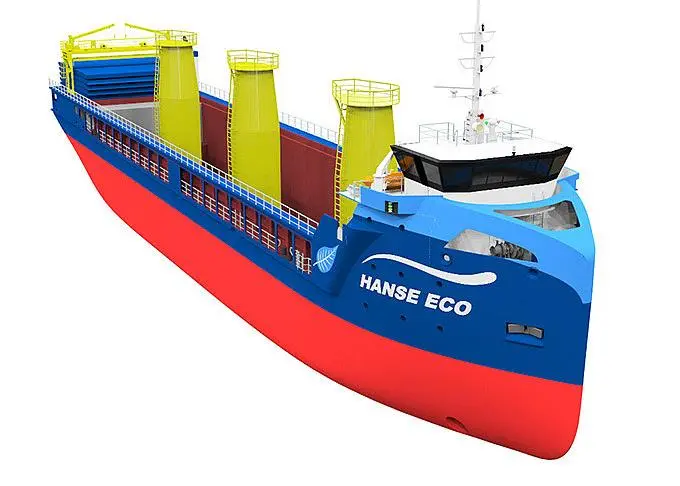
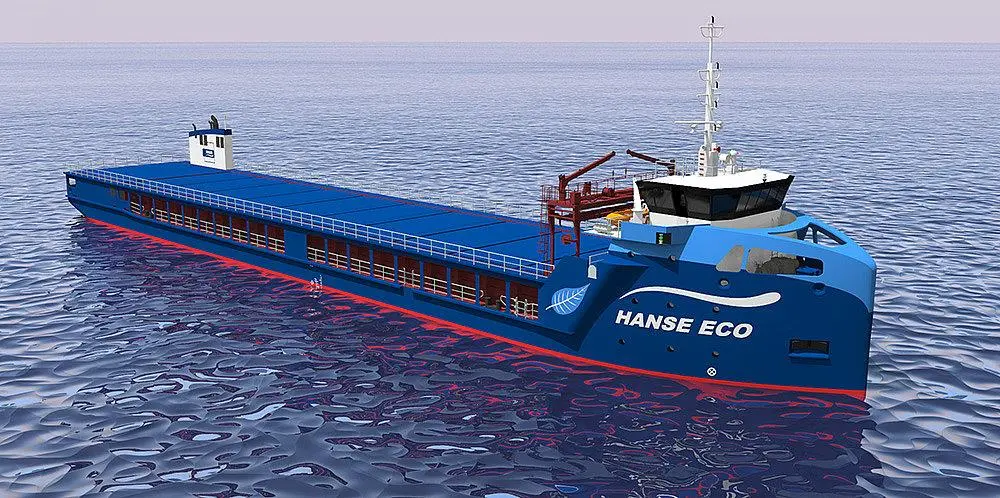
The new way of thinking is exemplified by the Hanse Eco breed of small vessel ordered by German investors and expected to make its debut in European waters within the next few months.
Booked from Dayang Offshore Equipment Co (DYOE) of China, and incorporating a high degree of European technology, the 4,200dwt class is flexibly configured to offer scope for project shipments and outsized freight while efficiently covering the broad demand for dry bulk loads and breakbulk cargo.
As indicated by its appellation, the Hanse Eco generation has been conceived with an acute awareness of the rising swell of regulatory and customer pressures on transport contractors’ environmental credentials. IMO Tier III NOx emissions compliance is a given, headlining a raft of features aimed at ensuring a high and lasting environmental standard. The series has been shaped with climate protection and the ‘mega’ trend of digitalisation as pivotal considerations bearing ultimately on market reach, efficiency and economics.
The programme consisting of five newbuilds has been implemented by Rhenus-Arkon-Shipinvest (RHAS), established in June 2017 after logistics group Rhenus secured a 40% holding in Arkon Shipping, manager of a large fleet of coasters from its base in the German riverside town of Haren-on-Ems.
The concept design was delivered by Dutch consultancy Groot Ship Design(GSD), working in co-operation with the owner, and drawing on the technical participation and inputs from DNV, Hamburg Ship Model Basin(HSVA), Dutch electrotechnical firm Eekels, Dutch cargo gear and access specialist Coops & Nieborg, and Belgian medium-speed engine maker ABC Engines. GSD supplied Dayang with all design information and a basic engineering package allied to the shipbuilding specification, pertinent rules and regulations and the latest technical developments aimed at reducing shipping’s environmental impact.
Since its inception in 2005, GSD has been an exponent of Cadmatic 3-D software for hull engineering, subsequently expanded to embrace piping and outfitting. The system’s application flexibility and ease with which modifications can be made are viewed as particular strengths, and have been used to effect in the Hanse Eco programme.
The ship’s configuration is such as to both maximise use of the given hull envelope in terms of paying volume and provide a very high degree of versatility as to the type of freight carried, ranging from workaday short-sea bulk and general commodities to shipments of long, high or otherwise indivisible items of project cargo, industrial and power equipment.
The bridge and accommodation are located forward, and the funnel casing is arranged right aft, on the port quarter, providing a long and unobstructed weatherdeck with flush hatch covers reinforced to accept deck cargoes.
On an overall length of just under 90m, the single hold gives a maximum overall volume of some 5,700m3, or 201,000ft3, with the added facility and flexibility for subdivision using up to three movable grain bulkheads, allowing four cargo segregations. The bulkhead panels can also be employed to create a load-bearing half tweendeck.
Furthermore, the ships have been designed to meet the full operational and regulatory requirements for sailing without the hatch covers in place. The ‘open top’ mode affords the means for transporting outsized shipments including fabrications, plant and machinery. Structures and equipment relating to the renewable energy sector have a particular relevance to this capability.
Recourse to European technology is expressed in the choice of a rugged and fuel-versatile design of four-stroke propulsion machinery produced at Ghent by ABC Engines. The six-cylinder model of the company’s DZC type, rated for 1,333kW at 1,000rpm, promises a 10-knot ‘eco’ speed on 4.2t of marine gas oil per day, and offers the potential to be run on biofuel.
The installation is IMO Tier III compliant by virtue of the adoption of a selective catalytic reduction (SCR) system supplied by the Swiss company HUG Engineering, and in which the exhaust stream is treated with a urea solution.
The main engine drives a nozzled, Promarin fixed pitch propeller through a ZF transmission of the 10000-series, and rotational energy in the driveline is harnessed by a 259kW shaft generator to deliver electrical power into the ship’s net when under way. The Oswald permanent-magnet shaft generator also offers a PTI (power take-in) capability, energised by the auxiliary generators so as to act on the shaftline, exerting supplementary, boost or emergency power.
Each of the two auxiliaries is from the Perkins range, whereby an E70 (TAG1M) diesel turns out 129kW at 1,800rpm. A further such aggregate, albeit set up for a slightly lower maximum power and speed rating, constitutes the emergency generator.
The electrical system was contracted from Eekels of The Netherlands, and features a DC main switchboard fed by the shaft generator driven by the main engine and/or the two auxiliary gensets. The respective generator types are connected to the DC distributor by means of an active front end(AFE) inverter and two rectifiers.
An AC switchboard is provided for users of the onboard electrical grid, which is powered by the DC distributor through two 90kW DC/AC converters. The entire system is integrated into the DC distributor, along with the 300kW bow thruster drive. Eekels used its proprietary MAS platform for the automation system. Powering arrangements include provision for a future uptake of batteries.
Last September, Arkon struck an agreement with the leading Norwegian short-sea player Wilson ASA. Under the deal, Wilson secured around 20 short-sea bulkers on long-term lease from the Arkon fleet, including the Hanse Eco series. The Bergen-based operator thereby brought the number of ships under its commercial control to more than 130 in the 1,500-8,500dwt range. As a consequence of the pact, Arkon has become an integrated part of Wilson’s chartering system, and handles export fixtures for the entire Wilson fleet throughout the Mediterranean region and Black Sea.
The launching of the lead Hanse Eco newbuild in China gave expression to the tie-up through her naming as Wilson Flex I, and bearing ‘Arkon-Wilson’ on the hull sides.
Wilson Flex V, the fifth ship in the series, has been opened to outside investors, whereby approximately EUR 2.2 million (US$2.6m) of equity out of a total newbuild cost of some EUR 8.7 million (US$10.3m) is to be raised through ‘crowd’ funding. The promoters hold out the prospect of “attractive dividends” and claim that the vessel type will consume up to one-third less fuel at a higher speed in relation to existing ships of similar capacity. Moreover, it is starkly contended that 45% of comparable vessels are outmoded and facing decommissioning.
Manning arrangements for the five newbuilds have been entrusted to Arkon’s existing contractor, the Bremen company United Lloyd Crewing. The complement of seven will comprise master, chief mate, watch officer, chief engineer, motorman and two ABs (one of whom will also act as cook). United Lloyd typically recruits from the Baltic States (Lithuania, Latvia and Estonia), Russia, Ukraine and Poland. Duty cycles will be four months on, one month off, for officers, and six months on and a month off for ratings, with the ships deployed throughout littoral Europe, from Russia in the north to the Mediterranean and Black Sea in the south and east.
The delivery schedule for the series has gone back over the life of the programme, presumably in no small part due to the pandemic. Handover of the first-of-class from Dayang is currently not expected before the end of September this year, with the subsequent four vessels following at intervals through to the second half of 2022.
Dayang was established at Tai Xing City in Jiangsu Province 14 years ago and is a subsidiary of the diversified ADDSINO Group, a listed state-owned company. The Hanse Eco programme demonstrates once again the growing reach and ambition of Chinese shipbuilding. It should be noted that German shipowners in the tramping and short-sea sectors were in the vanguard of foreign firms taking newbuild orders to China, decades ago, and the RHAS contract strengthens this association.
PRINCIPAL PARTICULARS – Hanse Eco class
|
Length overall |
88.60m |
|
Length bp |
84.99m |
|
Breadth, moulded |
14.00m |
|
Breadth, overall |
14.54m |
|
Depth, to main deck |
7.35m |
|
Draught, summer |
5.70m |
|
Corresp. deadweight |
c.4,200t |
|
Draught, ‘open top’ condition |
4.60m |
|
Corresp. deadweight |
c.2,918t |
|
Gross tonnage |
2,999t |
|
Cargo holds |
1 |
|
Movable hold bulkheads |
3 |
|
Hold capacity(without panels) |
c.5,696m3/201,000ft3 |
|
Hold capacity(with 3 bulkheads) |
c.5,550m3/196,000ft3 |
|
Containers(main deck only) |
84TEU |
|
Main engine power |
1,333kW |
|
Speed(economical) |
10kts |
|
Shaft generator(PTO/PTI) |
259kW |
|
Auxiliaries(gensets) |
2 x 129kW |
|
Bow thruster |
300kW |
|
Class |
DNV |
|
Flag/registry |
Portugal/Madeira |
|
Crew/berths |
7/8 |
DNV Class notations, Hanse Eco ships
|
DNV 1A |
Multi-purpose dry cargo ship, equipped for the carriage of containers, strengthened for heavy cargo. Unrestricted Navigation |
|
Grab 2-15 |
Hold designed for loading/unloading by grabs |
|
E0 |
Unmanned machinery space |
|
BIS |
In-water survey |
|
BWMT |
Ballast water treatment |
|
DG |
Carriage of dangerous goods |
|
DBC |
Carriage of solid dangerous goods in bulk |
|
NAUT(NAV) |
Ergonomic bridge design |
|
TMON |
Tailshaft monitoring |
|
Vessel able to sail without hatch covers(open top) in accordance with flag state regulations. NAABSA: vessel able to load/discharge when safely aground |
Related Articles
 PROPULSION
 GENERAL NEWS
 HYDROGEN