



BROAD CANVAS FOR NEW CABLE LAYER
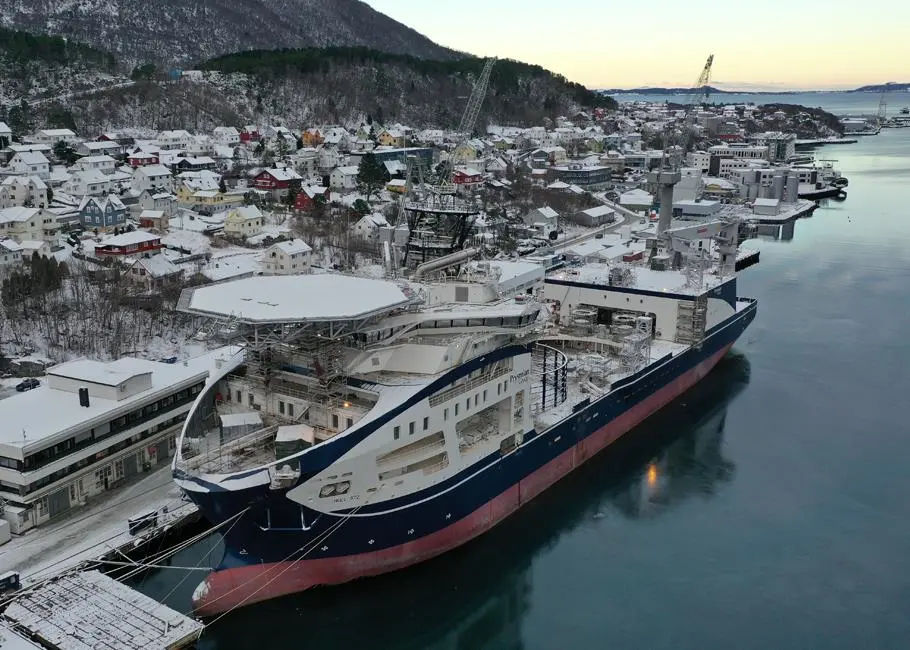
The DP3-class vessel represents a EUR 170 million (US$210m) investment by the Italian-headquartered Prysmian Group in support of long-term growth in the energy and telecom cable laying business. Designed to handle next-generation cable technologies, and equipped to carry out the deepest power cable installations at up to 3,000m, as well as shallow water assignments, Leonardo da Vinci marries operational versatility with a technical concept aimed at speeding project execution.
The global submarine cable market is forecast to reach US$26 billion by 2025, expanding at a compound annual rate of some 12%. A considerable spur is provided by offshore renewable energy generation, and the associated requirement for cable links.
Design and build was contracted from Vard Holdings, Fincantieri’s Norwegian subsidiary, with hull construction assigned to Vard Tulcea in eastern Romania, and outfitting and commissioning the responsibility of Vard Brattvaag on the Norwegian west coast, where handover to Prysmian took place in August 2021. Newbuild supervision was managed by the Glasgow firm SeaTec, part of the V.Group. While the design is based on a Vard naval platform, the entire wherewithal for the ship’s cable laying role emanated from Prysmian itself.
Depending on project requirements, Leonardo da Vinci can be equipped with Prysmian’s proprietary Hydroplow, Heavy Duty Plough, and Seamole tools, so as to conduct simultaneous lay and burial or post-lay burial operations. The vessel has facilities for onboard cable jointing, and can also serve as a platform for state-of-the-art jet trenching remote operated vehicles (ROVs) and mass flow excavator tools. The ship’s bollard pull capacity, variously described as in excess of 180t and close to 200t, is a fundamental attribute.
Prysmian claims that the high load intake and laying precision for complex assignments, coupled with fast transit speed, will expedite project timescales. Optimised transportation and underwater installation will also contribute to reduced environmental impact, an objective more directly achieved by a diesel-electric system employing one of the industry’s most fuel-efficient designs of medium-speed engine, the Wartsila 31 series.
The first mission assigned to the Leonardo da Vinci is the installation of the Viking Link submarine cable connecting the British and Danish power grids. The 765km interconnector will be the longest of its kind worldwide, transferring high-voltage DC electricity in either direction between substations in Lincolnshire and southern Jutland. The vessel sailed from Norway to load cable at Prysmian’s Arco Felice production plant at Pozzuoli near Naples.
Later this year, the ship is due to fulfil other contracts, including the new submarine power connection between Lanzarote and Fuerteventura in the Canary Islands, and cable laying for the 480MW Saint-Nazaire wind farm off the Loire-Atlantique coast of France.
Two carousels of 10,000t and 7,000t load capacity feed two independent laying lines, conferring increased operational flexibility. The starboard and portside laying lines, served by draw off/hold back (DOHB) engines and linear machines, respectively, deploy cable over 6m-diameter stern sheaves.
Leonardo da Vinci provides a showcase for Wartsila medium-speed diesel power, used for all six main gensets, delivering electrical energy throughout, for the three ABB Azipod propulsors, four manoeuvring thrusters, ship’s services and the hotel load. Four larger aggregates are formed around eight-cylinder models of the W31 vee-type engine, which has a design nominal maximum rating of 4,880kW at 750rpm. The two other sets use eight-cylinder in-line versions of the robust, small-bore W20 engine. The gensets are complemented by banks of batteries.
Such is the power concentration that the vessel offers a top transit speed of just above 16 knots, according to Prysmian, cutting transportation time for cable from factory to point of use.
The specific, hybrid nature of the vessel’s propulsion setup led RINA to formulate the ‘Battery Powered’ notation. The subject installation encompasses two 750kWh energy storage systems made up of lithium batteries that, in addition to a peak-shaving role, can render continuity of dynamic positioning in a worst case scenario. In the event of fire or flood in either of the two engine rooms, the hybrid propulsion plant and its sophisticated automation enable the batteries to take over as the supply source for electrical power to one thruster for a minimum of 15 minutes.
RINA’s executive vice president Paolo Moretti said “We worked closely with Prysmian and Vard to create the Battery Powered notation which, together with the Green Plus notation, will certify the sustainability ambitions of the owner. We have specifically analysed this innovative arrangement to ensure the vessel meets the same level of safety as the DP3 notation.”
To maximise position keeping and slow-speed directional stability, four manoeuvring thrusters are fitted in the foreship section, comprising two tunnel thrusters and two retractable, azimuthing units.
The retractable thrusters are of the WST-24R design developed by Wartsila’s technology and service centre in the Netherlands. Vertical retraction reduces drag and depth when the vessel is in transit mode. Each nozzled, 360 degree-rotatable unit can be operated independently, optimising station-keeping performance, while the innovative use of an eight degree tilted configuration minimises thruster/hull interaction. The net effect is a claimed 20% improvement in thrust relative to other non-tilted thrusters.
An additional merit of the WST-24R is the combined steering and retraction system, which involves a lower component count resulting in a lower weight and reduced maintenance scope. The ‘plug-and-play’ attributes of the design, which was delivered to the yard pre-assembled and aligned, saved time and resources at the installation stage. Increased thrust effect from a given power will result in fuel savings.
Husbandry of Leonardo da Vinci has been entrusted to the Monaco company Sea World Management, which already acts as the contractor for Prysmian’s three other cable layers, the Giulio Verne (dating from 1983), Ulisse (2011) and the UK-registered Cable Enterprise (2001).
TECHNICAL PARTICULARS – Leonardo da Vinci
|
Length overall |
171m |
|
Breadth, moulded |
34m |
|
Draught, summer |
8.5m |
|
Deadweight |
18,400t |
|
Displacement |
36,400t |
|
Gross tonnage |
27,500t |
|
Cable storage carousels |
10,000t + 7,000t |
|
Propulsion system |
Diesel-electric/battery |
|
Main generators |
4 x Wartsila 8V31 + 2 x 8L20 |
|
Battery banks |
2 x 750kWh |
|
Main propulsors |
3 x aft Azipod |
|
Speed, maximum |
c.16kts |
|
Manoeuvring thrusters |
2 x retractable forward + 2 x bow tunnel |
|
Bollard pull |
180t-plus |
|
Endurance |
90 days |
|
Accommodation, berths |
120 |
|
Class |
RINA |
|
Flag |
Italy |
Related Articles
 PROPULSION
 GENERAL NEWS
 HYDROGEN