



AMMONIA PROJECT TO INTEGRATE NEW ENERGY-SAVING SOLUTIONS


The project, which commenced in May 2021, aims to promote the adoption of clean energy technologies, particularly for retrofit, and will involve demonstration-scale installations on an oil tanker, a container ship and a ferry. In parallel ENGIMMONIA will study how to abate emissions from dual-fuel ammonia engines, via specific N2O abatement solutions. With funding from the European Union’s Horizon 2020 research and innovation program, the project is coordinated by Italian company RINA Consulting and involves 21 project partners from nine countries, including several technical universities and shipowners.
There are two main goals for the technology development, says project coordinator, Stefano Barberis from RINA. ENGIMMONIA will study the benefits of using ammonia as a bunker fuel, with much of the work undertaken at MAN Energy Solutions’ engine laboratory in Denmark focused on N2O Emissions abatement. The Port of Genoa in Italy will be involved in evaluating bunkering and logistics in Europe.
The second goal for the project aims to test other onboard technologies including waste heat recovery via Organic Rankine Cycle (ORC), adsorption chillers for space cooling and the installation of photovoltaic (PV) composite surfaces on the vessels. These installations will involve onboard fuel/energy/heat management optimisation via a real time energy management system. While the installations will be demonstration-scale, naval architect firm C-Job will study the integration and upscaling of the solutions.
RINA will focus on the regulatory, policy, infrastructure and safety aspects of all of the technologies evaluated in the project. This will include analysis of the health and safety and classification aspects of the technologies, development of a roadmap for the adoption of the concepts and an in-depth analysis of bunkering ammonia, including a specific study at the Port of Genoa.
METIS and SEASTEMA will be developing digital services to acquire data from any instrument on board the vessels relating to operational efficiency and environmental performance; assist crew in operating machinery and vessel at optimum efficiency; and support data scientists in evaluating the new technologies and fuels. A key part of that will be to provide a platform for all the engineers working on the project so they can collaborate, access data and run feasibility studies, says Serafeim Katsikas, CTO at METIS.
“We need to gather data to understand all the factors that affect the performance of the vessel and the environmental footprint,” he says. This involves coordinating team members to determine the type of data they can provide, looking for ways to standardise the data and developing key performance indicators (KPIs). These KPIs will be used to evaluate individual technologies and their potential return on investment as well as to consider the safety and operational status of the whole vessel. “There are a lot of aspects to this that we have limited knowledge on today.”
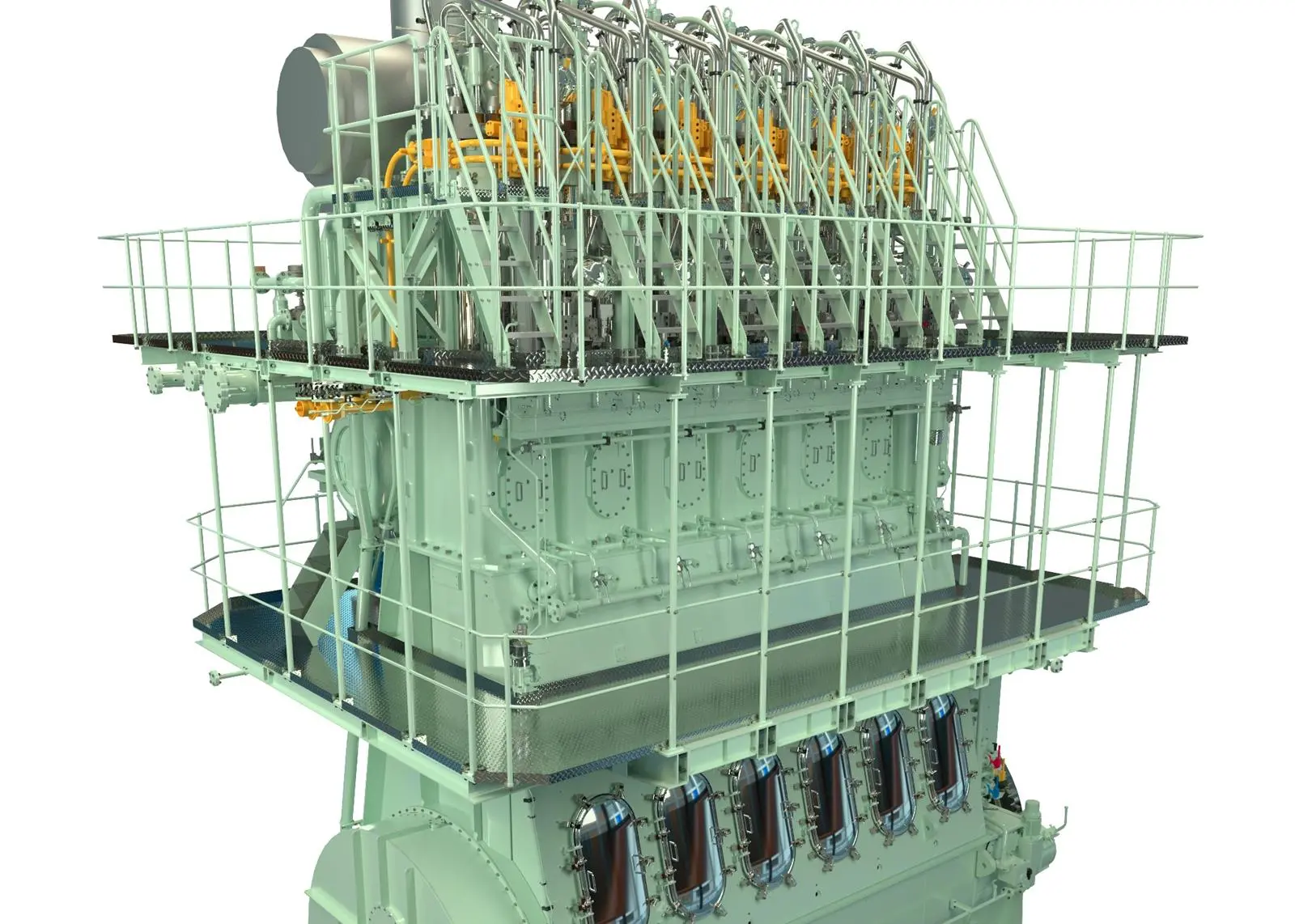
The three vessels won’t be fitted with engines that burn ammonia as fuel: there are two other European projects underway to develop 2-stroke combustion engines fuelled by ammonia, but the ENGIMMONIA project will study ammonia engine exhaust gas, particularly the formation of nitrous oxide (N2O or laughing gas).
The preferred option is to prevent its formation in the combustion chamber, say Stefan Mayer, head of engine process research at MAN Energy Solutions, but this is yet to be achieved in large 2-stroke engines. While confident that learning from smaller engine technology will help with this, he says the project partners are also addressing options for controlling N2O in the exhaust gas. “We are looking at a very wide envelope of combustion regimes and concepts,” he says. For this, MAN is partnering with leaders in modelling and simulation including researchers from Haldor Topsoe, Polytechnic University of Milan, Lund University, Aristotle University of Thessaloniki and the Technical University of Denmark (DTU).
DTU’s Professor Anker Jensen explains: “While catalysts for removal of NOx is a well-developed technology used on ships today, it is not so for catalysts for removal of N2O (by converting it to harmless N2 and O2 or H2O). Note that N2O is a gas with a greenhouse warming potential 300 times that of CO2 so only a small emission of N2O may offset the positive effect of burning a green and non-carbonaceous fuel like ammonia.
“The purpose of my part of the ENGIMMONIA is therefore, in close collaboration with the company Haldor Topsoe, to develop a catalyst that can remove N2O from the flue gas. Initially, we will screen the literature for candidate materials for both decomposition (i.e. no reactant added to the flue gas) of N2O and materials that catalyse the reduction of N2O to harmless N2 by reaction with NH3 – readily available on the ship.” His team will then synthesize materials and test them for activity in powder form. Top candidates will be formulated into catalytic elements for use on ships and then tested.
Supported by researchers from the Institute for Advanced Energy Technologies Nicola Giordano (CNR-ITAE), Fahrenheit is to develop an adsorption chiller specifically for use on ships. A specialist in sustainable energy solutions, Fahrenheit will develop a cooling system based on its adsorption chiller technology that will use waste heat from the ship’s engine to cool passenger areas. “When developing concepts, we always cater for the specific needs of the respective heat source and the cooling requirement. We are convinced of the great potential in deploying adsorption chillers on board ships,” says Eliza Nowak, project leader for Fahrenheit.
An adsorption chiller cools water that is then used to air-condition rooms or to cool, e.g., machines, servers or other processes. The unique quality of adsorption cooling is that it uses heat, e.g., central heating or waste heat from machines, instead of electricity as the main input energy. Therefore, the adsorption chiller saves approximately 80 percent of electricity costs that would normally occur for an air-conditioning system or chiller.
The first step in developing the onboard system is to identify the best material pairing of sorption and cooling agents for a prototype. “In this phase, we shall characterise different sorption agent configurations in regard to their sorption capacity, achievable cooling capacity and the thermal stability, and define the optimal combination for the application,” says Nowak. While developing the final prototype, the CNR-ITAE will test different configurations of adsorption modules and heat exchangers that Fahrenheit will then optimise. The final prototype will then be installed on a ferry belonging to the Greek shipping company ANEK, and its operation will be monitored and analysed. “We will use the demo installation on the ship as a reference project, and ultimately we want to expand new collaborations and contacts within the shipping industry,” says Nowak.
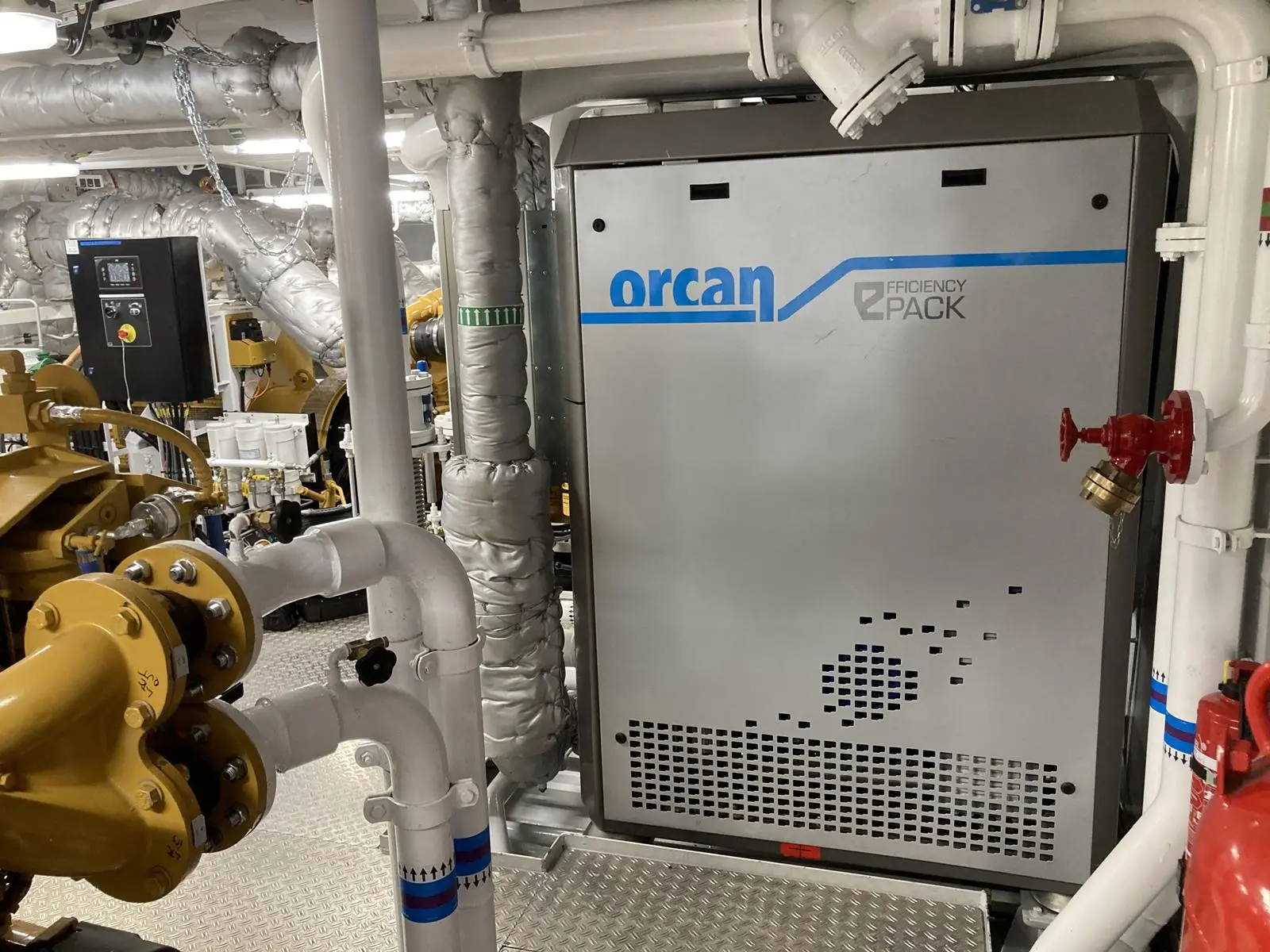
Orcan Energy will demonstrate a larger marine ORC system than has been available up to now. In particular, the system will be better suited to the requirements of large two stroke engines but will be based on the reliable and well-known technology Orcan has already introduced to the marine market, said a spokesperson for the company. It will be an enlargement of the product family. The ORC System is anticipated to be demonstrated initially on a tanker provided by Famous Accounting Single-Membered Company Limited where it will be used to convert waste heat from the main propulsion engine into usable electricity and therefore reduce fuel consumption.
Orcan Energy has redesigned its efficiency PACK specifically for the marine industry. A heat exchanger transfers waste heat from the engine jacket cooling water and exhaust gas to the ORC circuit. There, the refrigerant – a non-toxic, non-flammable hydrocarbon – evaporates and is fed as superheated vapor to an expansion machine where the high-pressure refrigerant is expanded, driving the expansion machine. This rotational energy is then used to drive a generator that produces electricity.
Haldor Topsoe will contribute its knowledge on green hydrogen production technology and derived shipping fuels such as green ammonia. For example, the company is participating in another project which aims at building a 10MW green ammonia plant directly coupled to local wind and solar power generation in Denmark. The plant is expected to be operational by 2023, making it the world’s first green ammonia plant of its kind. The dynamic approach entails that the clean power from wind turbines and solar panels will be connected directly to the electrolysis unit making it more cost-effective than if involving a battery or hydrogen storage.
The Spanish technology centre Tecnalia will work on the integration of PV systems on the vessels and ensure the composite materials with embedded PV cells that will be used are suitable for marine conditions.
The ENGIMONNIA project partners are National Technical University of Athens (Greece), National Research Council (Italy), Technical University of Munich (Germany), the University of Genoa (Italy), Aristotle University of Thessaloniki (Greece), Tecnalia Research & Innovation (Spain), Technical University of Denmark (Denmark), Lund University (Sweden), Polytechnic University of Milan (Italy), Orcan Energy (Germany), METIS (Greece), Fahrenheit (Germany), C-Job (Netherlands), Ricreation (Greece), Seastema (Italy), MAN Energy Solutions (Denmark), Anonimi Naftiliaki Eteria kritis (ANEK) (Greece), DANAOS Shipping (Cyprus), Autorità di Sistema Portuale del Mar Ligure Occidentale (Italy), Famous Accounting, Technical, Commercial, Brokering, Shipping Single Membered Company Limited (Greece), Haldor Topsoe (Denmark).
Related Articles
 ALTERNATIVE FUELS & LUBRICANTS
 ALTERNATIVE FUELS & LUBRICANTS
 ALTERNATIVE FUELS & LUBRICANTS