



LIGHTWEIGHT CNG TANKS FOR SPECIALIST CLASS OF SHIPS
The four-year project commenced in June 2017 and is being led by naval architects Navalprogetti of Italy with classification support provided by ABS. The project is due to be completed in January 2022, and its aim has been to develop a cost-efficient way of transporting natural gas that would otherwise be stranded or flared. The transportation of compressed natural gas (CNG) at a relatively small scale over short distances (around 2,500 kilometres) is likely to be more flexible than pipeline transport and more economical than LNG. Energy consumption for the compression process is about half of that required by liquefaction and regasification.
In an EU context, the project furthers the ambition for reducing Europe’s dependence on a single supplier by diversifying supply routes and unlocking new resources. In particular, GASVESSEL is expected to open up energy routes in Europe to three different oil and gas fields:
- East Mediterranean gas fields – the CNG concept will enable supply of remote areas such as the Greek and Italian islands and Cyprus
- Black Sea region – CNG transport offers a flexible solution for early start-up of gas exploitation, before the planned pipeline will be finished
- Barents Sea offshore oil field – the CNG concept will exploit gas associated with oil winning, which is currently reinjected in the oil fields.
CNG-burning dual-fuel engines
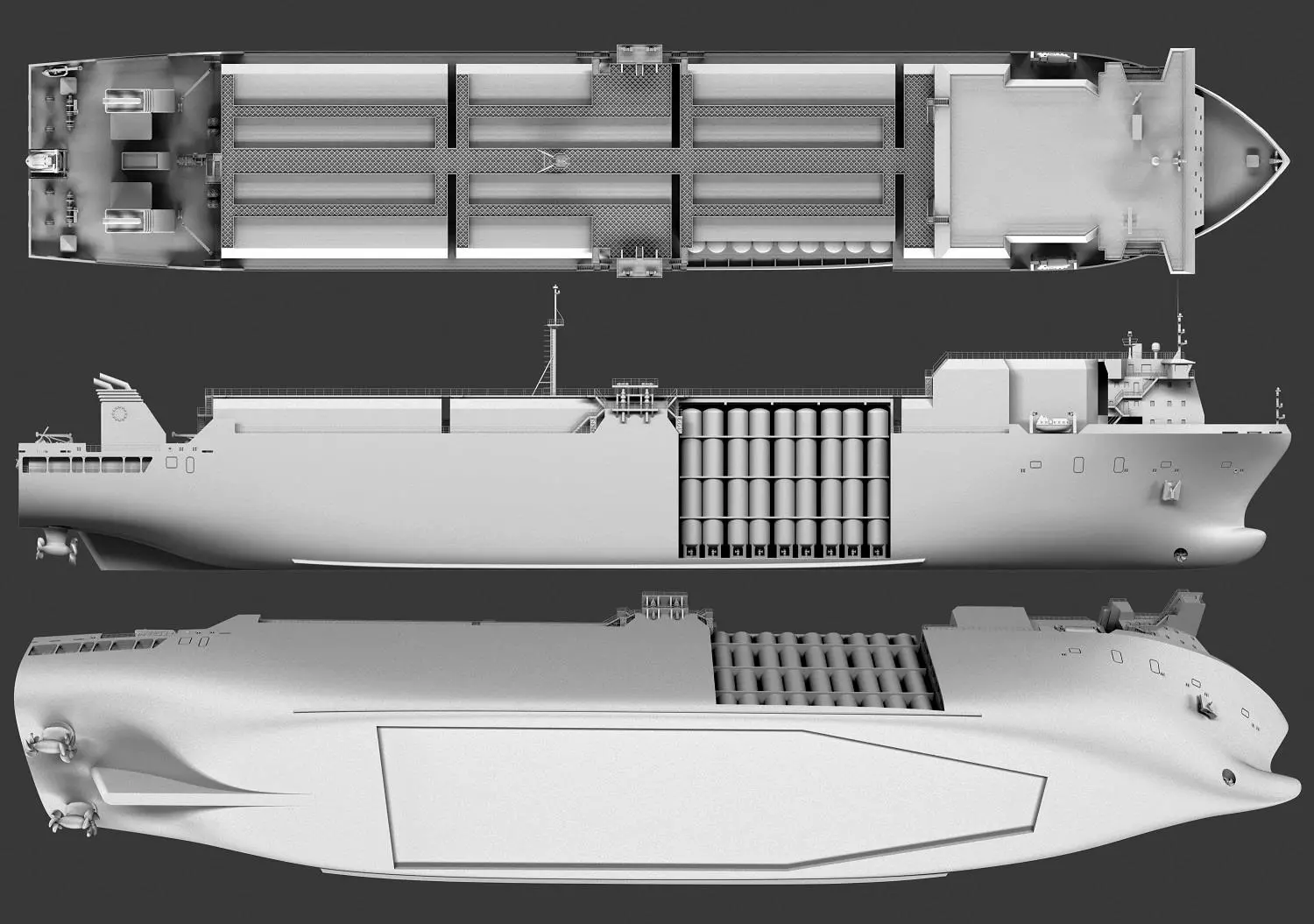
The ship design and cargo capacity can be adjusted depending on specific project requirements, but the vessel design that is currently being assessed under the scope of the GASVESSEL project has a length overall of 205m, a 36m maximum breadth and 7.5m design draft. The ship will have a cargo capacity of 15 MNm3 and be powered by four Wartsila 8V31DF dual-fuel engines (each 4240 kW at 720 RPM). As well as having dual-fuel power burning CNG, the ship will feature an air lubrication system. Hull and bulbous bow optimisations have achieved a reduction in resistance of approximately 15% at cruising speed.
Researchers from Cenergy and the University of Trieste developed a process simulation model to estimate the time needed for loading and unloading the CNG. The modelling indicates that it could take around 100 hours (35-51 hours for loading and 46-55 for unloading), depending on ambient temperature. Energy consumption for the loading process could vary in the range of 150–180 kJ for a unit mass of CNG. The total fuel consumption of the modelled processes varied between 1.14% and 1.45% of the total cargo.
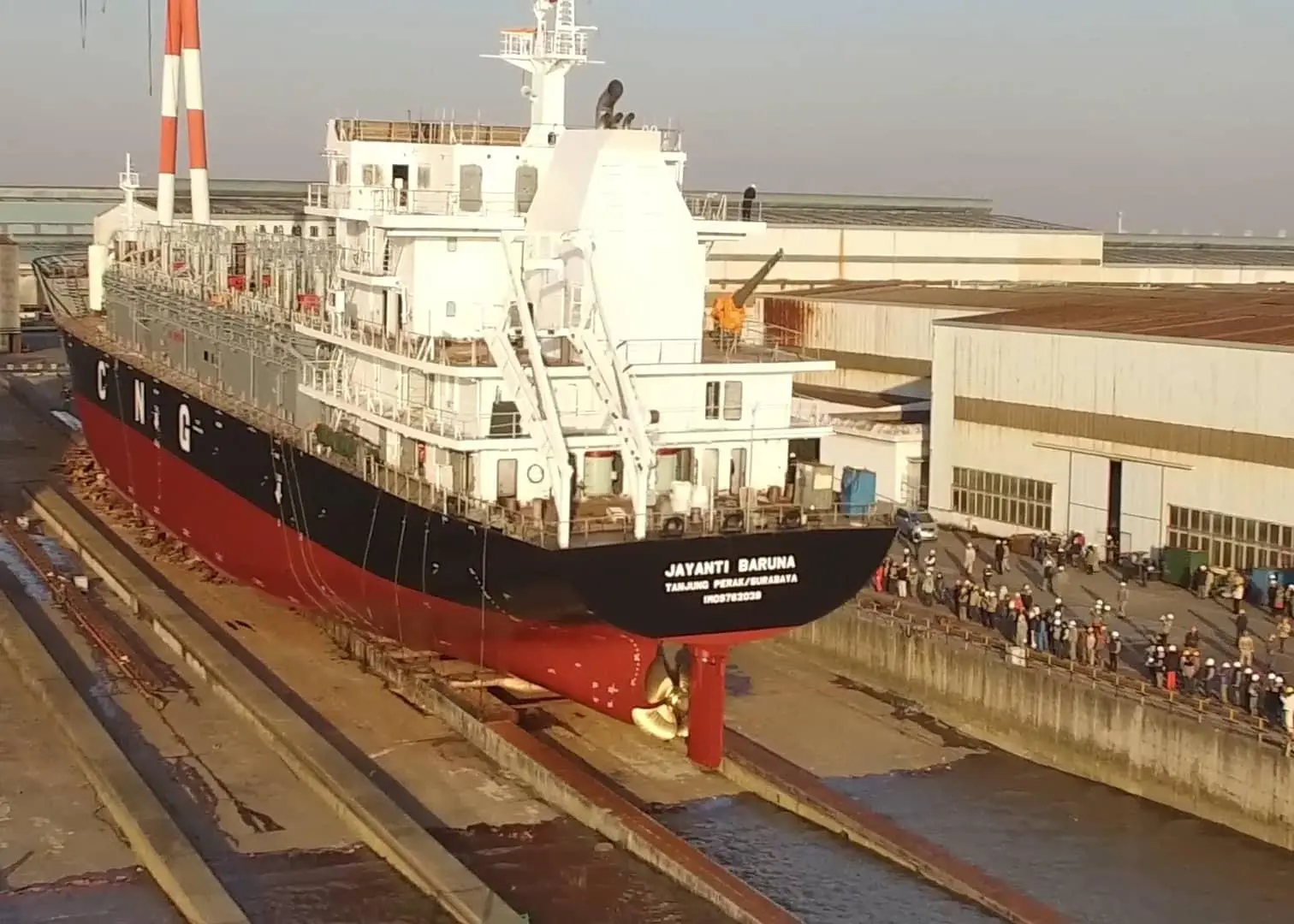
The researchers note that the first and only CNG ship currently in service, the Jayanti Baruna, was launched in January 2016 in Indonesia. It is classed by ABS. The vessel has a capacity of 0.67 MNm3 @250 bar of gas. The gas is stored in a vertical cylinder (height 12 metres, diameter 615 mm, thickness 19 mm), and the ratio container/cargo weight is 0.15. This low ratio between the mass of transported gas and the vessel’s cargo weight could be one of the reasons why CNG ship technology currently has such a limited uptake.
Non-load sharing metallic liners
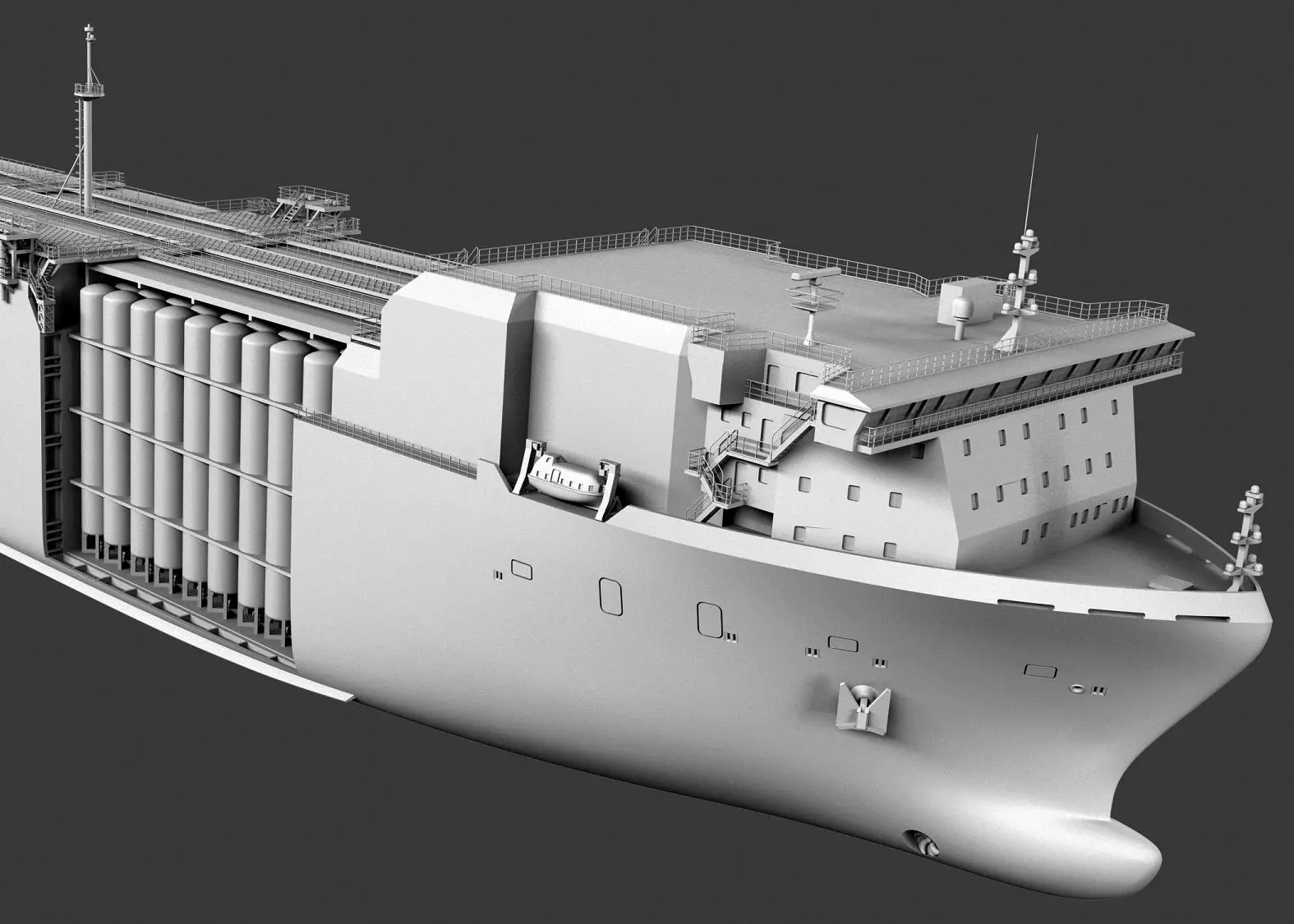
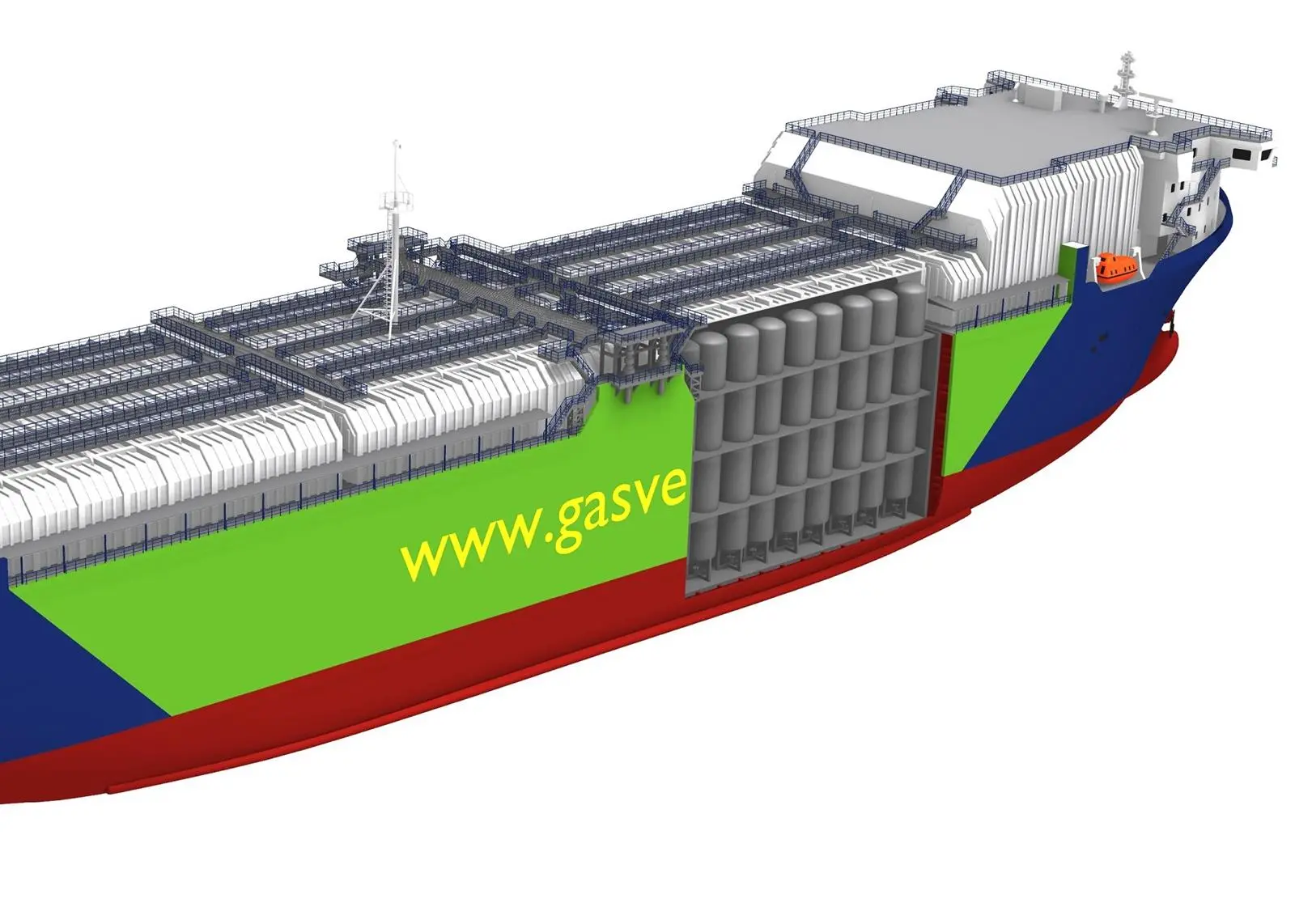
Therefore, a unique and important feature of the GASVESSEL project is the development of large, light weight cargo tanks. The design consists of compressed gas cylinders of around 3m in diameter and 22m in length, installed and fixed vertically within the ship’s hull and designed to store CNG (with a minimum methane number of 70) @300bar and 20oC.
Their design was developed by engineering company CNGV of Slovenia using software provided by Italy’s ESTECO Enterprise. CNGV and engineering and fabrication company BMPlus are currently burst and fatigue testing prototype cylinders under the supervision of ABS. CNGV has already provided finite element structural analysis that implies that the concept is technically sound and feasible.
The cylinders are made of a 6mm stainless steel liner wound with carbon fibres. The design reduces the total weight down to 70% of the current alternatives of the same capacity. The fabrication involves a specially-developed hydroforming and autofrettage processes, while the winding process is optimized to provide the most efficient design. The pressure cylinder design is now patented in 13 countries: China, Norway, UK, Germany, France, Spain, Italy, Greece, Cyprus, Turkey, South Africa, Singapore and the US.
Both the pressure cylinder and the CNG ship concepts have received Approval in Principle from ABS. Stavros Niotis, Senior Principal Engineer, Global Gas Solutions ABS, says: “In general, the technology of compressed gas cylinders with non-load sharing metallic liners is well known in industries other than shipping. However, what makes this design unique is the size of the cylinders and the construction techniques that must be followed during their fabrication. This is to verify that the liner will always have good contact with the various layers of the carbon fibre windings during the cylinder’s lifetime and for the intended operation.”
High pressure design implications
In evaluating the design, Niotis says: “The main safety issue associated with CNG carrier designs is the high pressure at which the natural gas will be stored, so its systems need to be able to handle much higher pressures as compared to other ship types. Also, the risk of explosion in case of failure of such systems is high and the potential consequences can be catastrophic.
“For the cargo containment system, the high temperatures that will be developed during loading are also highly important as they can affect the properties of the carbon fibre windings. The ship’s cargo holds, where the cylinders are placed, are designed to be continuously inerted in line with the ABS Guide for Compressed Natural Gas Carriers.”
The cargo containment area will consist of an eight cargo holds, each one divided in two sections by one longitudinal bulkhead, designed to contain the CNG pressure cylinders. The manifolds are placed amidships, and loading will be done from ship’s side. The loading and unloading cargo station is located on the deck according to OCIMF rules. The cargo holds are double bottom and double sided. These spaces achieve complete segregation of the cargo and to store ballast water.
Each cargo tank is comprised of four pressure cylinders interconnected via common header. The ship systems are designed to provide continuous monitoring and control of the various piping arrangements including cylinder pressure and temperature during loading, unloading and transportation, while a dedicated ‘blow-down’ system will verify that any part of the cargo will be vented before any more serious occurrence. The cargo holds will be inerted with nitrogen at a positive pressure of 50 mbar.
The cargo tanks will be connected to loading/unloading manifold via cargo deck piping which will be routed via a segregated pipe tunnel that runs above the cargo holds dome, in a central position. The cargo pipe tunnel will also inerted with nitrogen. All the CNG piping will be butt-welded without flange connection to prevent any leakage during operation.
Under the scope of the GASVESSEL project, detailed analysis has been performed relating to the loading/unloading systems and facilities that will be required for the new class of ship. The loading and unloading operations will be carried out while the ship is berthed or secured by a single mooring, and the production facility or CNG FSU will supply the gas to the ship at about 240 bar. The ship is fitted with cargo compressors to raise the pressure from 240 to 300 bar inside the cylinders to increase cargo carrying capacity. Compressors will also be used during ship unloading operations as scavenging compressors when the differential pressure between gas in the cargo cylinders and receiving shore system is low enough to affect the scheduled discharging time.
Once cargo loading is complete, all the remote-controlled stop valves between deck piping and cargo containment systems will be closed to segregate the cargo tanks from each other. The deck piping will remain pressurized after loading. After unloading, residual gas is expected to be about 30bar.
The ship could receive natural gas previously dehydrated and desulfurized by a production facility or a CNG floating storage unit (FSU), as there is no provision on board the ship for preliminary treatments of the natural gas. “Currently the project does not cover the option of loading gas directly from stranded fields as some preparation and treatment needs to be done before the gas is transferred to the ship,” says Niotis. “It is a technically feasible option, especially from the ship design perspective, but it would need to be further assessed.”
Several contacts are already in progress with companies interested in CNG transportation and distribution.
Eight countries are represented in the GASVESSEL project: Navalprogetti (Italy), Dow Deutschland Anlagengesellschaft (Germany), Dowaksa Deutschland (Germany), PNO Innovation (Belgium), Vnipitransgaz (Germany), SINTEF Ocean (Norway), BMPlus (Italy), CNGV (Slovenia), Cenergy (Italy), Hanseatic Lloyd Schiffahrt GMBH & CO KG (Germany), Cyprus Hydrocarbons Company (Cyprus), Esteco (Italy) and American Bureau of Shipping – ABS Hellenic (Greece). The project has received funding from the European Union’s Horizon 2020 research and innovation programme.
Related Articles
 PROPULSION
 GENERAL NEWS
 HYDROGEN