



PRODUCTION OF NEXT-GEN HYBRID-SUPERCAPACITOR POWER SYSTEMS DUE IN 2023
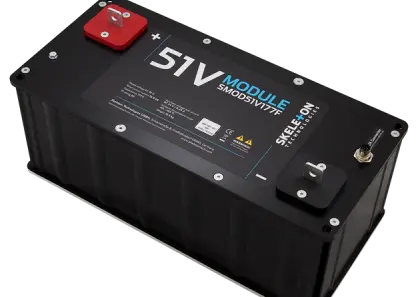

Skeleton Technologies claims the highest specific energy density on the supercapacitor market, achieved using its proprietary Curved Graphene nano-technology. The company’s 51V module can be used in series for applications requiring up to 800V, says Dr. Sebastian Pohlmann, VP Automotive and Business Development. Expanding the energy density of the company’s supercapacitors will increase supercapacitors suitability for other shipboard operations that might require short power peaks or cyclic events, adds Pohlmann, including winch operations and engine starts. The Motorship previously reported in 2019 on research by KHI into the potential applicability of supercapacitor technology for both AHC aboard drillships and for peak shaving and load ramping purposes in combination with dual-fuel engines.
Skeleton Technologies is currently developing a new system, based on a new chemistry for electrodes, that the company expects will offer 10 times the energy density of current technology. “Our Curved Graphene technology has already improved energy density by a factor of two to three. With graphene, we are pretty close to the theoretical limit for the surface area of the electrode, so a few years ago we decided to develop a new kind of chemistry. That has now made the jump out of the lab to industrialisation. We call it a superbattery, and it is a combination of energy and power which has never really been seen before.” The new superbattery will combine the high energy density of batteries with the high power density of supercapacitors to give a system that has both characteristics and can be charged in as little as 15 seconds. It is expected to reach the market in 2023.
Meanwhile, Skeleton Technologies is continuing to develop refinements based upon its existing graphene-based electrode chemistry. In February, Skeleton Technologies and its Norwegian partner NXTech launched a joint project in February aiming to develop marine-certified ultracapacitor modules to be initially used in active wave heave compensation (AHC) systems suited to offshore operations. Batteries have been used to power such systems, but they have a relatively short lifetime, down to a few months, due to their limited cycling. Pack sizes have also been unmanageable due to the power density required to perform AHC functions.
Batteries have been used to power such systems, but they have a relatively short lifetime, down to a few months, due to their limited cycling. Pack sizes have also been unmanageable due to the power density required to perform AHC functions.
The use of Skeleton’s ultracapacitor technology for AHC can reduce energy demand by 75%. The project aims to develop a marine-industry specific ultracapacitor module that has more than double the power density of ultracapacitors currently on the market, and it is expected to be ready for series production in March 2022.
Related Articles
 BATTERIES, SUPERCAPACITORS, FUEL CELLS AND OTHER ENERGY STORAGE TECHNOLOGY
 BATTERY HYBRIDS & FULL-ELECTRIC VESSELS
 BATTERY HYBRIDS & FULL-ELECTRIC VESSELS