



CHEVRON EXPANDS CLEAN ENERGY PLANS WITH NEW TECHNOLOGY PARTNERSHIPS
The corporation’s previous guidance called for $3 billion, and with the financial boost, it has set the following 2030 growth targets:
- Grow renewable natural gas production to 40,000 MMBtu per day to supply a network of stations serving heavy duty transport customers;
- Increase renewable fuels production capacity to 100,000 barrels per day to meet growing customer demand for renewable diesel and sustainable aviation fuel;
- Grow hydrogen production to 150,000 tonnes per year to supply industrial, power and heavy duty transport customers; and
- Increase carbon capture and offsets to 25 million tonnes per year by developing regional hubs in partnership with others.
In making the announcement on 14 September, the corporation also reaffirmed its 2028 upstream production greenhouse gas intensity targets which equate to an expected 35% reduction from 2016 levels.
New Partnerships
Chevron U.S.A. and Caterpillar announced a collaboration agreement in September to develop hydrogen demonstration projects in transportation and stationary power applications, including prime power. The plan is to confirm the feasibility and performance of hydrogen for use as a commercially viable alternative to traditional fuels for line-haul rail and marine vessels. Linked to the collaboration, and facilitated by Progress Rail, a Caterpillar company, the parties also agreed to demonstrate a hydrogen-fuelled locomotive and associated hydrogen-fuelling infrastructure.
The news followed a Caterpillar announcement that it will begin offering Cat® generator sets capable of operating on 100% hydrogen, including fully renewable green hydrogen, on a designed-to-order basis in late 2021. More immediately, the company will launch commercially available power generation solutions that can be configured to operate on natural gas blended with up to 25% hydrogen.
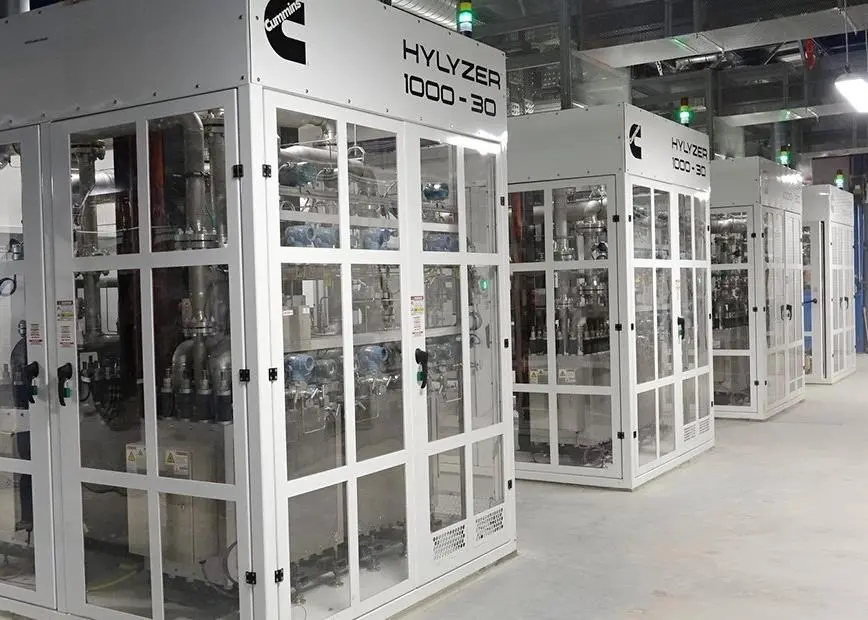
Earlier this year, Chevron U.S.A. and Cummins announced they would explore a strategic alliance to develop commercially viable business opportunities in hydrogen and other alternative energy sources. The companies will initially collaborate on four main objectives: advancing public policy that promotes hydrogen as a decarbonizing solution for transportation and industry; building market demand for commercial vehicles and industrial applications powered by hydrogen; developing infrastructure to support the use of hydrogen for industry and fuel cell vehicles; and exploring opportunities to leverage Cummins electrolyser and fuel cell technologies at one or more of Chevron’s domestic refineries.
Cummins has deployed more than 2,000 fuel cells and 600 electrolysers around the world, and in July, the company began testing a hydrogen-fuelled internal combustion engine. The technology involves all new engine platforms equipped with the latest technologies to improve power density, reduce friction and improve thermal efficiency, allowing Cummins to avoid the typical performance limitations and efficiency compromises associated with converting diesel or natural gas engines over to hydrogen fuel. Following proof-of-concept testing, the company plans to evaluate the engine in a variety of on- and off-highway applications. The hydrogen engines can use green hydrogen fuel, produced by Cummins-manufactured electrolysers, emitting near zero CO2 emissions through the tailpipe and near zero levels of NOx.
Related Articles
 CARBON CAPTURE
 CARBON CAPTURE
 ALTERNATIVE FUELS & LUBRICANTS