



US REINVESTS IN GULF RAILFERRY LINK
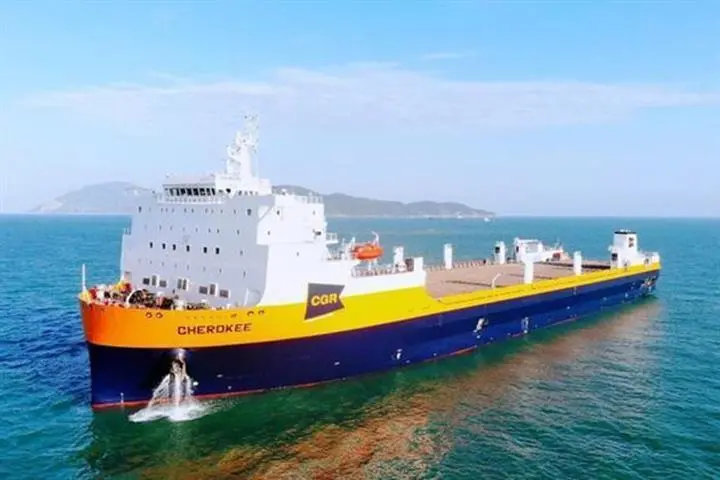
On a length of 180m and wide beam of 36.6m, the recently commissioned Cherokee is reckoned to be the world’s largest rail ferry, incorporating 2,500m of track on two decks for 135 rail wagons of 57ft (17.4m). She is the first of a pair of bespoke newbuilds to supersede two 1982-built vessels that have maintained the connection between Mobile, Alabama, and the Mexican port of Coatzacoalcos in Veracruz since the opening of the service in 2001.
Maintained by Jacksonville-based CG Railway, the joint venture of rail group Genesee & Wyoming and diversified marine transportation company Seacor Holdings, the operation provides a 956-mile crossing of the Gulf of Mexico as an alternative to the 2,200 rail mile cross-border routing, or 1,600 highway mile port-to-port journey.
Cherokee and future consort Mayan, which is expected to make her debut in November, will cut the transit time from the present five days to just three days, by virtue of being capable of making 14 knots, twice the speed of the existing ferries. The much faster transits, enabling more sailings every month, in conjunction with an increase in load intake from 115 to 135 units, will hoist route productivity and capacity, raising CG Railway’s potential annual railcar handling volume by 40%.
At the same time, the standard of marine engineering technology accessible to the project ensures compliance both with the new order of emission regulations and with the environmental criteria now being stipulated by customers through their supply chains.
Construction of the newbuilds was entrusted to China State Shipbuilding Corporation’s Huangpu Wenchong Shipyard, using a design prepared by Shanghai Merchant Ship Design & Research Institute (SDARI). China’s now vast and multifarious industrial production network has ensured predominant reliance on home-sourced equipment and machinery, albeit with recourse to propulsion technology licensed from Europe.
The Cherokee class employs Tier III-compatible twin main engines giving direct drive to twin screws. The installation is based on a pair of MAN small-bore diesels of the S35ME type in its B9.5 iteration. The six-cylinder models selected are of the EcoEGR version and are each rated for 4,800kW at a crankshaft speed of 155rpm. The machinery was produced under licence by CSIC Diesel Engine Company.
For Tier III engines with exhaust gas recirculation, EcoEGR is a specific fuel oil consumption (SFOC)-optimised variant of the EGRBP bypass-matching system that is available on all ME-C engines with high-efficiency turbochargers. Overall SFOC is lowered significantly without increasing NOx emissions. This is obtained by using the new tuning method simultaneously to operating the EGR with 10-15% recirculation in Tier II mode, and with slightly increased recirculation in Tier III setup compared to the standard EGR control.
Each drive train culminates in an Alpha controllable pitch propeller, manufactured by Zhenjiang Tongzhou Propeller Co, another MAN licensee.
The three main gensets are of domestic design, comprising two 1,164kW models of the HFCS 632-84E type and a singleton HFCS 634-84K of 1,330kW, all emanating from Zhenjiang China Marine-Xiandai Generating Co.
Twin variable pitch propellers and twin flap rudders, plus a 500kW bow thruster, confer the necessary manoeuvrability for berthing the ship stern-to at the terminals in the US and Mexico. The beam of 36.6m was determined by the two-tier, six-track shore linkspans.
The forward position of the bridge and accommodation block means that a short section of the upper freight deck, otherwise completely open, is protected from the elements. The funnel casing aft is offset on the port quarter, ensuring unimpeded six-lane track access. As the number of tracks increases to 10 and eight, respectively, on the upper and main deck, the onboard rail layout incorporates multiple switchpoints. The main deck tracks are interposed by three lines of pillars supporting the weather (upper) deck.
The design not only fulfils the need for swift turnarounds at the terminals, but also overcomes the technical challenges associated with a double-deck configuration (unusual in railships) and addresses the heeling moments introduced when wagons are being rolled aboard on the outer tracks. In addition, particular attention has been paid to the integrity of the freight lashing arrangements for the heavy, laden rail cars, given the demanding conditions that can be encountered in the Gulf on the year-round sailing schedule.
Among the notable examples of long-term thinking employed in the new ships is a clutch of features spurred by Covid-19 and possible future such scenarios, as in the segregated passageways for local pilots and other visitors and separate HVAC systems to quarantine crew. Protecting customers’ supply chains from potential disruptions fits with a design and operational strategy that emphasises service dependability and reliability, on a par with realising new efficiencies.
The Mobile/Coatzacoalcos seaway railroad route currently transports approximately 10,000 carloads of widely varying commodities annually, serving shippers in Canada as well as the USA and central and southern Mexico. Freight includes chemicals and plastics, sugar, steel products, and pulp and paper.
The 175m vessels being replaced, Banda Sea and Bali Sea, started life as semi-submersible heavy-lift ships before conversion into rail ferries. Cherokee took up duty with the southbound sailing on September 12, taking over from Bali Sea.
PRINCIPAL PARTICULARS
Cherokee
|
Length overall |
180.0m |
|
Length bp |
176.8m |
|
Breadth, moulded |
36.6m |
|
Depth, moulded |
10.0m |
|
Draught, design |
6.7m |
|
Draught, scantling |
7.0m |
|
Deadweight, maximum |
21,903t |
|
Gross tonnage |
31,417t |
|
Displacement |
34,555t |
|
Track laneage |
2,500m |
|
Railcar capacity |
135(of 57ft) |
|
Main engine power |
2 x 4,800kW |
|
Speed |
14.4kts |
|
Auxiliaries |
2 x 1,164kW + 1 x 1,330kW |
|
Class |
ABS |
|
Class notations |
+A1, Vehicle carrier, E, +AMS, +ACCV |
|
Additional notations |
PMP, RW, BWT, IHM, TCM, UWILD |
|
Complement |
25 |
|
Registry/flag |
Majuro/Marshall Islands |
Related Articles
 PROPULSION
 GENERAL NEWS
 HYDROGEN