



ESD SUPPLIERS SEE REGULATORY FACTORS FANNING INTEREST
It is a sign of maturing interest in fuel efficiency technology that customers are moving beyond technical discussions towards detailed discussions about the economics of investments. The payback periods are already within two to five years, before taking into account potential future rises in fuel prices, or the imposition of carbon surcharges.
“We cannot wait for new propulsion technologies or future fuels but need to act now reduce emissions as much as possible,” said Marc Sima, co-founder and CEO of Fuel Save GmbH in Germany.
Sima said that interest in the company’s products was being pushed by the increasing focus on fuel efficiency. Maersk McKinney Centre for Zero Carbon Shipping had said in late October said that the global shipping industry would not be able to meet a target of net zero emissions by 2050 without a levy on fuel to encourage the use of alternative fuels. This has emphasized the need to act now, Sima noted.
Sima distinguished between the wider market, where certain sectors such as container shipping were coming under intense pressure from large customers to reduce their net emissions, and FuelSave’s own business.
The largest market for FuelSave at the moment is the offshore oil & gas industry, where tightening environmental regulations in certain markets are creating a need to reduce emissions, Sima concluded.
Sima noted that economics of investing in efficiency devices were changing in the commercial shipping market. The FS+ system was particularly well suited to vessels with high hotel loads or large auxiliary draws, such as cruise ships or vessels that spend a significant amount of time on dynamic positioning. He noted that those were precisely the vessel types that were likely to be most affected by the carbon intensity index (CII).
“We aim for a payback time of three years and below and try to only focus on such projects where this is feasible,” Sima told The Motorship.
The actual payback time depends on numerous factors, such as the usage of the ship, the load and operational profiles, the annual fuel oil consumption, the emission tax area, the fuel oil price etc. “The higher the fuel oil cost, the faster the return on investment,” he summarised.
FuelSave technology
The company, founded in 2012, started business by focusing on how to reduce emissions from trucks and utility vehicles, but quickly expanded its scope to include the maritime sector. Its FS Marine system uses intelligently controlled hydrogen syngas generator and injector, which combine proprietary gas injection with other processes to enhance the efficiency of diesel engines.
The system reduces fuel consumption between 10% and 15%, cuts CO2 emissions by about the same amount, filter smoke number (FSN) by 40% and NOx by between 30% and 80%, the company says. Engine wear and tear will also be reduced by the use of the system, which cuts maintenance and repair costs.
Waste Heat Recovery
Other energy saving devices, such as waste heat recovery technologies, are also reporting increasing demand. The rise in LNG-fuelled shipping is increasing interest in waste cold recovery as an additional source of efficiencies, while expectations of higher fuel prices for alternative fuels in the future are also fanning interest.
Orcan, another German technology group that offers energy saving solutions to the maritime industry, points out that there are four sources of waste heat that can – and should – be used to generate electricity. These are exhaust gases, jacket cooling water, thermal oil and waste steam. Its efficiency PACK can generate between 100 kW to 200kW of electricity per module and each module can cut CO2 emissions by up to 450 tonnes per year.
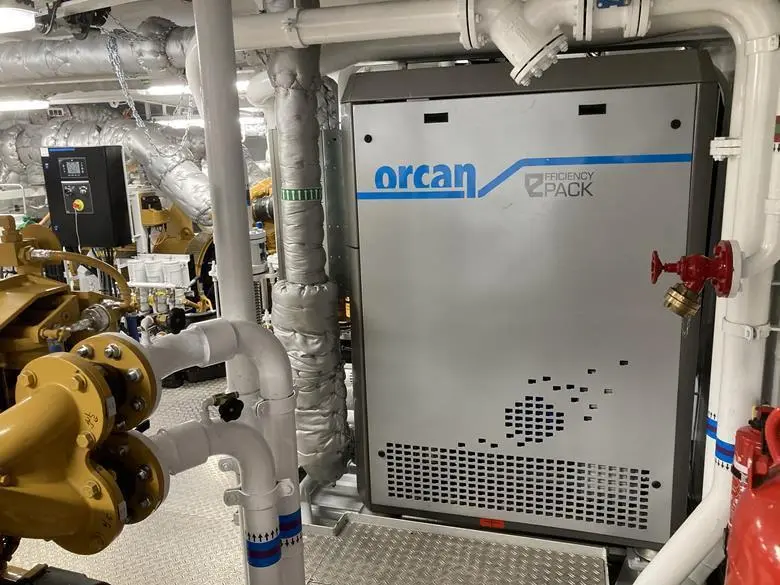
The company ran a development project of marine products jointly with MTU, the diesel engine builder, from 2014 to 2017 and the first system was installed on a Dutch hybrid propulsion domestic ferry in 2017. The product rollout took place last year and more than 20 projects are currently in development.
“Typically, we target an internal rate of return of up to 20, or a payback of two to four years, or in case of a newbuilding ship, the installation must create a positive accumulated cash flow from day one of operation. Assets are financed, so fuel savings minus finance cost must be positive from day one,” said Marcel Flipse, Head of Marine Applications at Orcan.
A payback time between three and five years is the target for Climeon, a provider of energy efficiency technology, headquartered in Stockholm, Sweden. Running hours, available waste heat, fuel type, whether the ship in question is a newbuilding or retrofit and generator type all affect the payback time, said Fredrik Thoren, Head of Maritime at Climeon.
Its waste heat recovery technology, the Climeon Heat Power System, uses principals of an Organic Rankine Cycle (ORC), but at much lower pressure levels.
“The patented low-pressure technology allows for optimal efficiency from low-temperature heat sources such as jacket cooling water. Exploiting the temperature difference between the hot and cold water sources, Climeon’s Heat Power System produces usable electric power for the ship’s electrical demand, reducing the load on the ship’s generators,”
A control system automatically and continuously ensures that the power output is maximised or optimised, based on site preferences.
“The system’s compact and modular design offers the highest efficiency conversion of low-grade waste heat within the ORC market, and its ability to utilise sea water as the cooling source, allows for simple integration with the vessel’s existing systems and makes it highly suitable for marine applications,” he told The Motorship.
As a proven technology since 2015, the Climeon Heat Power System has received approval from major certification companies and helped ship owners like the Finnish cruise ferry company Viking Line and Virgin Voyages to increase their energy efficiency, saving fuel costs and reducing impact on the environment.
“We have had a pilot installation Climeon Ocean 100 installed on Viking Grace – this was the first generation of Ocean system with a nominal power output of 100 kW (maximum 120 kW). This installation was a part of EU project, so the cost of equipment and installation received an EU contribution,” recalled Kari Shao, Project Manager at Viking Line.
Generates 700 MWh per year on large cruise ferry
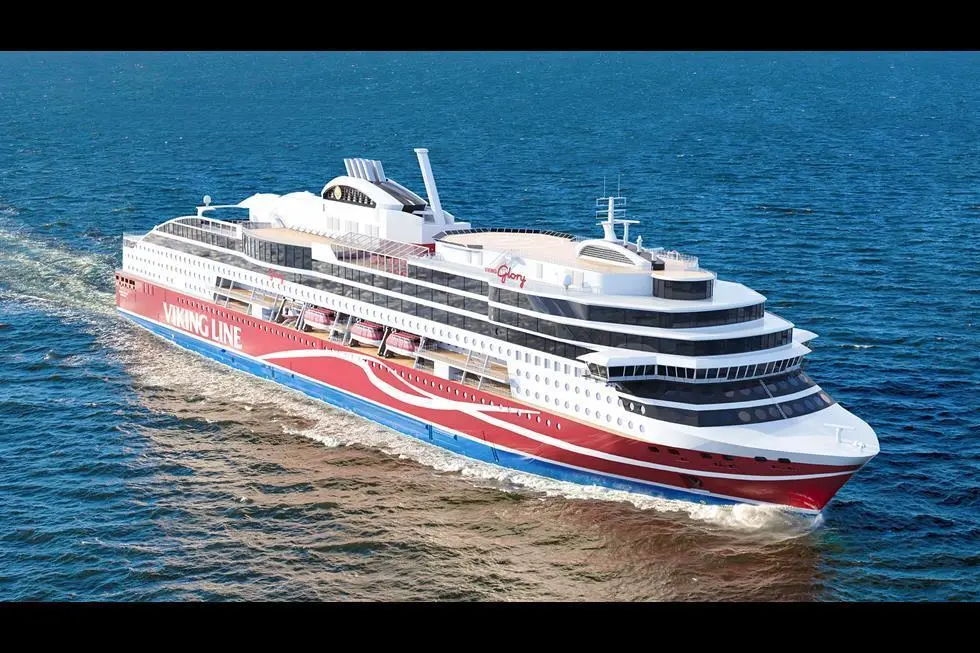
Viking Grace is a 57,565 gross ton cruise ferry that entered service in 2013. It was one of the first large dual fuel engine passenger ships and it has used LNG as fuel since entering service. Shao is now project manager for Viking Glory, a 63,000 gross ton newbuilding nearing completion at the Xiamen shipyard in China.
“Viking Grace was, already before installing Climeon Ocean, the world’s most environmentally-friendly passenger ferry. With the Climeon Ocean this was further improved. The Climeon Ocean system was installed in 2015 on Viking Grace and has proven to deliver more than 700 MWh of electricity per year from heat that otherwise should be wasted. This corresponds to almost 300 tons of CO2 saving per year, and a payback time including integration costs of less than three years,” Shao pointed out.
Viking Grace is powered by four eight cylinder Wartsila 50 DF engines with a combined output of 30,400 kW that drive electric motors connected to two propellers.
With the system fully deployed, one ship has the potential to save up to 750 tons of fuel and up to 1,900 tons of CO2 per year. “On Viking Glory we have the new model of this ORC and what’s new is a steam turbine,” Shao noted.
Shao declined to comment on the payback period for the installation, citing commercial confidentiality, as Viking Line was not involved in the equipment procurement.
However, Shao acknowledged that there is a great interest in cost effective fuel efficiency equipment. The speed with which regulations are introduced appeared to be outpacing the development of new technology, Shao said, adding that the company had specified that Viking Glory should have this state-of-the-art technology installed.
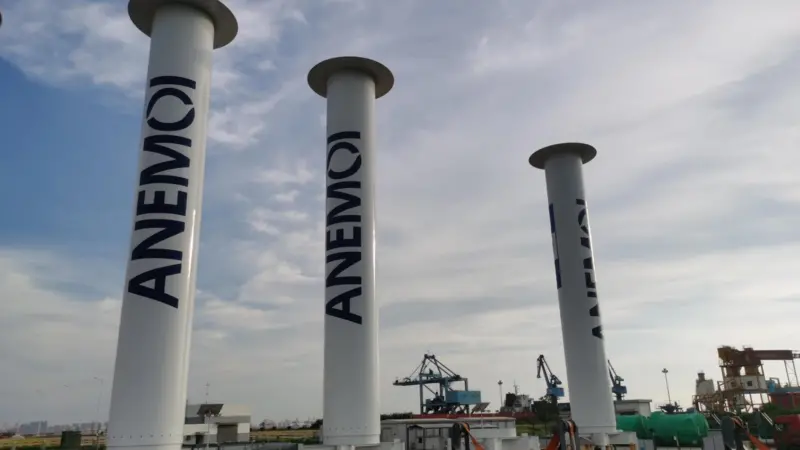
“To inform the public about this technology is a little more difficult when it’s not visible as a sail or solar panel,” Shao concluded, referring to an experiment to use a Norsepower rotor sail on Viking Grace.
Related Articles
 ENERGY SAVING DEVICES
 ENERGY SAVING DEVICES
 AMMONIA