



More Demand And Demand For More, Says ABB

Early fuel cell projects were small demonstrators on small vessels, he said. But now, “we see more and more projects being announced that are reaching megawatt scale,” he told The Motorship.
Back in April 2020 he was quoted in an ABB statement in which he foresaw “fuel cells being scaled up from a few hundred kilowatts to megawatts by 2022 to 2023” and he stands by that prediction.
He cited a number of projects currently out for tender that will require fuel cells of that size, including a bulk carrier for HeidelbergCement – a concept that won Norway’s biennial Heyerdahl Award for environmental maritime innovations in March this year – and a tender announced in November last year to provide a fuel-cell-powered ferry to link Bodø and Moskenes on Norway’s west coast, for which batteries are not an option because of the distance involved.
For its own part, ABB has linked up with US-based fuel cell manufacturer Ballard. Bogan said this collaboration brought together Ballard’s fuel-cell expertise with ABB’s knowledge of marine applications, “so I think we have a good match in knowhow and competence”.
Ballard has a ‘Marine Centre of Excellence’ in Denmark and acknowledges on its website to being “actively involved in a number of marine projects, including megawatt-scale marine power solutions with ABB”.
One of those projects – announced in November 2020 and reported by The Motorship at the time – is to develop a hydrogen fuel cell powered ferry for Danish operator DFDS that is planned to enter service between Copenhagen and Oslo in 2027.
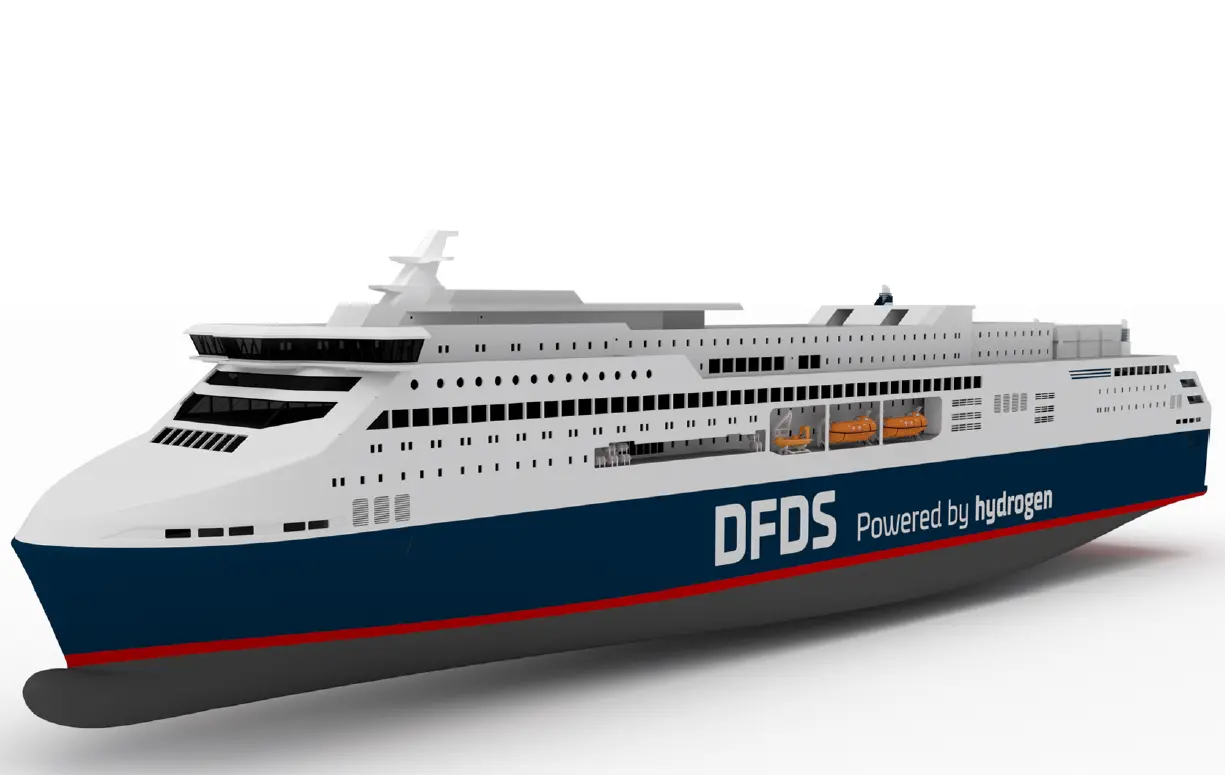
The 2,300-pax, 2,300 lane-m, vessel will require 23MW of power from its fuel cells, a step change from current technology that DFDS CEO Torben Carlsen described at the time as “a monumental task”. The cells will use hydrogen produced using green electricity from offshore wind turbines.
ABB does not make fuel cells but that will change. The company signed a memorandum of understanding with hydrogen specialist Hydrogène de France (HDF) in April 2020 to jointly manufacture megawatt-scale fuel cell systems based on the hardware it has developed for the marine sector with Ballard.
Construction work on the factory has started, Bogan said in late October, and he expects fuel cell production of the ABB/Ballard units to start during 2022, alongside HDF’s own manufacturing programme, which is focused on land-based fuel cell applications. “We are looking to produce our megawatt fuel cells there in the future”, he said.
ABB is involved in a number of fuel cell projects for which it provides the control system, including the DFDS project. Another – announced in July – involves EDGE Navigation and Ulstein, which are working on a container ship concept that will use Ballard fuel cells.
Meanwhile, it is working with the Norwegian research organisation SINTEF, which has a research lab in Trondheim where the two organisations have installed a complete power plant including diesel engines, batteries and fuel cells to allow tests to verify control strategies for different equipment configurations. One outcome of this has been understandings relating to both CAPEX and OPEX in relation to optimising the lifetime and efficiency of fuel cells, Bogan said.
Related Articles
 ALTERNATIVE FUELS & LUBRICANTS
 ALTERNATIVE FUELS & LUBRICANTS
 ALTERNATIVE FUELS & LUBRICANTS