



PEM Fuel Cell Demonstrates Maritime And Land Potential
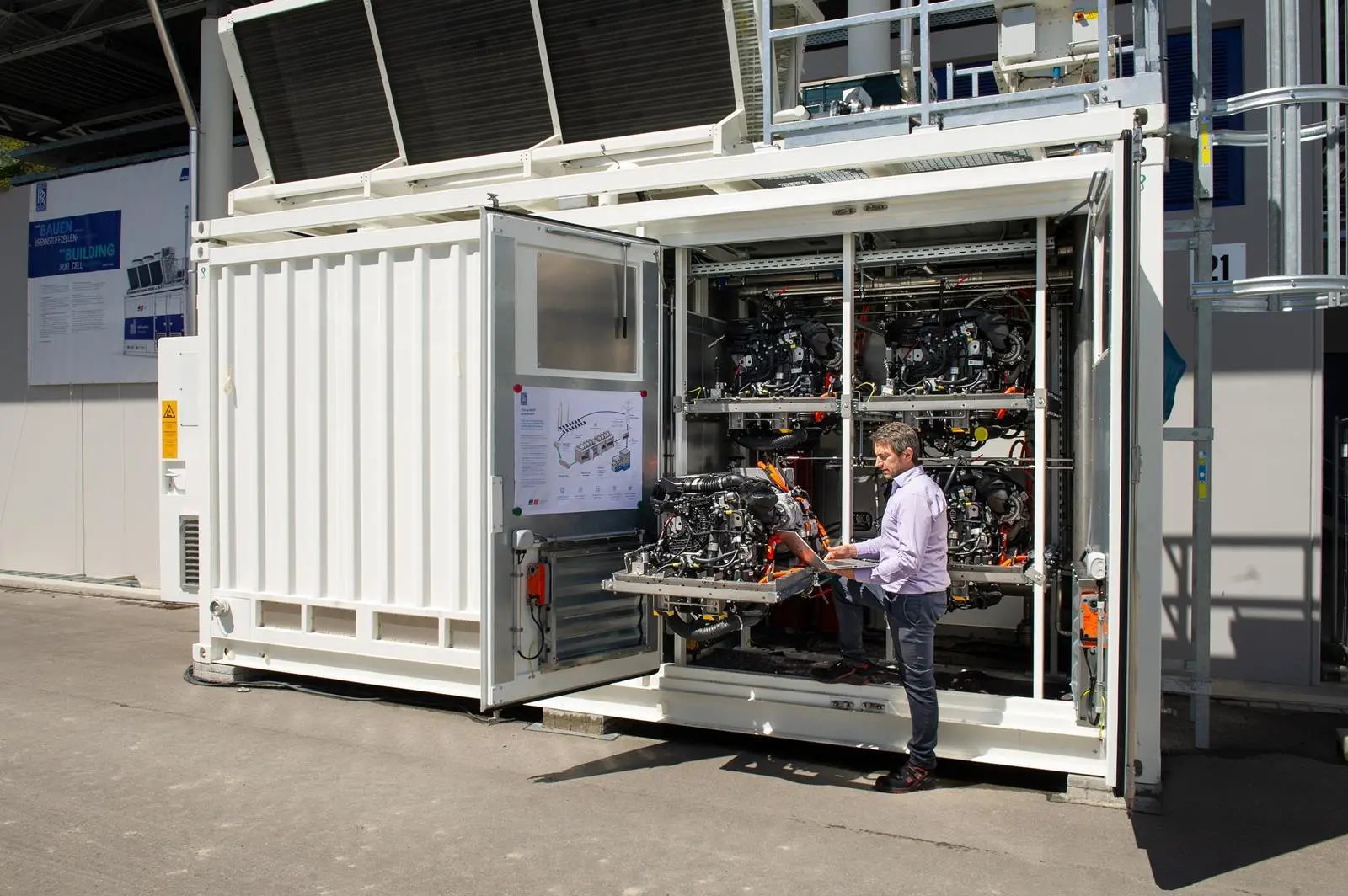
Speaking to The Motorship, he described that achievement as “a great story of success” and said that the system was now being tested as part of its commissioning.
When the installation was announced in June, it was described as being a demonstrator to ensure electricity supplies, and a valuable part of the investment has already been realised: hydrogen infrastructure had to be put in place, requiring construction permits to allow fuel cells to be operated in urban environment. “That’s an effort all our customer will face in the future,” he said.
It uses four automotive polymer electrolyte membrane (PEM) fuel cell modules and a battery has been included in the set-up to simulate an uninterruptible power supply for a data centre, which Gorse said was “the most challenging application for a for battery/fuel cell system since it takes all the load in a millisecond”.
The demonstrator’s cell/battery arrangement is applicable to marine applications because it is comparable to an onboard requirement for both propulsion and hotel loads. He acknowledged that the demonstrator’s output is quite low, but its design is modular, he said, “so we can upscale it to several megawatts if needed”.
“Without changing the architecture, we will be able to double the power [and] combine more to get a megawatt installation”, he said. In addition, he believes that fuel cell technology will advance over the next five years, allowing them to offer fuel cell combinations “in the power range of 1-5MW easily.”
Another valuable learning point from the work so far “is how to partner with someone”, he said. “We are convinced the market will take up in this decade and if we do not hurry up, the market will take up without us.” So it is collaborating with Cellcentric, which is a joint venture of Daimler Trucks and Volvo Trucks which is exploring a fuel cell solution for the trucking industry. “We can use their experience, product quality and volumes in our in our markets to get a cost competitive and good quality product,” he explained. “Now it’s operational experience we want to get!”
Partnerships will also be key to bring it to the marine market, because regulations for marine applications are different from those applied to stationary purposes. “We will have to collaborate with class societies and customers who operate the ship to make it compliant”, he said.
He is currently looking for partners – both shipowners and fuel suppliers – for a proposed demonstrator ship with a target keel laying date of 2024. This will enable shipowners, crew and the fuel logistics sector to learn the practicalities of operating such a ship and for Rolls-Royce to learn how shipowners will use fuel cells.
At the moment, he said, some are anticipating using fuel cells to replace an auxiliary genset in a conventional machinery plant; others are considering the same, but in a diesel-electric system; and some are looking for a fuel cell propulsion system.
Related Articles
 ALTERNATIVE FUELS & LUBRICANTS
 ALTERNATIVE FUELS & LUBRICANTS
 ALTERNATIVE FUELS & LUBRICANTS