



Consortium to marinise Greek HIWAR gas reformation technology
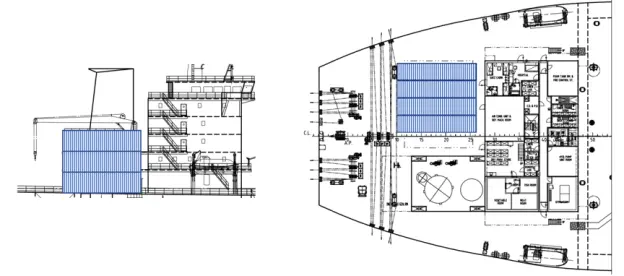
The consortium, which also includes an unspecified energy major, believes it could accelerate the development of hydrogen as a marine fuel without the need for extensive infrastructure investment.
The difficulties and costs associated with the production, distribution and storage of hydrogen on board are barriers to adoption for hydrogen as a fuel. By producing hydrogen on board from LNG, the solution offers a potential route to exceed IMO 2050 targets for 70% reduction of carbon intensity in a much shorter time frame.
The concept is based on Helbio’s patented Heat-Integrated Wall-Reactor (HIWAR) technology, which combines the ship’s fuel (natural gas) with steam to produce hydrogen and CO2. The hydrogen produced would be used directly in a mix with natural gas in internal combustion engines or in fuel cells, thus eliminating the need for hydrogen to be stored onboard. The Motorship notes that the system can produce hydrogen with a purity of up to 99.999%, making it compatible with PEM fuel cell requirements.
The Motorship notes that the use of gas reformation technologies to generate hydrogen on board have been successfully developed and installed on board vessels previously. However, the use of such solutions has been limited to comparatively low volume solutions, such as FuelSave’s FuelSave+ system, where the hydrogen has been used as an accelerant in combustion processes in diesel-fuelled engines.
HIWAR technology
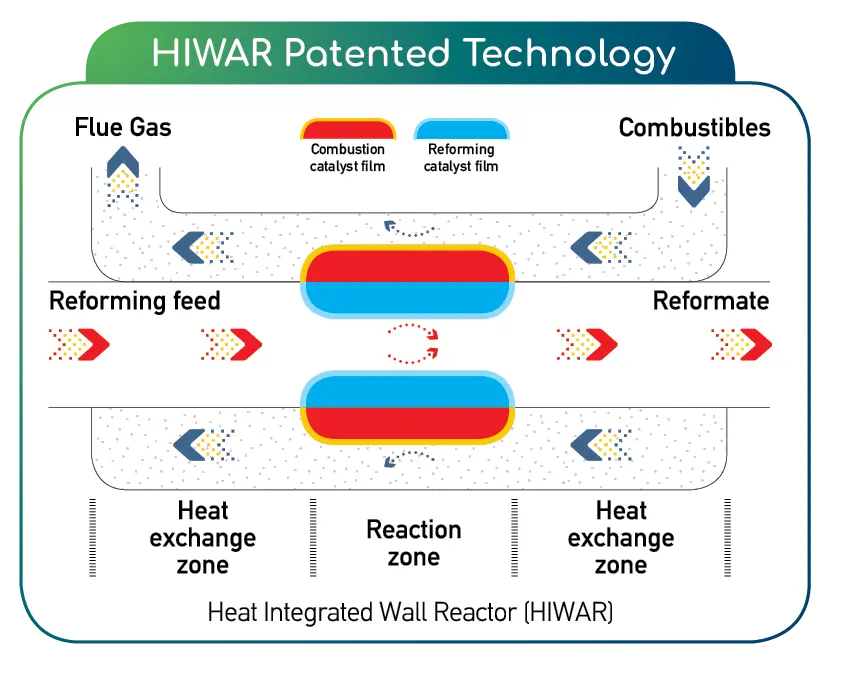
The HIWAR concept employs metal plates coated with a suitable catalyst arrayed so that exothermic and endothermic reactions take place on either side of the plate. The heat produced by combustion is conducted through the metallic walls towards the endothermic reaction of steam reforming, which take place at the opposite side of metal plate.
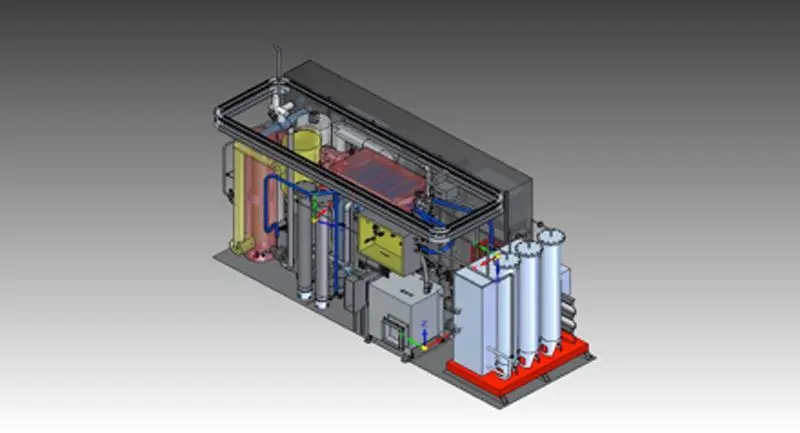
Helbio claims that the CPR (catalytic plate reactor) design offers superior heat transfer characteristics and minimal intra-catalyst diffusion resistance compared with conventional reactors. As a result, HIWAR reactors are smaller, lighter and have superior pressure drop characteristics compared with conventional alternatives.
The company has also developed proprietary catalysts that improve the reformation of fuels, both in the steam reforming step and in the subsequent partial oxidation step. During the latter step, the CO2 will be liquefied by the cryogenic stream of LNG that would be used as fuel anyway and stored on board for later disposal ashore for carbon storage and use. In case of tankers, the stored CO2 can also be used as inert gas.
RINA notes that the necessary steam reformation and CO2 liquefaction equipment can easily be fitted on the deck of a commercial vessel in a progressive manner, at subsequent drydocks after the ship’s delivery. The proportion of hydrogen consumed could be progressively increased by increasing the production of hydrogen on board, with a corresponding reduction in methane consumption (and associated methane slip).
Consortium
Wärtsilä and ABB will support the application of hydrogen in powering internal combustion engines and fuel cells respectively, while Helbio will provide the technology and manufacture the reformer. RINA and Liberian Registry will provide advice and guidance on the application of rules and regulations for novel concept alternative designs, based on Hazid/Hazop analyses, as well as specific rules for this kind of arrangement.
The Motorship notes that Helbio’s HIWAR technology has already won orders for other applications, meeting manufacturing and safety standards applied in other industries. Helbio announced that it had successfully produced a Hydrogen Generator with a hydrogen production capacity of 50m3/h in June 2021. The generator was expected to be installed in Sweden in Q4 in a pilot installation for an automotive hydrogen refuelling station.
Related Articles
 ALTERNATIVE FUELS & LUBRICANTS
 ALTERNATIVE FUELS & LUBRICANTS
 ALTERNATIVE FUELS & LUBRICANTS