



Reports of propeller shaft bearing damage increasing
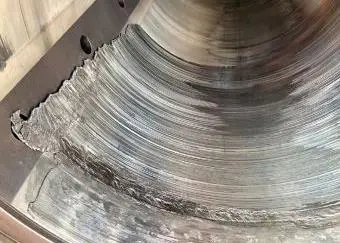
According to DNV data, partial or complete wiping of aft bearings has become increasingly prominent, concurrently with leaking propeller shaft aft seals – in many cases either as a contributory factor or a consequential event.
The issue can arise after continued operation with contaminated and/or degraded lubricant, typically arising out of a leaking aft seal; lowering of design and/or operating margins, i.e. shaft alignment sensitive installations operating with EALs; operational factors, e.g. incomplete propeller immersion; life cycle fatigue; or other events adversely influencing shaft alignment such as groundings.
Sealing ring arrangements
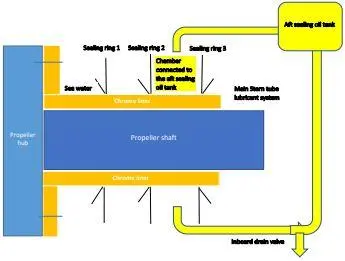
A typical shaft aft sealing arrangement (pictured) features a small barrier chamber space between sealing rings 2 and 3. The classification society notes that the proportion of seawater content in oil in the space and associated aft sealing system can be inherently high even during normal operation.
When operating with EALs, this may increase the risk of probable biodegradation and accelerated deterioration of the lubricant quality in this system beyond the oil maker’s recommended limits for continued use
The class society advises that one of the typical signs of deterioration of EAL quality involves elevated levels of TAN (total acid number), most commonly resulting from hydrolysis of unsaturated esters.
This can result in an increased risk of damage to sealing rings. If ring 3 deteriorates, and the sealing function opens the gateway to water contamination of the main stern tube bearing lubricant system, risking bearing/shaft damage and/or leakage of oil to the sea.
By comparison, there is a lower risk of similar issues with mineral oil installations, as the mineral oil in the chamber between rings 2 and 3 is not prone to a similar degree of deterioration under similar operating conditions. Besides, mineral oil properties also allow better water separation and drainage inboard.
DNV rules include verification of tightness of the shaft sealing arrangement periodically as part of bottom and propeller shaft-related surveys.
Recommendations
DNV recommends:
- Monitoring and regulating the EAL quality.
- Ensuring that samples are representative so that lubricant analysis results reflect the actual condition of the system.
- Undertaking prompt actions if main stern tube system lubricant analysis reveals elevated levels or an increasing trend of water content, TAN, bearing and/or shaft material wear elements, etc.
As a proactive measure for EAL applications on older vessels, consider the use of oil with the next higher viscosity grade above the design oil viscosity or optimise the aft bearing design to fulfil the latest DNV shaft alignment rules.
Related Articles
 ALTERNATIVE FUELS & LUBRICANTS
 FUELS & LUBRICANTS