



Mitsubishi Shipbuilding establishes decarbonisation group
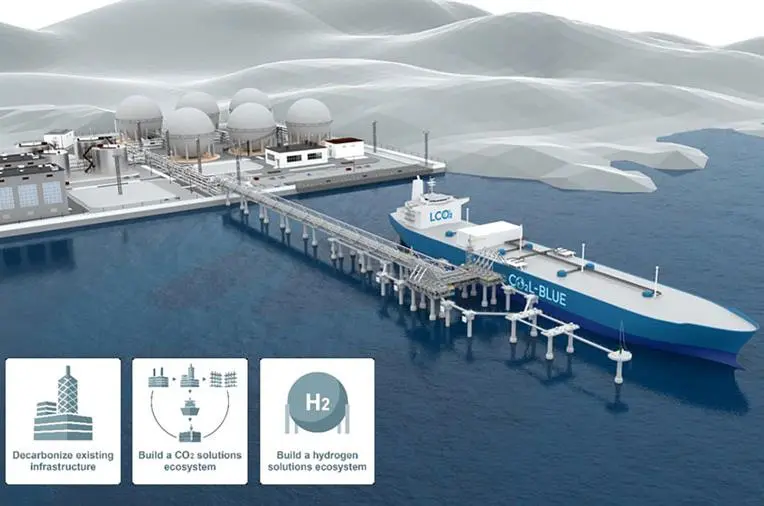
The new organization will consolidate a range of functions including technology development, market research and the formulation and implementation of business strategies.
MHI/Mitsubishi Shipbuilding has built over 5,000 vessels since its founding in 1884, actively adopting new technologies as a pioneer in the construction of energy carriers, including coal carriers, oil tankers, and liquified gas carriers. The recent drive for decarbonisation will require a transition to new energy, and premised on global trade, demand is expected to increase for clean energy carriers for ammonia and other materials, as well as liquid CO2 carriers to support reverse logistics for fossil fuels.
Toru Kitamura, President and CEO of Mitsubishi Shipbuilding said: “We have received numerous inquiries from customers regarding growth sectors such as LCO2 carriers and ammonia fuel vessels, and we need a dedicated organization to coordinate the technological innovation and handle this business. The establishment of the Marine Decarbonation Business Development Group will accelerate the pioneering of new businesses that utilise and apply the oil and gas technologies possessed by Mitsubishi Shipbuilding, and in combination with conventional shipbuilding technologies, allow us to achieve ‘organizational ambidexterity.’”
As part of the energy transition strategy promoted by MHI Group, Mitsubishi Shipbuilding has set a growth strategy called “MARINE FUTURE STREAM,” focused on the ship and marine sector. In this strategy, the company has set goals for the decarbonisation of the maritime economy through clean energy and the carbon cycle, the effective utilization of the marine space with digitalization and electrification, and the generation of new ideas through marine-related innovation.
In November 2021, Mitsubishi Shipbuilding and NYK Line agreed to jointly develop a large liquid CO2 carrier and participate in the carbon capture and storage value chain.
In January 2022, ClassNK has issued an Approval in Principle for the design of an 80,400dwt ammonia-fuelled Panamax bulk carrier developed by Japan’s Planning and Design Center for Greener Ships – Mitsubishi Shipbuilding is a member of the Center.
The industry has recognised the need for revolution if the goal of putting near zero-emission vessels on the water by 2030 is to be met, said Mr. Kazuki Saiki, Deputy Manager, Strategic Planning & Operation Office at Mitsubishi Shipbuilding.
Related Articles
 ALTERNATIVE FUELS & LUBRICANTS
 ALTERNATIVE FUELS & LUBRICANTS
 ALTERNATIVE FUELS & LUBRICANTS