



Hard Sail to be installed on new bulk carrier
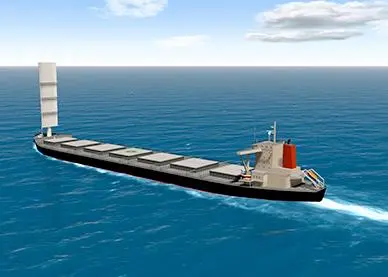
The telescoping sail system was jointly developed under the “Wind Challenger” project at the Oshima shipyard. The additional propulsion power it provides can reduce a vessel’s GHG emissions by an estimated 5% for a Japan to Australia route and 8% for a Japan to North America route compared to conventional ships of the same class.
The sail is made of glass fibre reinforced plastic, a light-weight material that has been used to maximise sail size an minimise impact on vessel stability. The sail extends, retracts and rotates automatically in response to wind characteristics detected by sensors, using hydraulic pumps for sail expansion and electric motors for sail rotation.
The system will be installed on a 235-metre bulk carrier currently under construction at Oshima Shipbuilding after shoreside tests. The vessel is slated for delivery this fall after sea trials and will transport cargo for Tohoku Electric Power.
The Wind Challenger Project started in 2009 with the “Wind Challenger Plan,” an industry-academia joint research project led by The University of Tokyo. MOL and Oshima Shipbuilding received Approval in Principle for the hard sail system from ClassNK in 2019.
The companies are considering the use of the sails on bulk carriers, tankers and LNG carriers of different sizes. However, car carriers are not suitable due to their high freeboard.
Related Articles
 ENERGY SAVING DEVICES
 ENERGY SAVING DEVICES
 AMMONIA