



Mitsubishi Shipbuilding and MOL complete conceptual study of ammonia FSRU
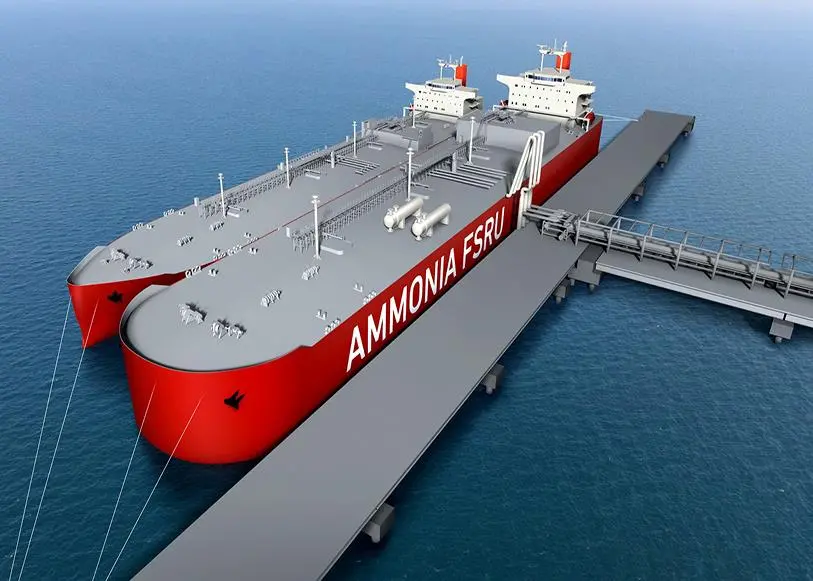
The study aims to promote the use of ammonia as an energy source that contributes to decarbonisation and the introduction of ammonia FSRU all over the world.
The ammonia FSRU is a floating facility for receiving and storing ammonia which is transported in a liquid state from its production area and the stored ammonia is then heated and regasified onboard for transfer to an onshore pipeline. Ammonia FSRUs can be built at a lower cost and in a shorter time than onshore ammonia storage and regasification plants, say the companies, and so can contribute to an early and stable supply of ammonia fuel.
In the newly completed conceptual study, Mitsubishi Shipbuilding conducted multiple case studies of FSRUs which have different specifications according to the ammonia’s supply conditions, regasification method, tank capacity, etc., in order to respond to a wide range of demands, and eventually developed designs for more environmentally friendly ammonia FSRUs. The study also covered the feasibility of using ammonia fuel to generate the power required for the operation of the FSRU itself.
Mitsubishi Shipbuilding recently concluded a memorandum of understanding (MoU) with MOL and The Kansai Electric Power Co. to jointly examine the possibility for future introduction of ammonia FSRUs.
Ammonia is currently mainly used as a raw material of fertilizers, and although the volume available for maritime transportation is limited, demand is expected to increase in the future as a next-generation clean energy that does not emit CO2 when burned.
Last year, Mitsubishi Heavy Industries (MHI) joined Lloyd’s Register’s Decarbonisation Hub, A.P. Moller-Maersk, MAN Energy Solutions, NYK Line, Total and the Mærsk Mc-Kinney Møller Center for Zero Carbon Shipping on a new project to guide the safe use of ammonia as a fuel for shipping.
Related Articles
 ALTERNATIVE FUELS & LUBRICANTS
 ALTERNATIVE FUELS & LUBRICANTS
 ALTERNATIVE FUELS & LUBRICANTS