



Bunkering: The Other Side Of The Efficiency Equation
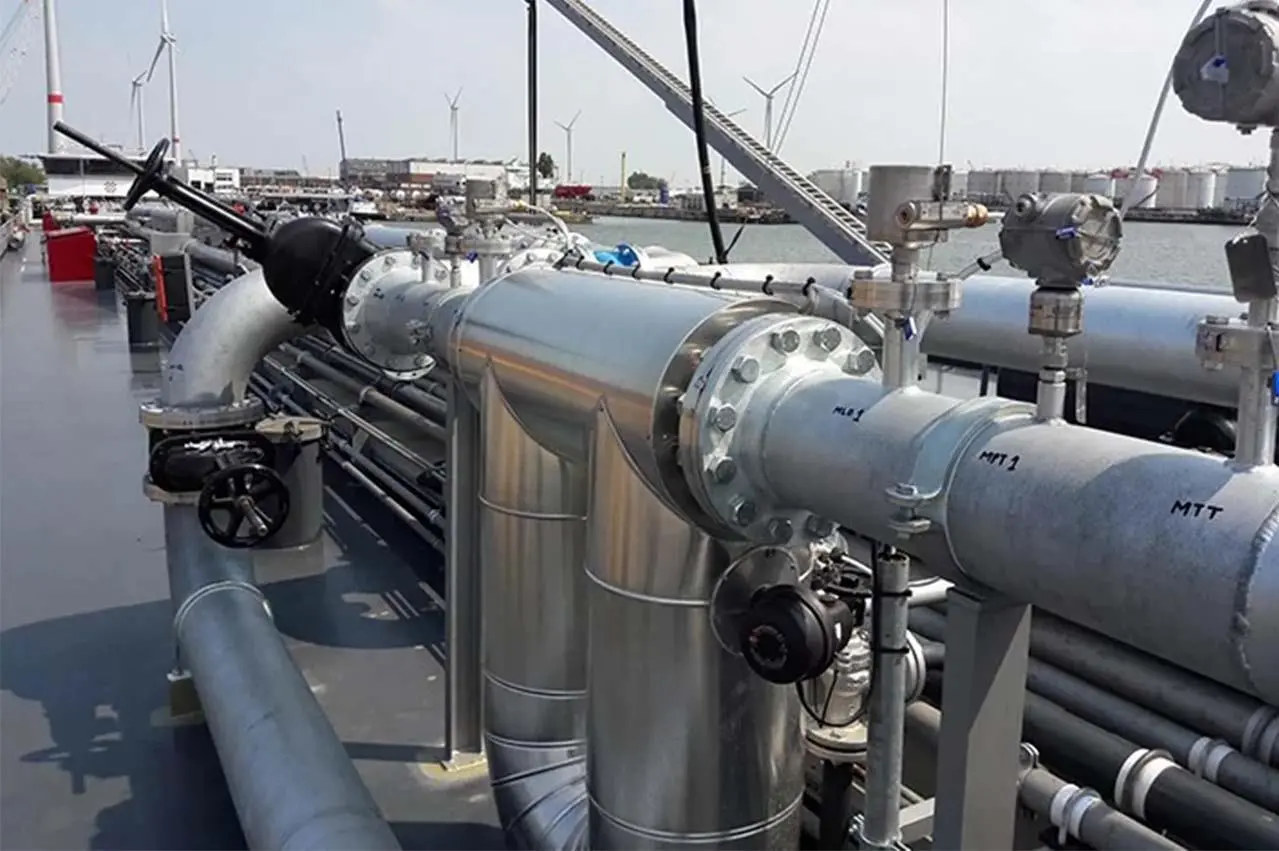
While the introduction of mass flow metering systems into the bunker market remains comparatively slow, outside Singapore which mandated the use of MFMS in 2017, ship owners and some trade bodies are continuing to push for their use.
Armelle Breneol, ExxonMobil’s Marine Fuels Technical Advisor, noted that interest in MFMS systems was not confined to larger sized vessels operating on time-sensitive schedules. “I’m aware of customers who are stipulating that fuel should only be delivered via MFMS systems,” Breneol told The Motorship, adding that operators of smaller-sized vessels were also expressing interest.
The advantages of using mass flow meters over existing methods of measuring stems include improved accuracy, to within a margin of +/-0.5%, as well as the elimination of potential causes of human error.
Errors can be introduced by human error during traditional tank dipping, or simply during the conversion of volume into mass, or by errors in measuring temperature or density.
Breneol added that ports, such as Singapore, that had introduced requirements for the use of mass flow metering systems had benefited from increased efficiency and shorter bunkering durations. “We can say that barges using mass-flow meters require 1-3 fewer hours to complete a bunkering operation than barges using free manual tank measurements,” Breneol said.
Aside from the operational efficiency gains, the use of mass flow metering systems also improves the transparency of fuel bunkering. The quantity can be simply read from a printed ticket that is attached to the BDN and any quantity disputes can be swiftly resolved by showing the delivery profile during the whole delivery timeline, Breneol adds.
There were additional benefits from an assurance perspective, as the calibration and security of the system’s pipelines could be independently certified.
The tip of the iceberg?
While testing agencies regularly publish data around fuel quality issues, including data around ports and geographies, there is significantly less transparency about fuel quantity disputes. “These disputes tend to occur between buyers and sellers, typically,” Eddie Fish, Market Development Advisor, Aviation & Marine Fuels at ExxonMobil noted.
As a result, it has been challenging for ExxonMobil to obtain quantitative data about the frequency of fuel quantity disputes.
ExxonMobil commissioned a brief survey of readers within a bunkering focused maritime publication last year to assess how frequently its readers experienced quantity issues relating to bunkering, and how frequently these issues resulted in disputes.
While the sample size was too small for the survey to be statistically meaningful, the survey revealed that around half of respondents had frequent quantity disputes. A second question, relating to the proportion of respondents who allowed the majority of quantity disputes to go unchallenged, revealed that 35% of respondents left more than 50% of quantity challenges.
Only 17% of respondents reported bunkering disputes to the relevant authorities, according to the survey. This meant that port authorities themselves were likely to have an incomplete overview of the scale of the problem, The Motorship notes.
The commercial logic behind leaving disagreements over smaller volumes was self-evident, particularly where the charter rate of the vessel meant it would not be cost-effective, Fish said.
A follow-up survey was expected to be launched by IBIA before the middle of February to gather a wider cross-section of responses. The Motorship notes that quantitative data about the frequency of quantity disputes could help to derive a base line to assess the potential reduction in disruption associated with the introduction of MFMS systems.
Aggregated reporting requirements
Fish notes that beyond the direct financial implications of variations between documented and physical delivery volumes, inaccurate bunkering data would distort vessel efficiency calculations. “How accurate can an assessment of a vessel’s emissions really be… if you’re already 5% out from the bunker ticket from the beginning?”
The improved transparency around bunker movements could also help suppliers to report their bunker volumes to port authorities faster.
The implications of variations in bunker delivery tickets are set to expand over the coming years, as regional and IMO regulations increasingly intend to incentivise energy efficiency through financial means. The IMO is considering introducing a financial element to the CII index from 2027, The Motorship notes, without discussing the potential implications for regional schemes, such as the EU’s Emissions Trading System, which will rely on declarations via the EU’s MRV system.
Related Articles
 ALTERNATIVE FUELS & LUBRICANTS
 FUELS & LUBRICANTS