



New Blue-Chip Reference For Methanol Fuel
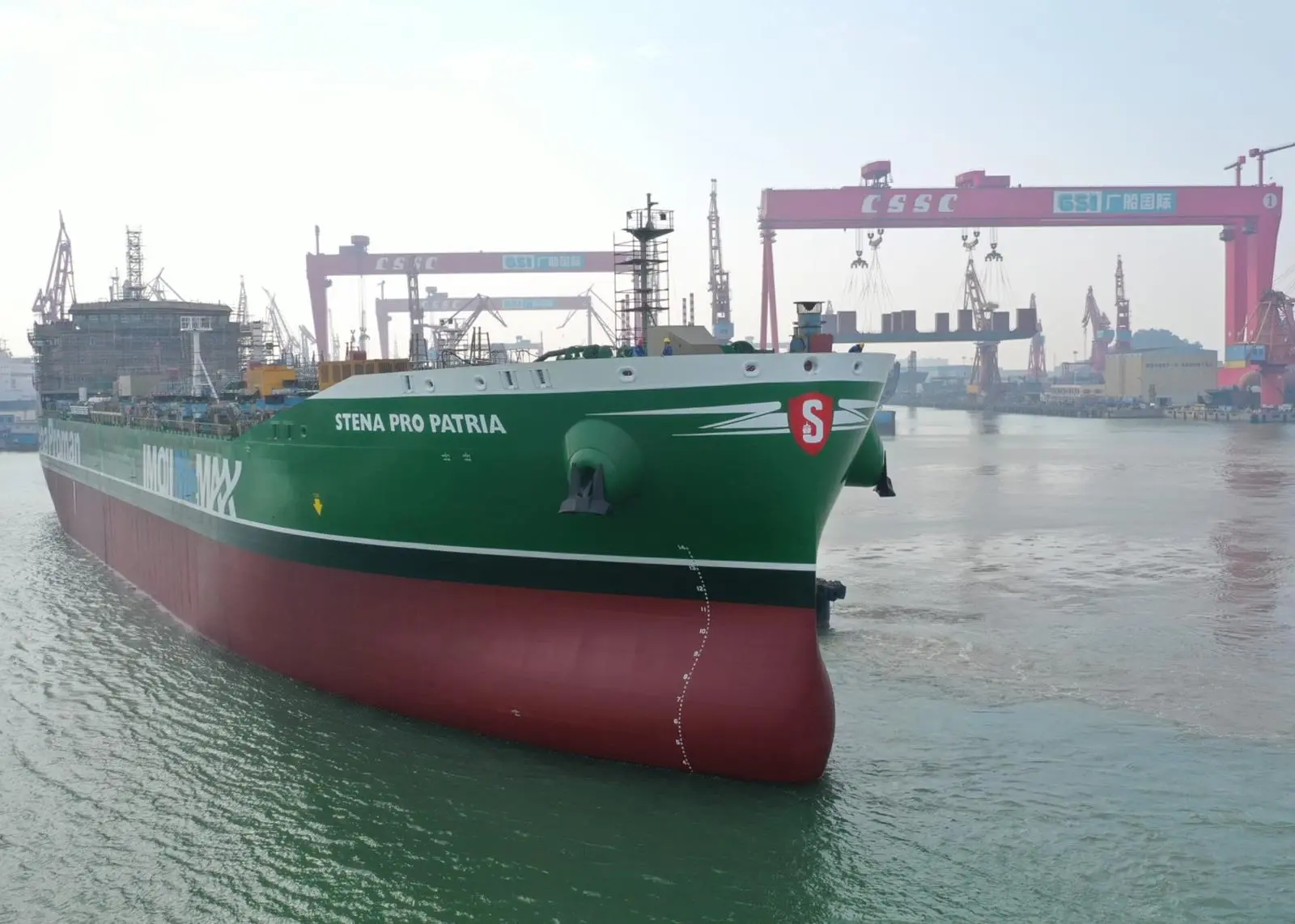
Currently fitting out in China, the 49,900dwt Stena Pro Patria will give first form to the IMOIIMeMAX design, the enhanced, dual-fuel version of the innovative IMOIIMAX generation delivered between 2015 and 2018, ranking among the most energy efficient medium-range tankers in existence. The versatile, IMO Type 2 newbuild will also operationally inaugurate the collaboration agreement struck in 2019 between the Swedish company and the Swiss-headquartered energy firm Proman, the world’s second largest producer of methanol.
Three such vessels have been ordered from Guangzhou Shipyard International (GSI) by the Stena Proman joint venture, while a further three newbuilds of the class have been booked at the Chinese yard to Proman’s own account.
The IMOIIMeMAX type perpetuates the features and qualities of the IMOIIMAX, but with the addition of methanol dual-fuel power. Stena Teknik and GSI were jointly responsible for drawing up the IMOIIMAX design, subsequently produced as a 13-ship series led by the Stena Impression in January 2015.
IMOIIMAX coupled increased cargo flexibility with reduced fuel consumption resulting from scrutiny of every sphere of energy usage. The aggregate effect of the combination of technical solutions adopted was a 10-20% reduction in energy consumption compared with other vessels of a similar size.
Each of the original series is fitted with a 6S50ME-B9.3 diesel engine, featuring low-load optimisation and exhaust gas bypass. Keeping faith with the marque, and using a similar engine structure and footprint, Stena Bulk and its partner have opted for a new development in dual-fuel powering. In this, the tanker programme provides a further reference for the latest iteration of MAN Energy Solutions’ ME-LGIM dual-fuel two-stroke engine design, the LGIM-W type, which burns a mixture of methanol and water.
Incorporating a special blending system, the addition of water to the methanol fuel achieves Tier III NOx compliance, without needing exhaust gas recirculation (EGR) or selective catalytic reduction (SCR). Methanol is not only a sulphur-free fuel, thereby virtually eliminating SOx emissions, but is also less pollutant in CO2 terms than conventional fuels.
The actual model fitted in the tanker, and as specified for each of the subsequent vessels, is a six-cylinder G50ME-C9.6-LGIM-W, to run on methanol while affording the capability to operate on conventional marine fuel, allowing seamless changeovers between fuels. The so-called ‘grey’ methanol that the ship will bunker is produced using natural gas as feedstock, but the engine type provides for future use of ‘green’ methanol derived from renewable sources. The vessel is expected to use some 12,000t of methanol per annum.
The power map for the six-cylinder engine nominated extends from 6,120kW at 79rpm, at the L4 rating point, to a nominal maximum continuous output of 10,320kW at the L1 rating, conferring substantial choice as to the contractual specification. In the case of the preceding IMOIIMAX tankers, the 6S50ME-B9.3 engine had been specified at 7,211kW, although the model’s nominal MCR was 10,680kW.
The Stena Pro Patria’s crosshead engine gives direct drive to a four-bladed propeller, abaft of which is a hub vortex absorbing fin to recover energy losses.
Clean nitrogen produced by a nitrogen generator, rather than ‘traditional’ inert gas and the associated generator, is used to facilitate the tank cleaning process and decrease the time between discharge and loading. Deriving gas for inerting purposes from a nitrogen generator is also claimed to be more efficient compared to an inert gas generator-based supply.
As befits its IMO Type 2 designation, the chemical/product carrier caters to a very wide range of cargoes, including vegetable oils, clean and dirty petroleum products, chemicals and caustic soda. The ship’s 16 cargo tanks and two slop tanks are uniform in filling capacity at 3,000m3, the maximum for Type 2 status. The large number of moderately sized tanks plus the wherewithal for eight segregations allows multiple cargo load configurations, conferring a ‘parcel’ carrying capability.
The handling system is based on 18 individually controlled deepwell pumps, rendering a high throughput rate and flexibility in cargo circulation. The tank cleaning arrangements are such that four tanks can be washed simultaneously using a layout that minimises shadow areas and contributes to expeditious turnaround times.
Stena Pro Patria and the second Stena Proman jointly-owned vessel, Stena ProMare, will enter long-term charter to Proman Shipping. Third-of-class Stena Prosperous will initially be utilised within Stena Bulk’s traded pool, for a period of two or three years, and will therefore be the first methanol dual-fuel tanker traded on the chemicals/clean petroleum products market without an active contract to a methanol producer. Thereafter, she will be engaged on long-term timecharter with Proman Shipping, which is based in Wollerau, Switzerland.
The second trio, for Proman ownership, will be named Provident, Progressive and Promise. The delivery schedule is due to be completed by the end of 2023.
The IMOIIMeMAX generation will transport methanol and other cargoes from Proman’s production hubs in Trinidad & Tobago and the USA to markets around the world, and will maximise the scope to handle a broad variety of products for backhauling.
As well as offering a pathway to reduced emissions, methanol is viewed as a cost-competitive fuel available at all major bunkering ports.
MAIN PARTICULARS – IMOIIMeMAX tanker, Stena Pro Patria
|
Length overall |
186.0m |
|
Breadth, moulded |
32.3m |
|
Depth, moulded |
18.5m |
|
Draught, scantling |
13.0m |
|
Corresp. deadweight |
49,900t |
|
Draught, design |
11.5m |
|
Corresp. deadweight |
42,500t |
|
Cargo capacity |
54,000m3 |
|
Main engine |
MAN 6G50ME-C9.6-LGIM-W |
Related Articles
 ALTERNATIVE FUELS & LUBRICANTS
 ALTERNATIVE FUELS & LUBRICANTS
 ALTERNATIVE FUELS & LUBRICANTS