



AiP granted for zero-emission bulk carrier
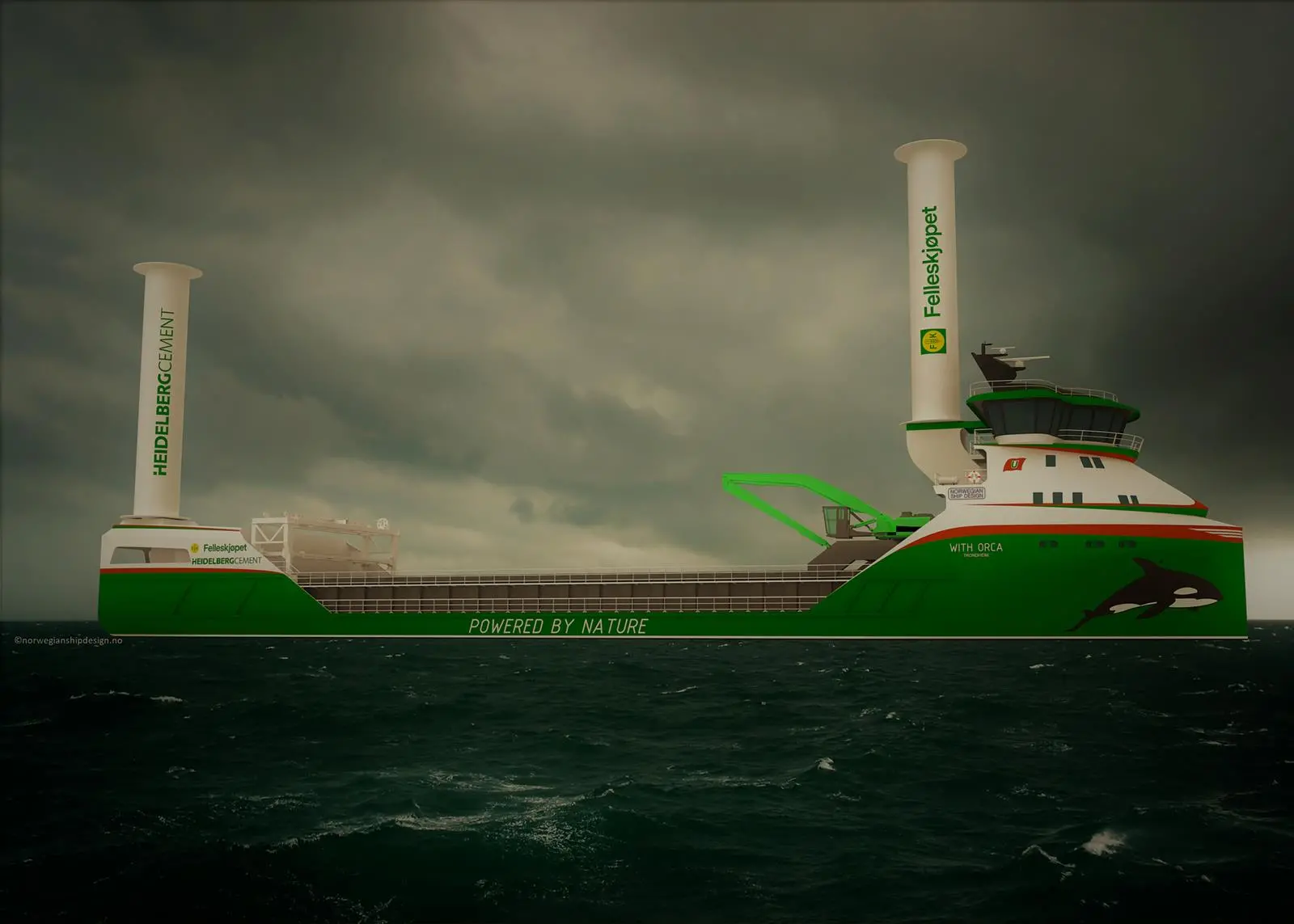
The vessel, designed by Norwegian Ship Design, is planned to enter into a long-term transport contract with cargo owners Felleskjøpet Agri and Heidelberg Cement. It is scheduled to enter operation in early 2024.
With Orca will be fully zero-emission in all operations. It will be powered by hydrogen, stored onboard in compressed form, and the hydrogen combustion engine will be optimised for increased efficiency. The vessel will also have a fuel cell system for energy production in low load conditions. The hydrogen will be supplied by Statkraft.
A significant part of the energy required to operate the 88 m/5,500 tonne vessel will be harvested directly from the wind through two large rotor sails. The vessel also has the ability to store excess energy in batteries.
The vessel’s sailing route will mostly be in open waters in the North Sea, where weather conditions are ideal for wind-assisted propulsion. With Orca will combine the cargoes of Heidelberg Cement and Felleskjøpet, carrying aggregates from western to eastern Norway and grain in the opposite direction.
LR awarded the AiP after completion of a risk-based HAZID certification.
Ivar Ulvan, Owner and Project Manager of Egil Ulvan Rederi, said: “Receiving the AiP from Lloyd’s Register is an important milestone for us. We have been working with the project for more than 1.5 years, and the AiP confirms that we have made good design choices in our effort to create a safe, efficient and feasible concept. We have learned a lot in the process towards the AiP, and LR has been very professional. We want to highlight their facilitation of the HAZID, which was skilfully carried out to an impressive level of detail. We look forward to continue working towards realising this ground-breaking project.”
LR is actively involved in a number of maritime decarbonisation projects through its Maritime Decarbonisation Hub.
Two hydrogen fuelled RoPax ferries expected to enter service in 2025 are being designed by Norwegian Ship Design. Crossing the Vestfjorden between Bodø on the mainland and three islands in Lofoten involves a close to 100 kilometres of open ocean crossing above the Arctic Circle and is considered Norway’s most challenging ferry crossing. The two ferries currently operating the routes will be converted from using LNG to use biofuels, and they will accompany the new ferries in the summer tourist season. The two hydrogen fuelled ferries will operate year-round and will require 5-6 tonnes of hydrogen daily – only “green” hydrogen is used.
Related Articles
 ALTERNATIVE FUELS & LUBRICANTS
 ALTERNATIVE FUELS & LUBRICANTS
 ALTERNATIVE FUELS & LUBRICANTS