



Hebridean Ferry Order In Line For Turkey
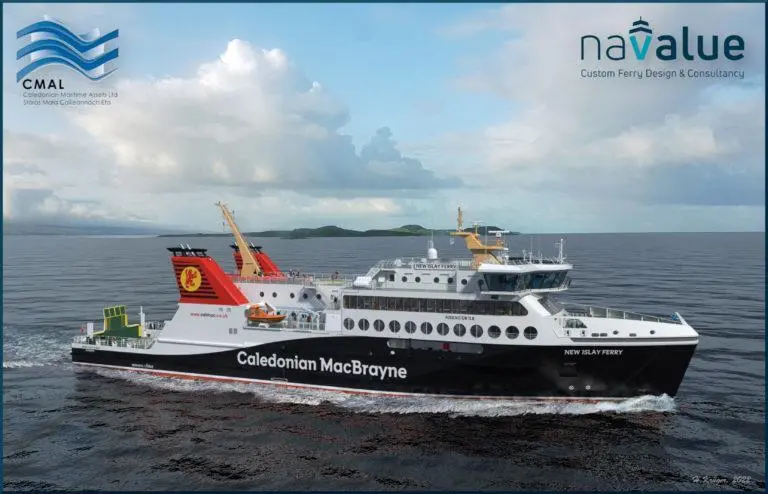
Cemre Marin Endustri has been named as the preferred bidder for the deal with Caledonian Maritime Assets (CMAL), which will assign the ships to its Caledonian MacBrayne (CalMac) fleet. Formalisation of the contract will follow a 10-day standstill period, with deliveries expected by October 2024 and early 2025, respectively.
CMAL had invited four overseas builders to bid for the ships, the Scottish nationalised yard of Ferguson Marine having been excluded from the shortlist. The endorsement of foreign construction also comes hard on the heels of the UK Government’s launching of a refreshed National Shipbuilding Strategy, with its ambition of bolstering the home industry.
The new CalMac vessels will replace the two existing ro-pax mainstays on the lifeline service between the Kintyre peninsula on the Scottish mainland and Islay, from where a connection is provided to the neighbouring island of Jura. Realisation of the project will secure an approximate 40% increase in vehicle and freight capacity on the Islay routes, and achieve a major advance in fuel efficiency.
German technical consultancy navalue, based at Flensburg, has been retained for the concept design. It is understood that the incoming ships will be specified with a diesel-electric power and propulsion system, to incorporate a hybrid element in the shape of a bank of lithium-ion batteries. Azimuthing propulsors will be used, and the requirement for exacting manoeuvring will call for two bow thrust units.
In reference to the project and the Islay routes, Scottish Minister for Transport Jenny Gilruth said “These links are some of the busiest services for freight on the Clyde and Hebrides network , and the new vessels will help grow the island’s economy, as well as bring added resilience to the (CalMac) fleet. This underlines the Scottish Government’s commitment to bringing in new ferries to support our island communities. We want to continue to see progress on bringing vessels into service on time and budget.”
The latter comment is significant, given the considerable delays and escalating costs associated with the two 102m ro-pax ferries under construction for CMAL/CalMac at Ferguson Marine’s Port Glasgow yard. The dual-fuel newbuilds are already four years late, and present indications are that they will cost more than double the original £97m (US$127m) contract price.
It is understood that the Islay ferries from Cemre will carry about 450 passengers and 100 cars, with the scope for a freight load intake of 14 heavy goods vehicle of 34t, or 11 of 44t. The current ships on the service are the 85m Hebridean Isles, completed by the erstwhile Cochrane yard at Selby in 1985, and the 90m Finlaggan, commissioned in 2011 and built by Remontowa Shipbuilding of Poland.
Remontowa was in the final-round competition for CMAL’s latest tonnage requirement, along with Sefine Denizcilik of Turkey and the Romanian arm of Damen Shipyards Group, as well as Cemre. Successful bidder Cemre has an export-orientated orderbook, featuring large fishing vessels for Norway and a ferry for Scandlines, and its track record includes Wightlink’s 2018-built 90m passenger/vehicle ferry Victoria of Wight, distinguished by a diesel-electric/battery power and propulsion system.
CMAL’s most recent “large” ferry addition, the 118m Loch Seaforth, was delivered by Flensburger Schiffbau-Gesellschaft in 2014. Beyond the Cemre contract, the Scottish company’s fleet investment planning foresees two new freight-carrying ferries for the Northern Isles plus an extensive renewal programme covering smaller ferries.
Related Articles
 PROPULSION
 GENERAL NEWS
 HYDROGEN