



MoU inked for dual-fuel ammonia fuelled VLCCs
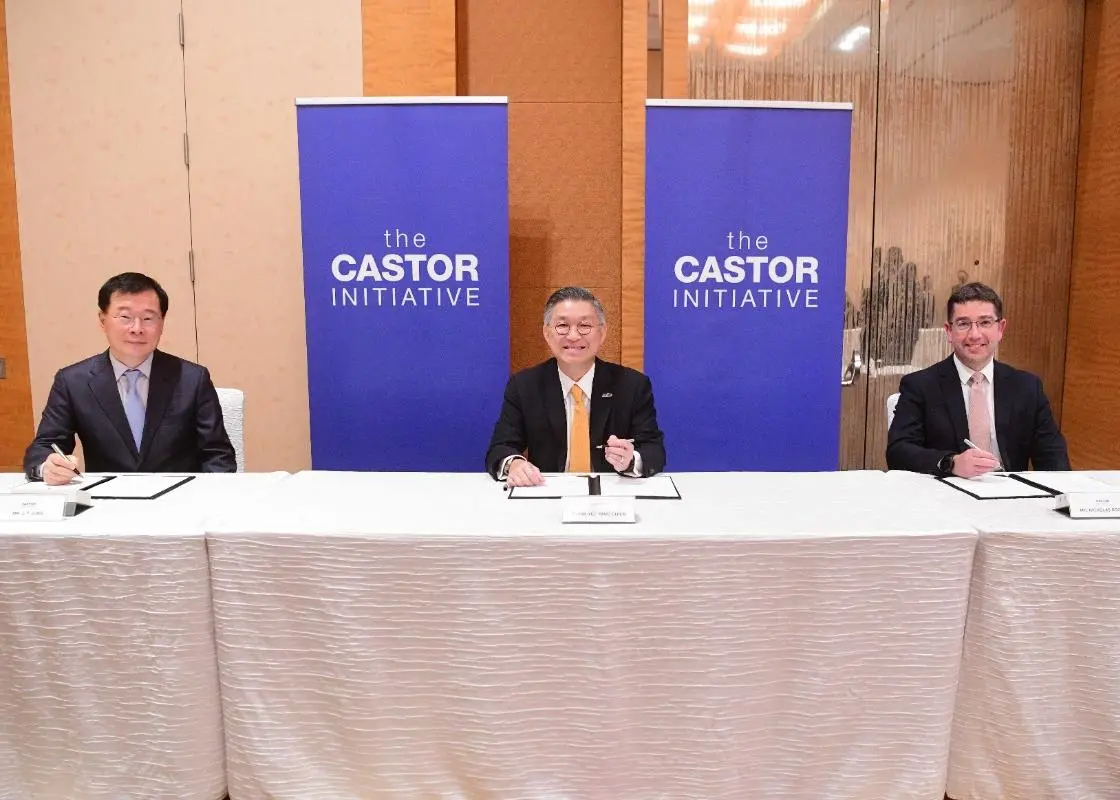
The first of the dual-fuel tankers are expected to enter into service in late 2025 and the second in early 2026. They will be owned and operated by AET.
The three companies are all founding members of The Castor Initiative, a multinational coalition committed to make zero-emission in shipping a reality, includes MISC Berhad (MISC), Lloyd’s Register (LR), Samsung Heavy Industries (SHI), MAN Energy Solutions (MAN), the Maritime and Port Authority of Singapore (MPA), Yara International ASA (Yara) and Jurong Port (JP).
Following the inking of this MOU, The Castor Initiative members will focus on identifying green shipping corridors to facilitate the bunkering of the vessels. They will also be looking into the establishment of approved training syllabus for seafarers in at least two maritime training institutions, saying it is crucial to ensure that the latest training and education is provided to the crew to enable the smooth operations of the zero-emission VLCCs.
Since the project began in January 2020, LR has made significant progress in early safety appraisals and research into the development of suitable fuel storage and supply systems, and the necessary risk assessments that will be required. In September 2021, LR awarded Approval in Principle (AiP) to SHI for its ammonia fuel supply and fuel storage system. SHI had earlier received an AiP in September 2020 for its ammonia-fuelled tanker design.
Lloyd’s Register Group Chief Executive Nick Brown said: “In 2018, Lloyd’s Register made it clear that the IMO’s 2050 emission target would require deep-sea zero-emission vessels to be entering service before 2030, and that zero-emission operation would need to become the default for most deep-sea ships delivered after 2030. Since then, we’ve seen the IPCC report of 2021 issue ‘a code red for humanity, and many call for net-zero emissions by 2050. Today’s announcement fires the starting gun for deep-sea shipping to transition to a fuel which contains no carbon molecules, and Lloyd’s Register is delighted to be supporting this transition.”
Jurong Port is home to the world’s largest port-based solar power generation facility as well as the world’s first green berths. Jurong Port Chief Executive Officer, Ooi Boon Hoe, said: “The signing of this MOU for the construction of two ammonia-fuelled very large crude carriers marks a significant milestone for deep-sea shipping’s adoption of zero- emission vessels. The shipping industry also needs the support of a robust logistics and supply chain solution ensuring the availability and delivery of ammonia as bunker. Jurong Port looks forward to exploring how we can contribute to the success of The Castor Initiative.”
Related Articles
 ALTERNATIVE FUELS & LUBRICANTS
 ALTERNATIVE FUELS & LUBRICANTS
 ALTERNATIVE FUELS & LUBRICANTS