



Ammonia import terminal planned for Rotterdam
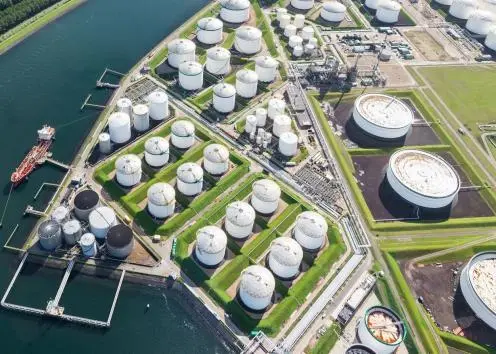
The companies have signed a cooperation agreement and are starting on the basic design of a terminal that will operate on the Maasvlakte under the name ACE Terminal. It is expected to be operational from 2026.
Demand for green hydrogen is growing in the energy sector, the transport sector and the petrochemical industry, both in the Netherlands and Germany. The companies say that an import terminal for green ammonia will make a vital contribution to the import of hydrogen, an essential link in the hydrogen chain, alongside hydrogen production, transport and storage. A reliable logistic chain is essential for developing the market for green hydrogen and for achieving the climate goals for 2030 and 2050.
At the intended location on Rotterdam’s Maasvlakte, vessels from all over the world can moor to discharge green ammonia, and in the initial phase possibly also blue ammonia. Use can be made of the existing infrastructure and the logistic facilities of the Port of Rotterdam. The site offers space for the development of an installation for converting ammonia into hydrogen. In the future, this installation will be connected to the national hydrogen network of Gasunie, that can serve the future hydrogen market in Northwestern Europe.
In addition to the production of green hydrogen in the Netherlands, the companies foresee demand in Northwestern Europe for the large-scale import of green hydrogen, in order to meet future demand. Green ammonia as a hydrogen carrier will play a vital role. Reacting green hydrogen with nitrogen forms green ammonia, allowing the hydrogen to be efficiently and safely transported in large volumes. The ammonia can then be stored and converted again to green hydrogen. Green ammonia is also immediately usable as CO2-free fuel for example for shipping or as a raw material for example for the production of fertiliser.
On the Maasvlakte, HES operates a strategic location with quayside capacity and direct access from the sea. Gasunie has infrastructure of existing storage tanks and a system of pipelines at this location. Vopak, with six ammonia terminals around the world, has extensive experience in the safe storage of ammonia.
The service proposition will entail an independent open access terminal infrastructure, in which the partners will not own the green ammonia. A market consultation procedure is soon to be launched, in which interested parties can announce their interest in the supply, storage and transhipment of green ammonia and hydrogen. Initial discussions are already underway with international market parties.
The Port of Rotterdam has joined the Joint Study Framework for Ammonia Bunkering Safety launched by ITOCHU Corporation in April this year. The 16-organisation group aims to share issues and knowledge on safety and guidelines for ammonia bunkering.
Last year, the port signed an MoU with Horisont Energi regarding setting up a corridor for transport of blue ammonia from Norway to Rotterdam. The blue ammonia, produced in Northern Norway from natural gas with carbon capture and storage, will be transported to the port for further distribution to meet expected demand in Northwestern Europe.
The Port of Rotterdam is one of the largest energy hub ports for northwestern Europe, with some 13% of total energy demand in Europe entering the EU via Rotterdam. The port has the ambition to be net zero CO2 emission in 2050 while at the same time maintaining its pivotal role in the European energy system. The demand in Rotterdam is expected to be up to 20 million tons of hydrogen, equivalent to 100 million tons of ammonia, in 2050, according to Port of Rotterdam estimates.
Related Articles
 ALTERNATIVE FUELS & LUBRICANTS
 ALTERNATIVE FUELS & LUBRICANTS
 ALTERNATIVE FUELS & LUBRICANTS