



MHI completes conceptual study for ammonia/LCO2 carrier
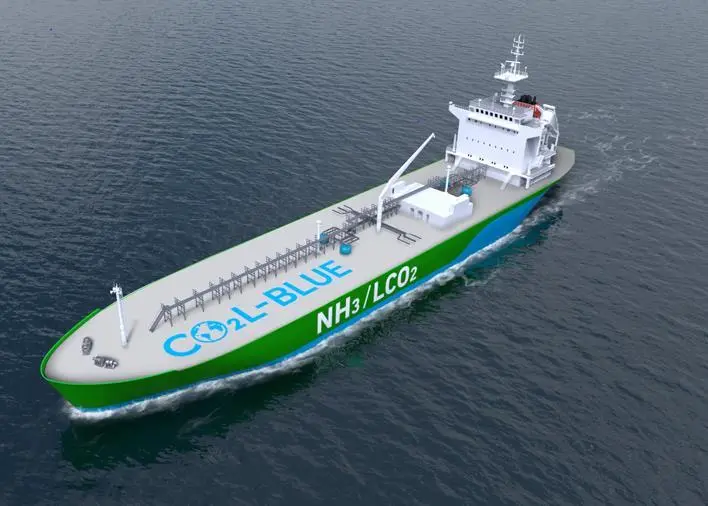
The study, conducted with Mitsui O.S.K. Lines, aims to provide the basis for a flexible vessel able to meet the projected increase in demand for transporting ammonia and LCO2. MHI Group estimates that the volume of CO2 reduction due to carbon capture, usage, and storage (CCUS) will amount to 4.3 to 13.0 billion tonnes annually by 2050.
The vessel is designed to carry ammonia on its outward journey and LCO2 on the return trip. Specific carriers for each material normally run empty on their return voyage, so a ship able to handle both substances will increase operational efficiency and contribute to enhanced transport efficiency overall.
In February 2022, Mitsubishi Shipbuilding and Sanyu Kisen agreed to build a demonstration test ship to transport LCO2. The 72-metre ship will have a tank capacity of 1,450m3 and will be built at the Enoura Plant of Mitsubishi Heavy Industry’s Shimonoseki Shipyard & Machinery Works. Delivery is scheduled for the late 2023 or early 2024.
Also in February 2022, Mitsubishi Shipbuilding and Mitsui O.S.K. Lines (MOL) completed a conceptual study of a floating storage and regasification unit (FSRU) for ammonia.
Mitsubishi Shipbuilding will continue to further develop the technology based on the knowledge acquired and technical issues encountered during this project, and in cooperation with marine-related corporations and petroleum development corporations, aims to commercialise the vessel.
As an integral part of MHI Group’s energy transition strategy, Mitsubishi Shipbuilding has established the MARINE FUTURE STREAM vision for 2050 in the ship and marine sector, setting the goals of a decarbonised marine world through autonomous operation and electrification, effective utilisation of the marine space through renewable energy and the carbon cycle, and marine-related innovation. Going forward, as a marine systems integrator, Mitsubishi Shipbuilding will continue to actively develop and commercialise LCO2 carriers, build a CCUS value chain spanning land and sea.
Related Articles
 ALTERNATIVE FUELS & LUBRICANTS
 ALTERNATIVE FUELS & LUBRICANTS
 ALTERNATIVE FUELS & LUBRICANTS