



MAN ES turns its attention to small-bore engines on its journey to new fuels
He was speaking in one of the engine designer’s ‘ExpertTalks’ webinars in late March and highlighted 2021 as “a fantastic year for ship contracting” with 32% of their total installed power specified for dual-fuel, which he expects to climb to 75% this year.
Significantly, however, most of this power share – 23%, rising to 70% this year – is for ships that cannot use their cargo as fuel, such as container ships, products and crude tankers, dry bulk and general cargo vessels. This, he said, is “the big game changer”.
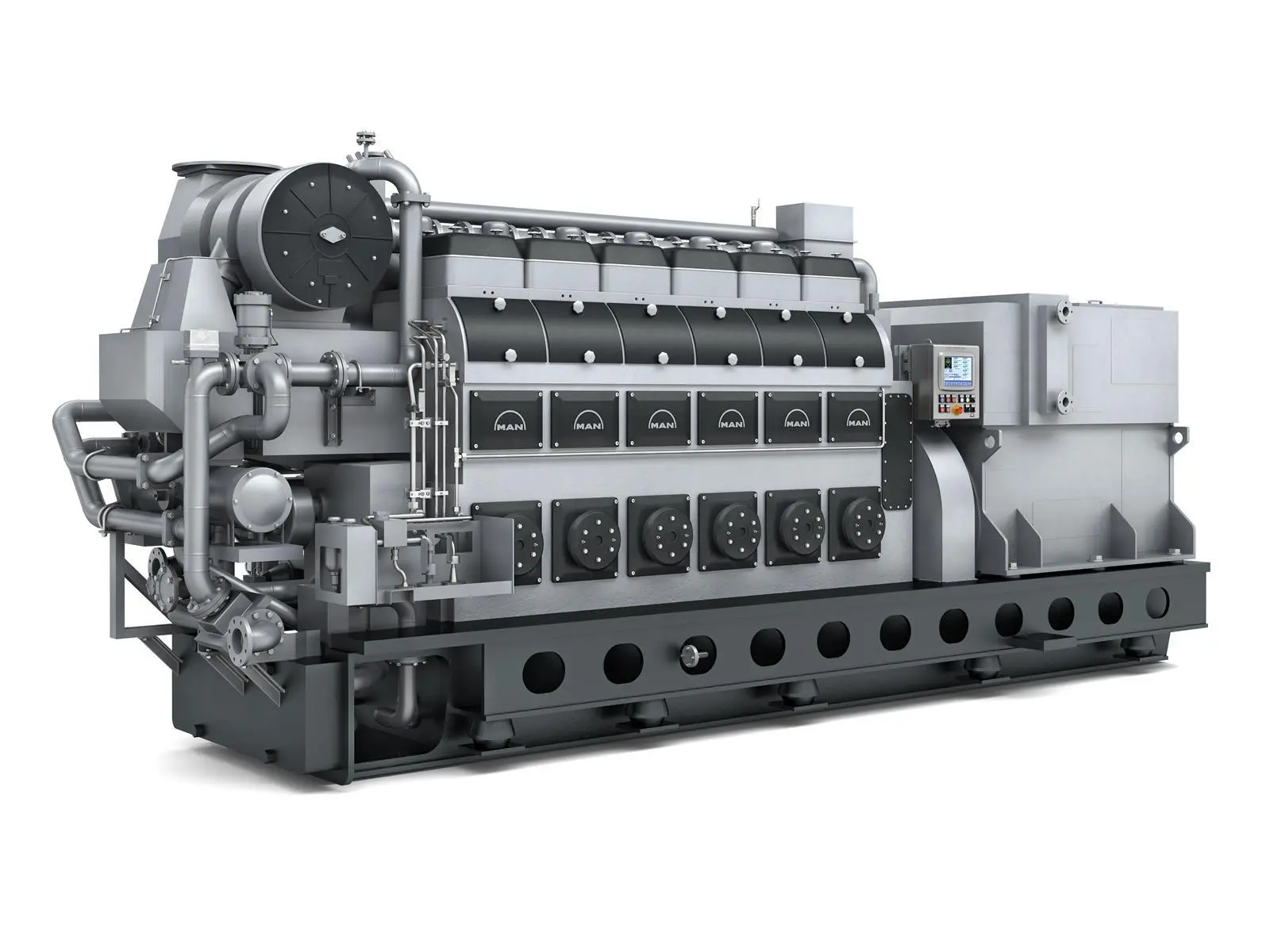
To be ready for the impact this will have on its four-stroke business, MAN Energy Solutions is “looking into all the different fuel types and analysing which may be most interesting for gensets”, he said. But already, the company has set out a possible timeline for offering four-stroke fuel options.
Hakon Juel Hansen, its promotion manager and business developer for small bore four-stroke gensets, said that at present its engines can use biofuel – such as Hydrotreated Vegetable Oil – synthetic fuel oils and methane. Next year, dual fuel methanol/diesel engines will be available followed in about 2025 by hydrogen/diesel options. In the longer term, ammonia/diesel versions will be launched (see box).
Simple and reliable
Five “crucial priorities” form the heart of its strategy for auxiliary engines, he said. They must:
● Provide a secure electricity supply;
● Have excellent dynamics (load-step performance);
● Be reliable and simple;
● Provide good combustion performance; and
● Have good consumption figures.
Mr Hansen said that providing a secure electricity supply – “we don’t want to see a black ship at 0200” – called for reliability and thus simplicity, so “our control platform for these dual fuel engines is not a sophisticated computer [or] common rail system”. Instead, “we have chosen a very straightforward, reliable, simple conventional control strategy and engine design.”
As for genset dynamics, MAN Energy Solutions’ specialist for small bore four stroke engines Klaus Petersen referred to its experience of its 28/32 DF and 23/30 DF engines, which have been on the market since 2014. Conventional diesel-only gensets could achieve 33% load steps, he said, which is also possible with its dual-fuel versions.
When increasing power, from zero to 20% load is in diesel mode, with incremental 20% load steps up to 100%, something that he said competing engines could not achieve. “It is possible to switch between gas and diesel modes even under full engine load” and the engine can run at 110% load in both diesel and gas modes, his presentation noted.
But combustion using future fuels in a dual-fuel four stroke engine is very different from in a conventional diesel engine, Mr Hansen said. Because of parameters such as different viscosities and a lack of ‘hidden lubrication’ compared with conventional fuel, engine modifications are required.
Additional and larger injectors may be needed, for example, because of the fuels lower energy densities, and new sealing materials may be required, because “these new fuels can be very aggressive towards the material”, especially methanol and ammonia. Engine control electronics will also need upgrading to suit new combustion parameters, he said.
When it comes to consumption, Hansen emphasised his main priority, saying that although consumption is good, “it’s not best in class, but we have prioritised security of the onboard electrical power supply”.
Future fuel options
MAN Energy Solutions already has “decades of experience” with biofuels and only minor modifications are needed for an engine to use it, its promotion manager and business developer for small bore four-stroke gensets Hakon Juel Hansen said.
Meanwhile, “very successful” full scale trials are being conducted with methanol fuel on a MAN L21/31 test engine in MAN Energy Solutions’ facilities in Frederikshavn, Denmark, where different combustion cycles are being evaluated. “We are moving very fast forward with the methanol version of our engines”, Hansen said, and “current findings show that only limited design changes are needed”.
Hydrogen and ammonia, however present bigger challenges, not least because four-stroke engines run typically 10 times faster than two-stroke engines.
Hydrogen is more likely to be used to produce synthetic natural gas, green methanol and green ammonia than to used as fuel on large merchant vessels, he said, “so hydrogen-fuelled MAN four-stroke gensets are not immediately planned”.
Although ammonia is considered a prominent future fuel for large engines, its potential for four-stroke small-bore engines running at a higher speed “are being investigated”, he said. In particular MAN Energy Solutions is one of four companies and the University of Munich taking part in the three-year ‘AmmoniaMot’ project, which started in December 2020 with support from Germany’s Federal Ministry of Economics and Technology.
Related Articles
 2-STROKE & 4-STROKE
 2-STROKE & 4-STROKE
 2-STROKE & 4-STROKE