



Provaris advances green hydrogen carrier design
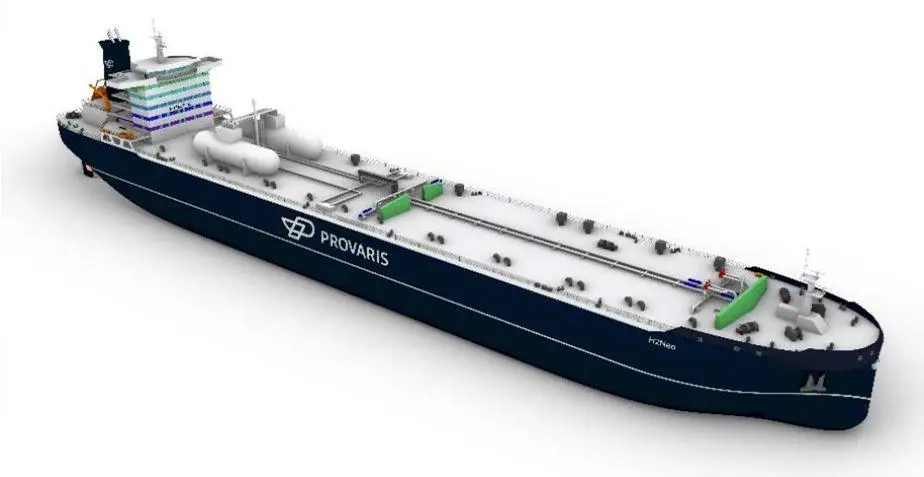
Provaris’ design team and consultants continue to advance the detailed Contract Design Package (CDP) phase, which is now 70% complete and on track for final delivery in June 2022. The team has compiled several work packages to provide an updated outline specification, general arrangement drawing, and other key design and engineering plans. These are now being shared with shipyards for construction schedule and capital cost estimates, along with class societies as part of the Approval for Construction milestone targeted for mid-2023.
The packages include hull design optimization (speed-power, structural steel assessments, and intact and damage stability), finite element modelling, shipboard safety systems, general arrangement drawings and a ship outline specification.
Two vessel sizes are being designed, one with 26,000m3 capacity and one with 200,000m3 capacity. Both have been granted Approval in Principle from ABS. The onboard storage tanks will have an operating pressure of 250 bar. Technical partners include Wärtsilä, Ballard Power systems and APL/NOV.
Provaris has engaged ABS Consulting for the gas dispersion, fire, and explosion safety studies necessary to allow class to verify the safety issues of the vessel surrounding its operation, especially in regard to the hydrogen storage tanks and cargo management.
Per Roed, Chief Technology Officer, said: “The H2Neo engineering and design is now progressed sufficiently to commence discussions with class for the design of testing and approval for construction. We are also now integrating port infrastructure designs for our supply chain discussions with ports in Asia and more recently in Europe.”
Discussions with class societies, including ABS, are underway, and Provaris is now progressing concept designs for the export and import of hydrogen in locations that include Asia and Europe. It is expected that a base design will be adaptable to multiple locations, with site specific access and regulatory requirements a key requirement for customisation.
Provaris has engaged Paaras Marine Solutions, a marine structural engineering company based in Singapore, to develop and assess port solutions for both the loading and unloading of compressed hydrogen using the Provaris GH2 Carriers, with the scope of the appointment to include:
- Singapore: concept development of an unloading marine jetty facility in Singapore to receive the GH2 Carriers for unloading and decompression of compressed hydrogen for local distribution. Concept solutions will include jetty solutions abutting onshore and a facility located offshore with subsea pipeline connecting on onshore distribution network
- Port Melville, Tiwi Islands, Northern Territory, Australia: evaluating existing marine facilities at Port Melville to accommodate GH2 Carriers including the loading facilities for compressed hydrogen.
- Barge Storage of Compressed Hydrogen: concept development of a storage barge will be considered for storing compressed hydrogen based on the requirements for intermittent or redundancy in the supply chain.
Concept designs will be included in the feasibility studies in progress for Tiwi H2 and HyEnergy (Western Australia), along with analysis of compressed hydrogen with port operators now underway in Europe.
Provaris says the advantages of compressed hydrogen include that it is commercially viable at low volumes, has a small footprint compared to liquefaction, is the most energy efficient way of transporting green hydrogen and can be loaded via onshore berth facilities or offshore buoy systems.
Martin Carolan, Managing Director & CEO, said: “Management has recently completed a visit to Europe and the UK to market Provaris’ compressed hydrogen solution, receiving an encouraging response given our target delivery for 2026. With the demand in Europe for import solutions starting from 2024-2026 the interest in transport solutions has increased given the focus on energy security and new gas infrastructure seeking approvals for gas imports required to demonstrate a hydrogen capability.”
Related Articles
 ALTERNATIVE FUELS & LUBRICANTS
 ALTERNATIVE FUELS & LUBRICANTS
 ALTERNATIVE FUELS & LUBRICANTS