



US Yard Readies Versatile Self-Discharger
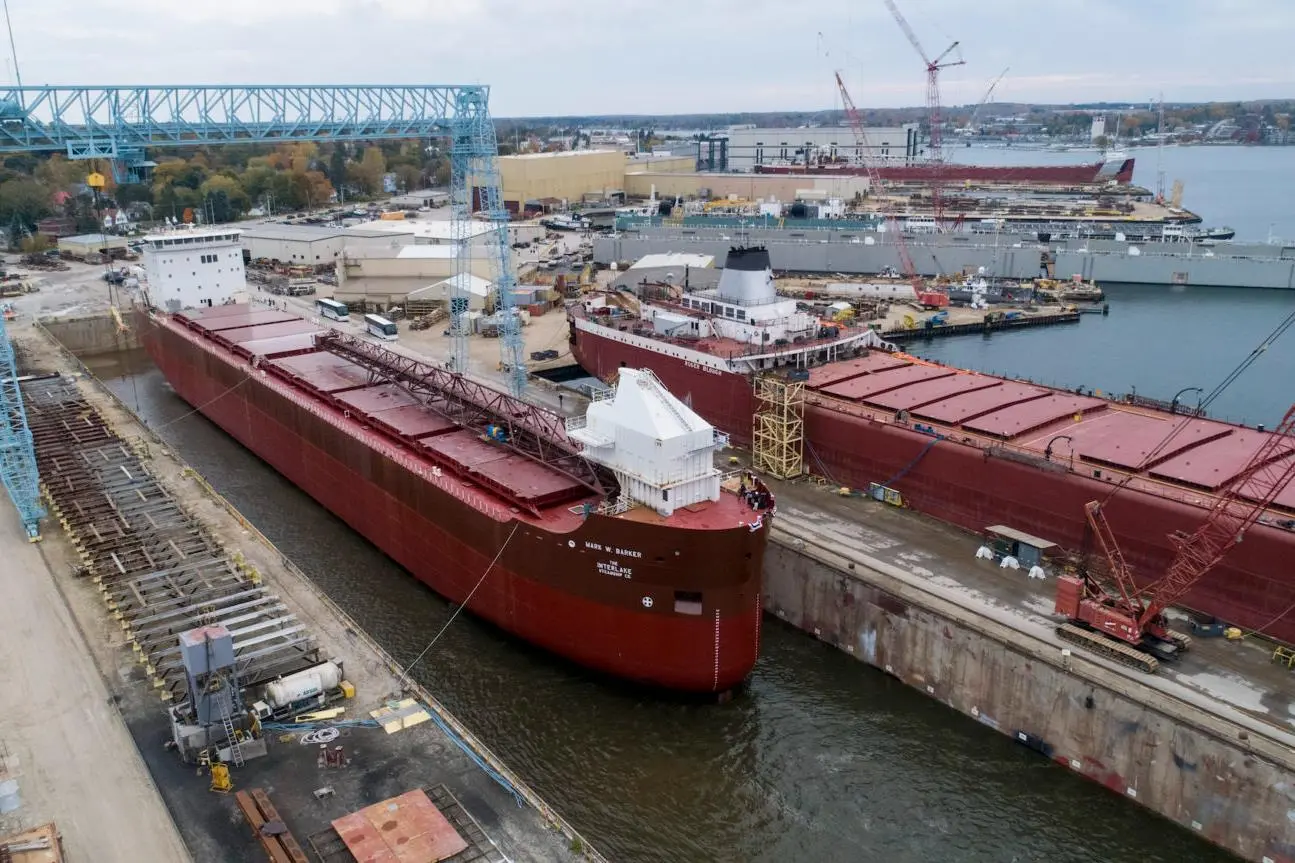
Constructed by Fincantieri Bay Shipbuilding to the order of Interlake Steamship Company, headquartered outside Cleveland, Ohio, the impending fleet entrant has the distinction of being the first US-built US Laker in nearly 40 years.
The 195m bespoke design was jointly developed by the owner and builder in cooperation with technical consultancy Bay Engineering, and features a 76m self-unloading boom conveyor pivoted forward. The primary power installation is based on a distinctive, home-grown brand of medium-speed trunk engine operating on the two-stroke cycle.
Dubbed the River-class by virtue of suitability for navigating restricted waterways, channels and docks, the Mark W. Barker will be the smallest unit in the Interlake bulker fleet while offering a high degree of operational flexibility.
Large, hydraulically-actuated covers close the ship’s five hatchways, in stark contrast to typical Lakers of similar size or larger which have 16-18 hatches and a multitude of securing gear.
Furthermore, instead of the traditional self-unloading Laker’s V-shaped hold whereby free-flowing bulk cargo is funnelled into a conveyor for discharge, the Mark W. Barker has a square-shaped, flat bottom hold. With no bottom slopes, a pair of front-end loaders will be used to move cargo to the belt channel through gates in the hold floor.
A transfer belt forward feeds the conveyor within the deck boom, which can be swung through 90 degrees either side of the vessel.
The forward mounting of the discharge boom, contrary to the more usual aft pivot-point arrangement on such Lakers, has been applied to give more flexibility as to cargo placement at docks and berths, notably including those posing access and space restrictions.
The combination of larger hatch openings and the flush hold was adopted so as to provide scope for other than the bulk commodities which are still the lifeblood of intra-Lakes traffic. The potential cargo range embraces project shipments, including windmill towers and large pieces of machinery and plant, plus steel coils and slab.
The new Laker provides a reference for US-manufactured, two-stroke medium-speed diesel propulsion. The installation comprises two 16-cylinder EMD710 engines, with a combined effect of around 5,800kW, transmitted through a Lufkin twin-input/single-output reduction gearbox to a Kongsberg controllable pitch propeller.
Produced by Electro-Motive Diesel (EMD) at La Grange, Illinois, the 710-series machinery in this latest application is certified to both EPA Tier 4 and IMO Tier III emission standards. The rotational force exerted by the main engines is also harnessed for the ship’s electrical energy needs, by way of two powerful shaft generators.
So as to ensure the requisite high degree of manoeuvrability for navigating narrow channels and rivers, including the tight bends of the Cuyahoga River in Cleveland, the bulker has Kongsberg bow and stern thrusters, and a flap-type rudder.
The high-lift rudder optimises wake flow through the propeller, promoting efficient performance in all conditions.
Mark W. Barker is understood to be the first US bulker for Great Lakes service built on the Great Lakes since 1983. Interlake’s preceding newbuild investment brought the self-unloader Paul R. Tregurtha into being during 1981, as the final delivery from American Ship Building Co’s Lorain yard in Ohio, which closed in 1985.
Launched as the William J. DeLancey, before taking on her present name in 1990, Paul R. Tregurtha was the last of the “1,000-footer” (305m-plus) series, 13 of which were ordered by various companies for trade on the Lakes.
1981 had also seen the delivery of another of the “1,000-footer” generation, in the shape of the Columbia Star, constructed by Bay Shipbuilding (now the Fincantieri-owned yard) for Oglebay Norton Corporation. The vessel was acquired and renamed American Century by American Steamship in 2006.
Related Articles
 2-STROKE & 4-STROKE
 2-STROKE & 4-STROKE
 2-STROKE & 4-STROKE