



New SDARI design uses torsional damper to eliminate BSR
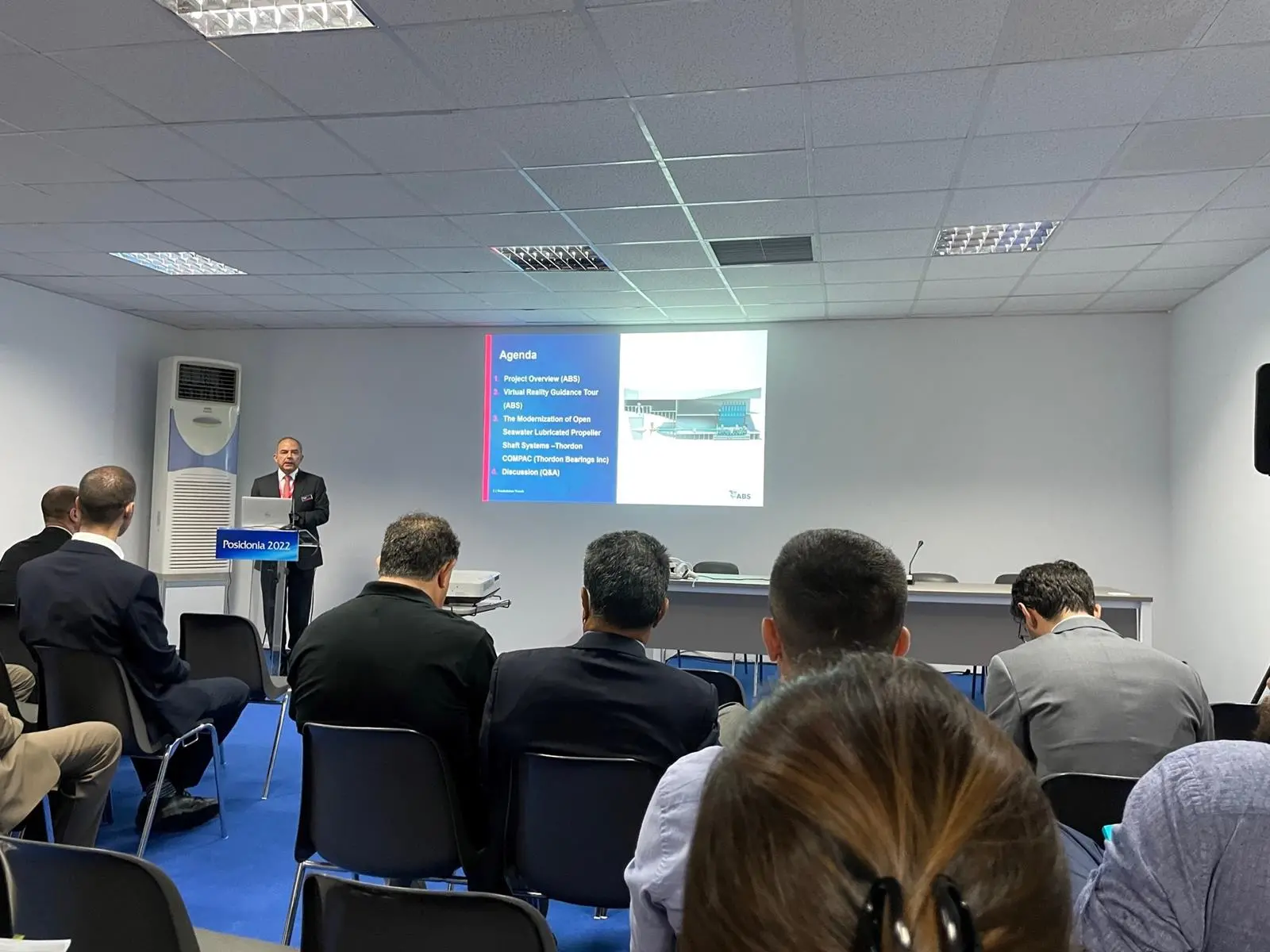
The innovative design features an open seawater lubricated propeller shaft system, supplied by Thordon Bearings, and the application of a new approach to the vessel’s aft layout.
The design was developed by Shanghai Merchant Ship Design and Research Institute (SDARI) and was developed in cooperation with ABS, Thordon Bearings Inc. and the National Technical University of Athens (NTUA). It introduces a new approach to the vessel’s aft layout, including the removal of the stern tube casting, employing seawater for lubrication and the creation of a chamber to permit in-water maintenance for the first time.
The design features a number of design amendments compared with a SDARI 3,800 TEU container feeder design, equipped with a conventional oil-lubricated sterntube.
Barred Speed Range (BSR)
The BSR is a ‘barred’ or a ‘forbidden’ speed range of operation. Spending too long in the barred speed range (BSR) can have a detrimental effect on shaftline fatigue lifetimes.
Vessels traditionally passed through the BSR as quickly as possible in order to minimise the accumulation of fatigue, which stems from operating in the zone of a major torsional resonance of the powertrain. Extended operations within the BSR would set off engine alarms in the engine control room. However, the need to restrict time within the BSR is an operational constraint for operators from a fatigue point of view. The BSR is also a factor impacting vessel manoeuvrability, particularly in bad weather.
Historically, BSR passage was limited to a few seconds; therefore, potential accumulation of torsional cycles, leading to fatigue and failure, was insignificant and created little cause for concern.
Most classification rules include a qualitative clause, such as “to be passed through as quickly as possible”.
Dr. Chris Leontopoulos also identified fuel efficiency (and consequently GHG emissions) impacts from the rapid acceleration and deceleration on vessels’ performance leaving and arriving at ports as a new concern.
Design modifications
Dr. Leontopoulos identified five design amendments:
– The shaftline for the vessel was shortened
– The forward sterntube bearing was removed
– The aft sterntube bearing was replaced with a seawater lubricated bearing
– The sterntube casting was removed
– A torsional vibration damper was added
The shorter shaftline also opened up opportunities to minimise engine room space, with consequent increases to the vessel’s potential cargo capacity.
However, the design modifications also lead to the creation of a new space, which has been dubbed the Irregularly Shaped Chamber (ISC), following the removal of the stern tube casting.
Potential Maintenance Benefits
The new ISC space is large enough for an engineer to enter and work within the new space. As a result, the ISC would allow engineers the possibility to access the stern tube while the vessel is afloat, which would permit in-water inspections and maintenance of the shaft line components for the first time.
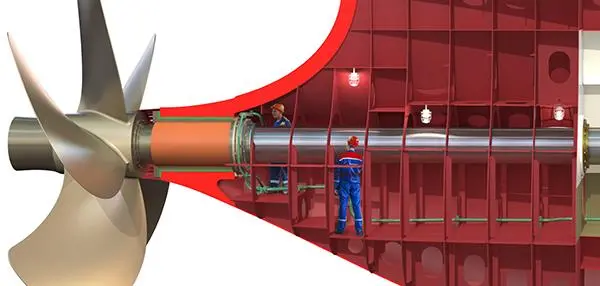
The new COMPAC Bearing can also be replaced from the inside of the vessel, which eliminates the requirement to withdraw the tailshaft and propeller and disassemble the shaftline to access the bearing. Dr. Leontopoulos added that this also reduced the potential for human error (Maintenance Induced Damage) during the replacement process.
The process can be completed in a day, eliminating the need for a dry docking, which would offer direct operating expenditure savings of up to USD100,000. This does not take into account the indirect benefits offered by making the vessel available for several weeks.
ABS notes that vessels equipped with water lubricated sterntubes are eligible for ABS’ Tailshaft Condition Monitoring (TCM-W) notation, which can extend the tailshaft survey interval up to 15 years, without requiring shaft withdrawal. This was subject to the vessels being equipped with appropriate monitoring solutions.
Classification compliance
Dr. Leontopoulos noted that ABS had conducted extensive modelling to ensure that the new design complied with ABS’ shaft alignment rules and with vibration rules.
He specifically addressed potential concerns that a shorter shaftline with one fewer bearing might have a lower shaft alignment strength, by noting that the seawater lubricated polymer bearings have a slightly greater tolerance compared with traditional white metal oil-lubricated bearings.
Dr. Leontopoulos also shared results that the bearings were all positively loaded and within the manufacturer’s limits.
He also demonstrated that the design was within engine flange shear moment and shear force bending moment envelope limits. These criteria were fulfilled under fully laden, ballast and dry dock conditions.
Torsional Vibrational Stress
From an engine designer perspective, perhaps the most interesting aspect of Dr. Leontopoulos’ presentation concerned the impact of the installation of a vibration damper upon the vessel design’s torsional vibration stress.
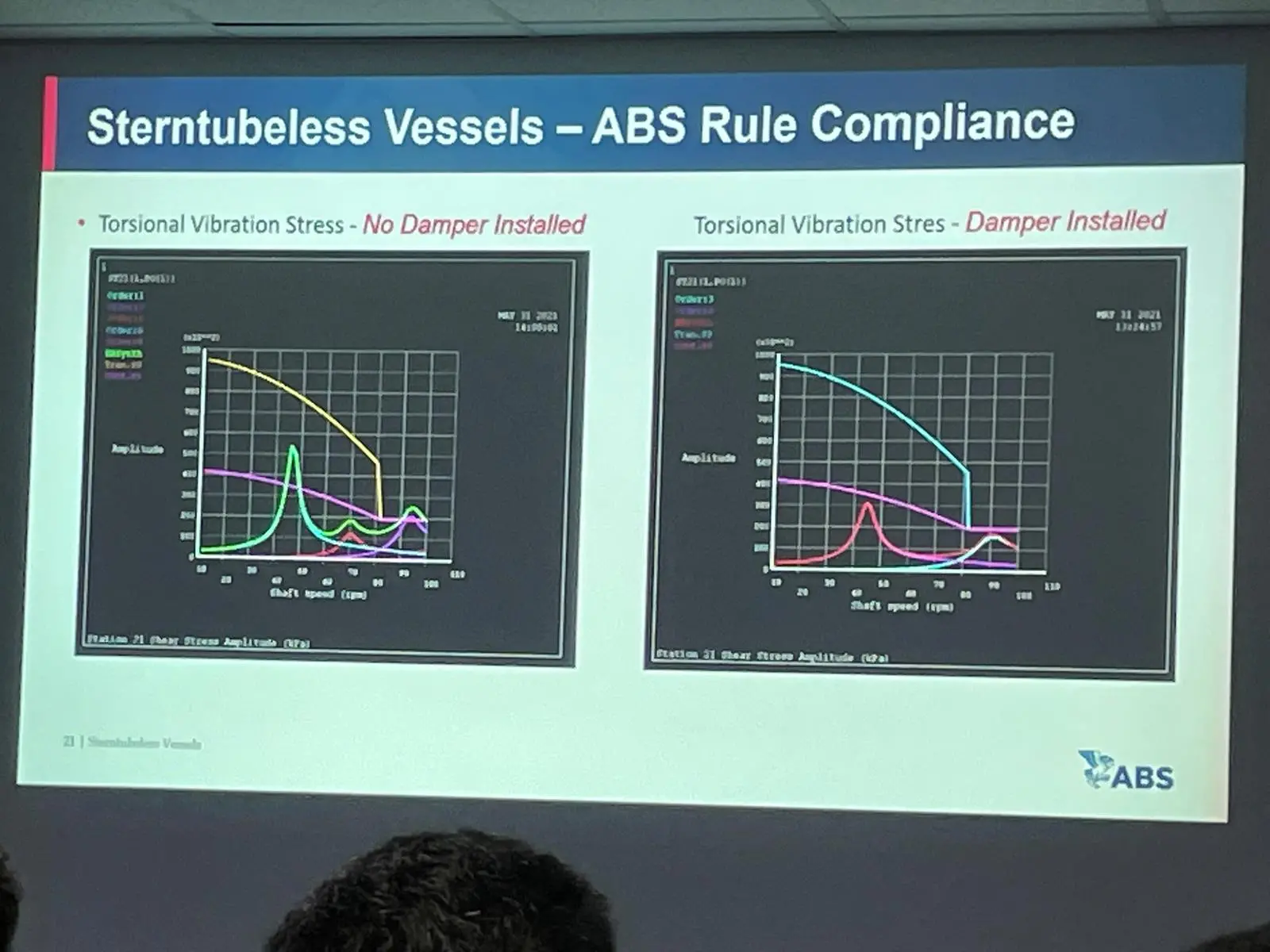
By adding a torsional damper aft of the engine, ABS’ modelling indicated that the shear stress remained below the continuous shear stress limits.
“This means that there is no need for a barred speed range… which means that you have full manoeuvrability of the vessel. And if you want to operate close to the barred speed range, you’re not breaking any RPM… and you don’t have to have any fatigue concerns.”
Dr. Leontopoulos noted that the elimination of the BSR would offer a number of advantages (see Barred Speed Range box above).
Among the opportunities would be the elimination of operational constraints around vessel speed limits, which currently impact vessels operating in the Great Lakes region of North America.
The elimination of potential shaftline fatigue concerns is also expected to offer benefits for engine power limitation solutions.
Environmental Benefits
The replacement of an oil-lubricated sterntube with Thordon’s COMPAC open seawater lubricated propeller shaft bearing system is likely to lead to a marginal improvement in operational performance, owing to the reduction the weight of the shaft line and reduced friction. Research is continuing into the potential impact on engine specifications presented by shortening the shaftline.
The elimination of the requirement for oil-based lubricants would also lower consumables expenditure, and would greatly lead to a reduction in pollution from oil leakages. As an industry, oil leakage from sterntube seals has been estimated at up to 80 million litres per year.
However, the main attraction of the system is likely to be the improvements in the EEXI and CII ratings for vessels operating with such systems.
Tony Hamilton, Technical Director of Thordon Bearings, noted that while modern water lubrication systems had been successfully specified in both naval and commercial vessels for decades, uptake in the tanker and gas carrier markets had been slower until now.
“Thordon has more than 500 merchant fleet vessel references, and along with other bearing suppliers, there are well over 700 vessels operating an open seawater lubricated propeller shaft bearing system. Our COMPAC bearing is specially formulated to reduce start up friction and eliminate stick-slip, offering considerable advantages to ship owners, not only in bearing wear life predictability and reliability, but they are also more economical to maintain and easier to install.”
Potential applications for larger vessels
While the potential efficiency savings from the design were focused on operational cost reduction, the design offers other potential improvements.
The additional space at the stern of the vessel could be used to shorten the shaftline and increase the cargo capacity of the vessel.
“Increasing the cargo capacity of the design within the existing envelope would help to improve CII and EEXI ratings,” Dr. Chris Leontopoulos noted, adding that the additional space might permit other hydrodynamic optimisation. SDARI had not modified the lines of the container feeder design.
The incremental gains offered for the single skeg 3,800 TEU container feeder could also be achieved for larger twin skeg vessels. In fact, proportionally greater efficiency savings were likely to be seen in the dry bulk and oil tanker and carrier segments, given the space saving offered for longer shaftlines.
Related Articles
 LNG
LNG
 LNG
LNG
 SHAFTS AND PROPELLERS