



IMO agrees autonomous ship draft work plan
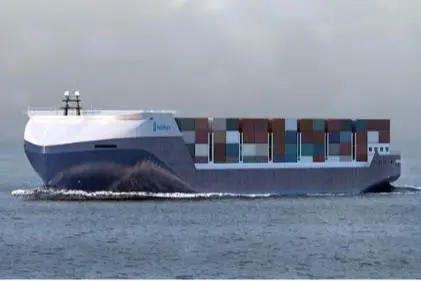
The session was held 7-9 September (7-9) and considered issues relating to the Maritime Safety committee (MSC), Legal Committee (LEG) and Facilitation Committee (FAL). The IMO’s current road map, approved by MSC105 in April 2022, calls for a goal-based non-mandatory Code to be adopted in the second half of 2024 and a mandatory Code to enter into force on 1 January 2028.
Towards those goals, the Joint Working Group developed a table – intended as a living document – to identity preferred options for addressing common issues, such as the roles, training and responsibilities for master and crew of autonomous ships and the responsibilities of remote operators.
A draft work plan was agreed, for approval by the three committees, which envisages the Committees reviewing the report of the first session and a second Joint Working Group to be convened in 2023.
The IMO has defined four levels of autonomy:
1. Ship with automated processes and decision support: Seafarers are on board to operate and control shipboard systems and functions. Some operations may be automated and at times be unsupervised but with seafarers on board ready to take control.
2. Remotely controlled ship with seafarers on board: The ship is controlled and operated from another location. Seafarers are available on board to take control and to operate the shipboard systems and functions.
3. Remotely controlled ship without seafarers on board: The ship is controlled and operated from another location. There are no seafarers on board.
4. Fully autonomous ship: The operating system of the ship is able to make decisions and determine actions by itself.
The joint working group meeting was preceded by an IMO Seminar (5-6 September) which brought together stakeholders to share insights. At the session, Wu Sun outlined IACS proposals for the maritime autonomous surface ships (MASS) Code, saying it should focus on gaps and themes such as definitions and terminology, remote control/operation centre, autonomous navigation, advanced monitoring systems e.g. capable of fault detection, diagnostics, and adaptive controls.
IACS strongly recommends that the MASS Code should be verified and validated. It should be developed to have a correct, complete and consistent set of requirements with the following categories:
1. Functional requirements – what the MASS should do, explained down to the sub-system level and also including different software (including AI) and hardware constituents.
2. Performance requirements – how well, and under what conditions (e.g. time constraints, concurrent execution, etc.) the functions should be executed.
3. Interface requirements – how the hardware and software will be linked at a sub-system level.
4. Communication requirements – how MASS will communicate with remote crew and other vessels, including other autonomous vessels, and also the methods and protocols of communication within the MASS hardware and software sub-systems.
5. Safety Requirements – what the hardware and software components should do and not do, including mitigations and provisions relevant to monitoring and recovering from loss of function.
6. Cyber Security Requirements – details of the known vulnerabilities that exist in hardware and software system components.
IACS foresees that technical challenges still exist for ensuring all-weather situation awareness, for the development of a unified algorithm of collision avoidance, for connectivity and information exchange between MASS and conventional ships and other stakeholders, and for defining safety requirements and proving MASS system compliance. IACS aims to create the requirements for the appropriate execution of MASS surveys and inspections.
Anne Miettinen, from the Finnish Ministry of Transport and Communications, spoke at the IMO seminar on the co-existence of MASS with conventional vessels and MASS infrastructure. She said that MASS should be able to interact with conventional vessels and shore-based actors such as VTS, fleet management, ports and remote control centres. Both human-machine and machine-machine interfaces based on digital data are required, but MASS should also be capable of voice communication through VHF possibly by relaying radio communications to remote control station.
The IMO wants to ensure that the regulatory framework for Maritime Autonomous Surface Ships (MASS) keeps pace with technological developments. The Maritime Safety Committee (MSC 101) session held in June 2019 approved Interim guidelines for MASS trials (MSC.1-Circ.1604). The guidelines state that trials should be conducted in a manner that provides at least the same degree of safety, security and protection of the environment as provided by the IMO’s relevant instruments.
Related Articles
 ENERGY SAVING DEVICES
 LNG
LNG
 ALTERNATIVE FUELS & LUBRICANTS