



IEA scenarios offer views on shipping’s 2050 fuel mix
NZE Scenario
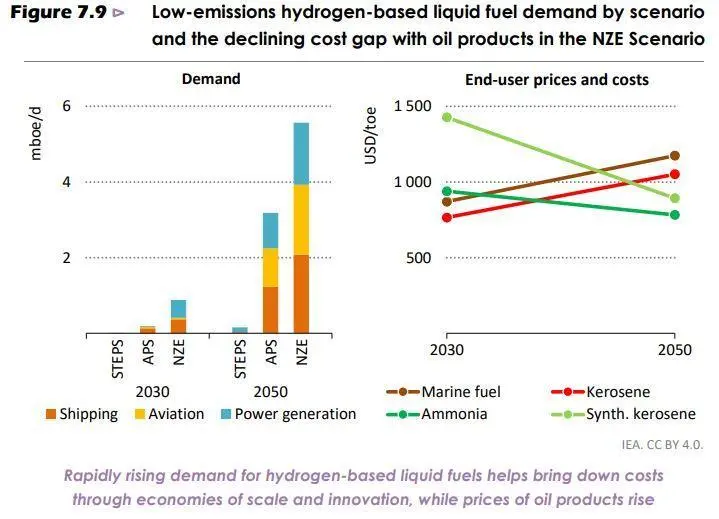
According to the IEA’s Net Zero Emissions by 2050 (NZE) Scenario, by 2050 more than 14,800 TWh of electricity is expected to be used to produce low emissions hydrogen, equivalent to more than half of today’s global electricity demand from all sources.
Around 25% of total low‐emissions hydrogen in 2050 will be converted to low emissions hydrogen‐based fuels.
By 2050, ammonia will meet around 45% of demand for shipping fuel. Bioenergy and hydrogen each meet a further 20% of demand, with the use of hydrogen focussed on short‐ to mid‐range shipping. Electricity is expected to play a minor role focussed on meeting demand from small ships and ferries used for short distance operations.
Due to ships’ lifespan of 20‐35 years, the uptake of new low‐emissions technologies is likely to be slow, and oil is likely to still constitute almost 15% of shipping fuel demand by 2050.
Globally, the main sectors seeing an increase in the use of oil are aviation and shipping, petrochemicals (where oil is used as feedstock), and heavy trucks. These sectors are expected to see a rise in demand of around 16 mb/d between 2021 and 2050, but from the mid‐2030s growth in these sectors is more than offset by declining oil use elsewhere, especially in passenger cars, buildings, and power generation.
APS Scenario
The report also includes two other scenarios: the Announced Pledges Scenario (APS) assumes that all aspirational targets announced by governments are met on time and in full, including their long‐term net zero and energy access goals, while the Stated Policies Scenario (STEPS) shows the trajectory implied by today’s policy settings.
The APS Scenario anticipates that shipping will play a larger role in biofuels end use demand mix by 2050 compared with the NZE Scenario results, as global demand for liquid biofuels in 2050 is 40% higher than in the NZE Scenario. In the APS Scenario 2050, total liquid biofuels consumption rises to over 9 million barrels of oil equivalent/day, 75% of which consists of advanced biofuels. Around 40% of this total is consumed in aviation and shipping. By comparison in the NZE Scenario, around 90% of liquid biofuels produced in 2050 are advanced biofuels and 75% are consumed in aviation and shipping.
This year’s report predicts that, for the first time ever, current policy settings worldwide are strong enough to deliver a distinct peak in global demand for fossil fuels this decade. However, they are not enough to avoid severe impacts from climate change.
As of July 2022, almost 800 companies worldwide had made net zero emissions pledges, according to the Net Zero Tracker (2022). Increasingly, companies in hard‐to‐abate sectors are joining sectoral initiatives, notably in the steel, cement, aviation, and shipping industries. To date, initiatives and top‐20 company pledges in the steel, cement and shipping sub‐sectors each cover around 25% of their global emissions.
The report is available here.
Related Articles
 AMMONIA
 AMMONIA
 AMMONIA