



Electronic control gives 49/60DF its leading status
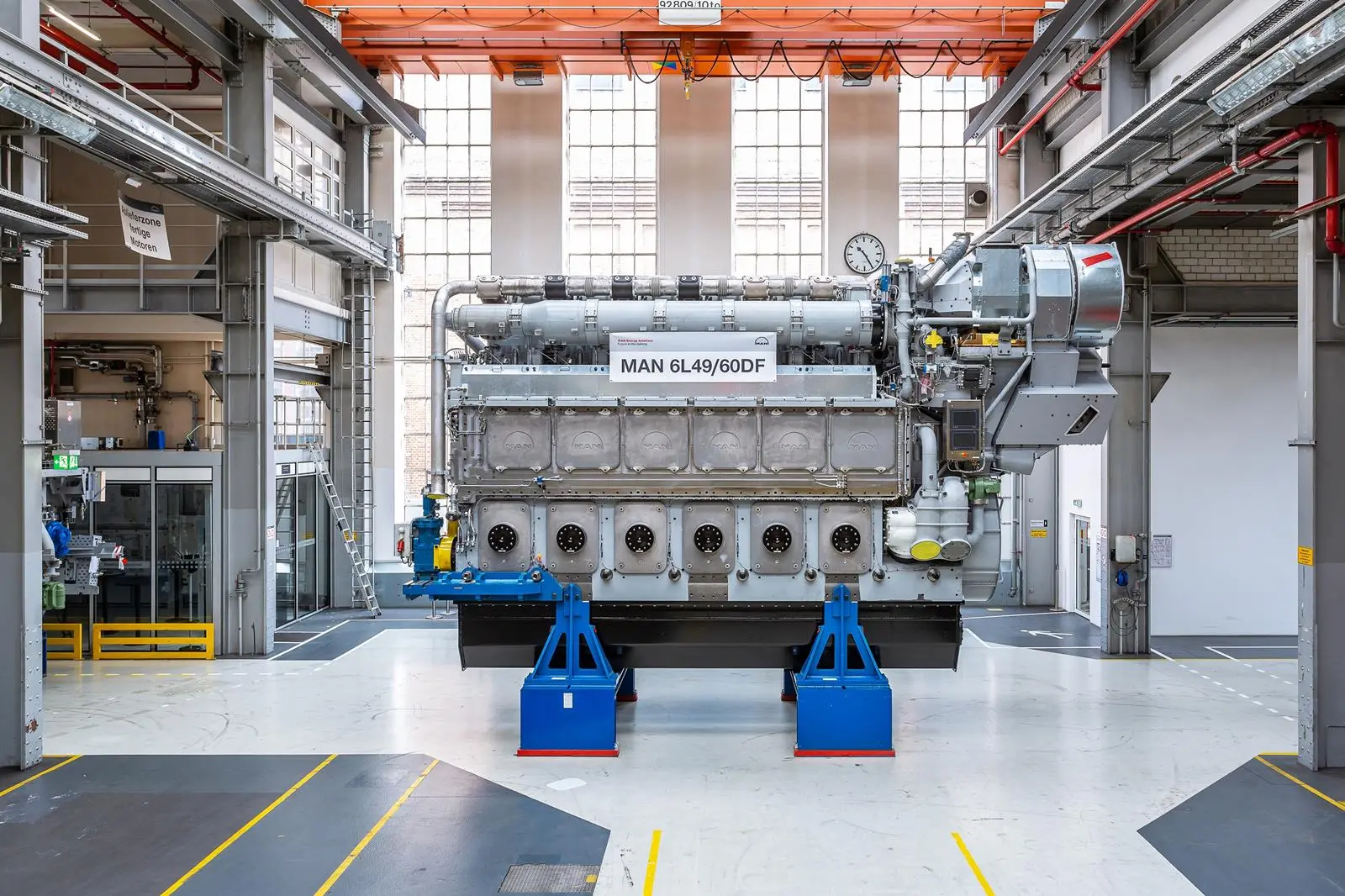
MAN Energy Solutions’ latest dual-fuel four-stroke engine, the 49/60DF, is its most powerful dual-fuel four-stroke engine yet, exceeding even the larger 51/60DF, thanks to its electronics. In fact, under certain conditions, it is the most efficient four-stroke dual-fuel engine on the market, MAN ES’ Sales Manager, Marine Four-Stroke, Thomas Huchatz, told The Motorship.
It is rated at 1,300kW/cyl at 600rpm – making it the most powerful engine in MAN ES’ four-stroke family – and, without its attached pumps, consumes 6,990kJ/kWh in gas mode, giving it an efficiency of 51.5%.
When the engine was formally launched during the SMM exhibition in September, MAN ES listed a number of its technical features, including the OEM’s second-generation Adaptive Combustion Control, ACC 2.0, and the latest version of its SaCoS 5000 (Safety and Control System generation 5) automation system.
These are vital not only to its initial performance but also to its future development, said Stefan Terbeck, principal technical project manager of the 49/60 engine family, in particular naming the ACC 2.0 as ‘key’ to introducing new fuels to the engine. It can operate on LNG and diesel fuel, along with “a number of more sustainable fuels including biofuel blends and synthetic natural gas,” the SMM statement said.
But it also quoted Marita Krems, Head of Four-Stroke Marine and License at MAN ES, noting that engine is making its debut “at a time where … fuels like methanol, ammonia and hydrogen are continuing their rise,” although she acknowledged that “none [of these fuels] has established market dominance as of yet.”
Nonetheless, Terbeck indicated to The Motorship that methanol was likely to be added to the engine’s fuel options in the future while Huchatz predicted that this will be followed by ammonia and hydrogen, depending on market demands.
MAN ES has previously announced that its stationary gas-fuelled engines are hydrogen-ready, capable of operating with up to 25% hydrogen in their gas fuel mix and in an announcement last November, it referenced its ACC – which was introduced about five years ago – as being instrumental for that, saying that the control system “reacts fully automatically to varying hydrogen contents in the natural gas.”
At its heart are firing pressure sensors in each engine cylinder that allow automatic cylinder pressure analysis (CPA) to be performed in real time. Now, the 49/60DF is the first engine type to be fitted with ACC 2.0 which is able to analyse combustion in each cylinder for every cycle, which is made possible by the greater calculating power of ACC 2.0 compared with the original version fitted to the 51/60DF. Terbeck had also been project manager for that engine, which now has about 8M running hours under its belt and said that “we have seen what can be improved and put that into ACC 2.0.”
One change he mentioned is that the 49/60DF has more sensors, including for NOx, allowing closed-loop control for NOx emissions. This makes it possible to operate the engine closer to limit values rather than allowing an operating margin.
With the data gained by the CPA, Terbeck mentioned that the ACC 2.0 can control numerous combustion parameters, which reflect changing fuel properties, ambient conditions, air fuel ratio and component aging.
For example, if an engine that normally uses MGO or MDO is switched to a blend containing, say, 40% biofuel, the lower heat value will change and combustion can be delayed and the ACC 2.0 takes this into account, he explained.
The CPA will also instantly adjust for factors related to pilot fuel injection to correct the combustion parameters for best efficiency or for best dynamics so, “by having fully electronic access to our actuators, gas valves, pilot fuel valves, waste gate and gas pressure governor, we can adjust the combustion automatically to the fuel used,” he said.
This will be especially relevant for methanol, Huchatz added, because it has a lower energy density from diesel fuel. That also presents some physical challenges, since greater volumes will have to be injected into the combustion chamber.
Safety and control
Readers may recall a first application of SaCoS 5000 on the MAN 45/60CR engine in 2017 but it has been further refined since then. This latest version was first applied to MAN 32/44CR engines and is being introduced on the 35/44DF and other MAN four-stroke machines.
This latest version now finds its place as a vital component in the package of technologies that, together, make the 49/60DF an efficient multi-fuel power platform.
Working alongside the ACC 2.0, SaCoS 5000 helps make the new machine a ‘software engine’, Huchatz said, since it provides an improved interface between the engine and the outside world that can be used to transfer more data than before and in a higher resolution for remote analysis and support, he said.
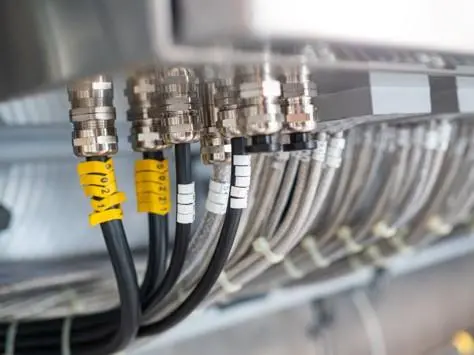
This goes beyond the now-common practice of collecting data from onboard machinery and transferring it ashore. “This new system is technically capable having data going the other way, so that we can push data onto the engine,” he said. That opportunity could be used, for example, to ensure that the engine always has the latest combustion parameters necessary for its efficient operation. At present, these updates might only be possible when a technician visits and uploads new data directly from a laptop, for example.
“We have to convince owners that there are benefits from this,” he said, but that is not the only constraint holding back its implementation: over-the-air updating such as this is not yet possible from a regulatory point of view so “we are talking with class societies about how this can be done,” Huchatz said.
This difficulty has arisen because hitherto an engine and its control system is class-approved as a combination of hardware, software and data. If some of that data is subsequently changed, it might have implications for emissions, for example, requiring the class society to re-evaluate the set-up, Huchatz explained.
This has implications from a regulatory standpoint, Terbeck added. An engine is allocated an emission identifier related to its NOx-affecting components that, in the past, was based only on its hardware, which would not change. But once software becomes part of the system, any change – for example to the NOx-mapping – requires that this identifier should reflect that change.
Security
Another consideration for any system that relies on data transfer is cyber security and in April this year, the International Association of Classification Societies (IACS) adopted two Unified Requirements related to cyber resilience on ships. These will be applied as mandatory to new ships contracted for construction from 1 January 2024 and the major classes have already defined different levels of cyber security beyond the requirements soon becoming mandatory, Huchatz said.
With increasing use of digital and remote software services, the risk of cyber-attacks increases, he pointed out, and protecting passwords and physical access to systems can only offer basic protection. “If you want to go to beyond Level One, you need features that only SaCoS 5000 can offer, he said.
Terbeck drew a comparison with conventional virus protection software on personal computers, which requires regular updating, but is still at risk of being bypassed.
Such traditional measures are well known in relation to IT security, where the main priority is to protect data, whereas for technical systems the focus is on their safe and secure operation, for which reactive measures such as subscription-based virus protection is not sufficient.
For operational technology (OT) security, when the main focus is to ensure the safety and availability of the engines and the ship, SaCoS 5000 was conceived with ‘cyber security by design’ and “’defence in depth’ in mind. “It features a built-in and fit-for-purpose layered design across separate zones using advanced network topologies comprising segregation and segmentation,” Huchatz explained.. These are fundamental features that ensure cyber security resilience and improve uptime and performance, he added.
Related Articles
 2-STROKE & 4-STROKE
 2-STROKE & 4-STROKE
 2-STROKE & 4-STROKE