



Hybrid Norwegian Coaster From Sri Lanka
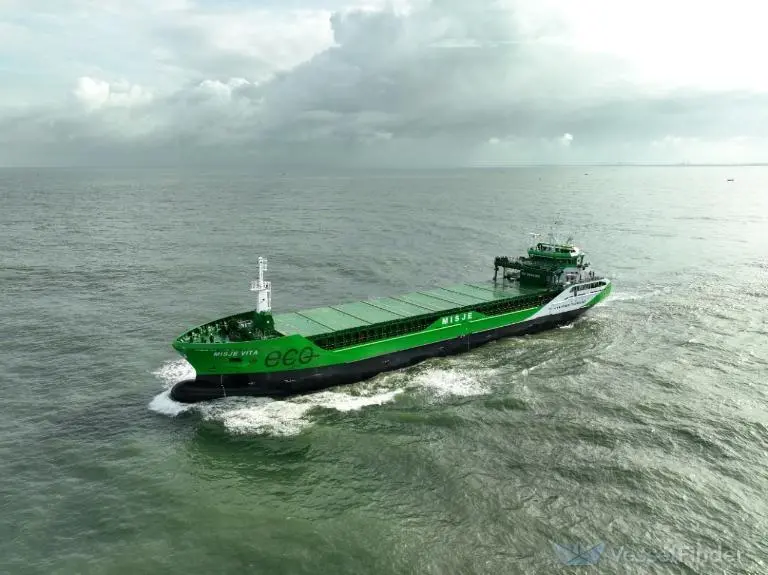
As well as 100% NOx abatement, it is claimed that the 5,300dwt class, dubbed the EcoBulk type, offers a 47% reduction in SOx and CO2 emissions relative to existing tonnage of similar size. Fuel consumption is expected to be 15% less than that of a comparable, conventionally-engineered vessel.
Six newbuilds were booked in two ordering tranches by Bergen-based Kare Misje & Co, and delivery slots were subsequently reserved at Colombo for four further vessels, raising the prospect of a 10-ship programme. The entire series has been allocated to subsidiary Misje Eco Bulk.
Developed by the Norwegian design arm of the Wartsila organisation, the fully integrated hybrid solution incorporated in the EcoBulk short-sea traders will enable emission-free sailing in and out of port and during cargo loading and discharge operations.
The ships cater to the range of bulk commodities, timber and steel products plus unit loads, with a divisible single hold affording an underdeck capacity of 245,000ft3. Each vessel has a four-stroke diesel engine with a hybrid electric drive encompassing active front end (AFE) technology allowing bi-directional power flow, and wherein the battery bank is mainly for peak shaving while capable of supplying constant power for a certain period in steaming mode. Distinct power and energy management systems (PMS/EMS) control and manage electrical power production and consumption, overseeing the genset, hybrid drive, batteries, switchboards and consumers.
The single hold accounts for nearly 60m of the 85m length between perpendiculars and for 12.8m of the 15.4m beam. Rising above the weatherdeck by way of deep hatch coamings, the hold space height of 9.8m contributes to the maximisation of the hull’s revenue-earning potential, given a moulded hull depth of 8.8m. Two removable bulkheads with multiple placing points confer scope for a very high degree of separation or subdivision of the cargo section.
The tank top is strengthened for loads of 15t per m2 and weatherdeck stows are possible through the 1.6t per m2 reinforcement of the pontoon-type hatch panels. The mechanical ventilation system allows for six air changes per hour.
Misje Vita has a Wartsila 20-series, medium-speed main engine rated for 1,600kW, complemented by an electric hybrid solution comprising a PTO/PTI shaft generator-cum-motor and 1,000kWh bank of batteries.
The diesel machinery is served by a proprietary NOx Reducer (NOR) and intended operation is on marine gas oil (MGO). Anticipated consumption at sea is about 5.2t per day, while the battery installation and provision for a connection to the shoreside grid will obviate the need to burn fuel when berthed.
The EMS is pivotal to the Wartsila hybrid arrangement, optimising the energy flows between the different power sources, storage and consumers so as to realise the highest efficiency possible.
Delivered in September and currently trading along Europe’s Atlantic fringe, the construction schedule for the Misje Vita faced production and supply-side challenges wrought by the pandemic. Sister newbuilds are due to follow at approximately four-monthly intervals. The implementation of the EcoBulk programme was the culmination of four years’ work and expenditure of NOK10m ($1m)-plus in the development of a vessel design for the future.
The award of the EcoBulk series to CDL, which is majority-owned and technologically-supported by Onomichi Dockyard of Japan, is vindication of the Sri Lankan yard’s rising profile in the international market.
MAIN PARTICULARS – Misje Vita/EcoBulk type
|
Length overall |
89.95m |
|
Length bp |
84.95m |
|
Breadth |
15.40m |
|
Depth |
8.80m |
|
Draught, summer |
6.55m |
|
DWCC (Deadweight, carrying capacity) |
5,120t |
|
Draught, winter |
6.30m |
|
DWCC |
5,000t |
|
DWAT (Deadweight, all-told) |
5,329t |
|
Hold capacity |
6,930m3/245,000ft3 |
|
Main engine power |
1,600kW |
|
Energy storage system |
1,000kWh |
|
Speed, laden |
11.5kts |
|
Speed, ballast |
13.5kts |
|
Ice class |
1C |
|
Class |
DNV |
|
Flag |
Norwegian |
Related Articles
 PROPULSION
 GENERAL NEWS
 HYDROGEN