



ABS grants design approval for compressed hydrogen carrier
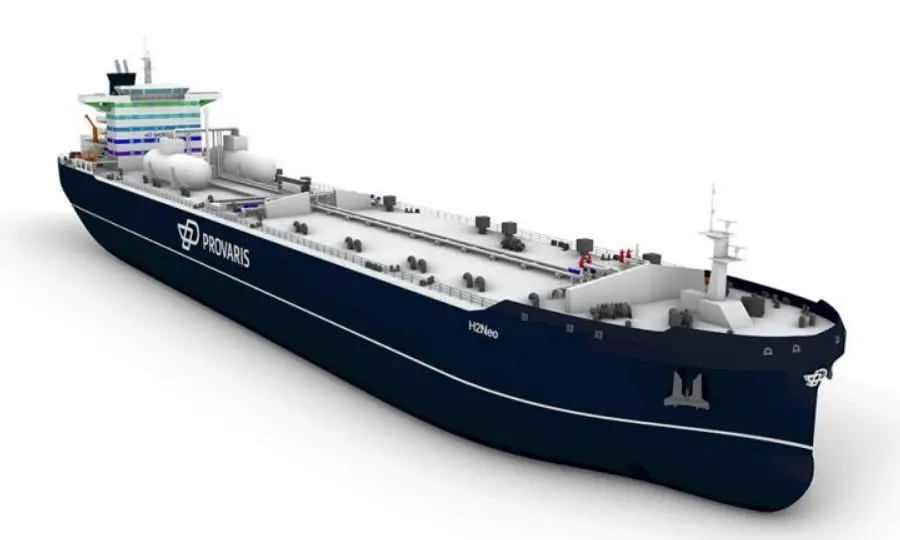
The approval allows shipbuilders to provide firm quotations for the construction of a fleet of H2Neo carriers that will incorporate the company’s multi-layered hydrogen storage tank.
The H2Neo design is characterised by two large-diameter cylindrical tanks, one in each of the port and starboard cargo holds, with a maximum allowable operating pressure of 250 bar. To avoid boil-off / cargo losses and to avoid the need for insulation and energy-intensive cooling during the voyage, the hydrogen is carried at ambient conditions.
The tanks are designed so that they cannot suddenly rupture and release a catastrophic amount of energy. This is achieved by a cargo tank construction that is composed of layers of steel, nested together, including a stainless-steel inner layer to protect the high-strength carbon steel from hydrogen embrittlement. This nesting ensures that sudden through-wall cracks are impossible. Moreover, the layered tank construction benefits the construction methodology of the cargo tanks.
Additional safety measures are applied through continuous monitoring of the cargo tanks integrity. By using components and software that are proven, and readily available, in the market, Provaris has developed a monitoring system that will be installed on the outermost layer of the cargo tanks.
An advantage of the patented design, says Provaris, is that it involves the integration of a relatively thick steel layered tank (as required for 250 bar) into the hull of a relatively conventional ship- sized hull with low operating drafts.
Provaris now plans to construct and test a prototype hydrogen tank, and to prepare for ship construction with a selected shipyard. The ship design is verified as capable of transporting compressed hydrogen at bulk scale at 250 bar pressure.
Provaris’ Chief Technical Executive Officer, Per Roed, said: “Through our close collaboration with ABS throughout this three-year process, we are confident that our compressed hydrogen carriers can safely and effectively establish the maritime transportation of hydrogen at a time when storage and transport remain key to unlocking markets with ambitions for hydrogen imports at scale from 2026.”
ABS’ Senior Vice President – Global Engineering and Technology, Patrick Ryan, said: “ABS recognises the potential that hydrogen shows in supporting a sustainable, lower carbon future. Safe and efficient storage and transportation of hydrogen at sea will be critical to the development and viability of the global hydrogen value chain. We have been working closely with Provaris, initially granting AiP in 2021 and subsequently reviewing their comprehensive FEED level package for the H2Neo.”
Provaris aims to make a construction award in 2023.
Related Articles
 AMMONIA
 HYDROGEN
 HYDROGEN