



Report identifies clear training gap on alternative fuels
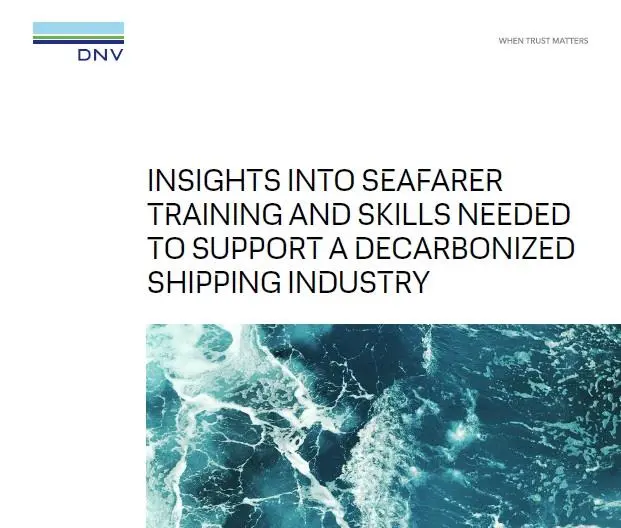
Titled ‘Insights into seafarer training and skills needed to support a decarbonized shipping industry’, the report uses DNV’s GHG Pathway to model three different decarbonisation scenarios, including dual-fuel internal combustion engines running on methanol, ammonia or liquid hydrogen, as well as hydrogen fuel cell, ammonia fuel cell and battery systems.
Urgent training need
The study revealed that all three potential decarbonisation scenarios pointed towards an immediate need to train seafarers. However, the timing and type of training provided will depend on the ambition of decarbonisation trajectories and the future fuel mix.
In the ‘Decarbonization by 2050 scenario’, modelled by DNV, 750,000 seafarers would require additional training to handle alternative fuels and technologies by 2050.
The study said that there are a number of safety challenges related to alternative fuels in shipping. Seafarers will need additional training concerning the particular risks associated with using alternative fuels for propulsion in order to ensure not only their safety but the safety of the environment and local communities.
The trouble is that training seafarers to support shipping’s decarbonisation is already subject to several constraints, including a slow pace of regulatory development and lack of clarity surrounding the viability and uptake of alternative fuel options, which makes investment in seafarer training challenging.
This, coupled with uncertainty surrounding regulatory developments and financing, is making it difficult to plan for the further training of the maritime workforce and attract investment in skills programmes compatible with the industry’s future needs.
The report points out that guidelines for alternative fuel technologies are already under development by the International Maritime Organization (IMO). Maritime schools and training centres could use IMO model courses once developed, forming part of the education for all seafarers.
It concludes that meeting decarbonisation goals, coupled with fast-moving technological developments, requires careful monitoring and reflects a general trend towards a ‘higher-skilled’ seafarer.
Special attention should be paid to IT systems which can equip all relevant seafarers with new skills and help them transfer to new types of jobs created by new technologies.
Lastly, a holistic view, taking into consideration human, organisational and technical challenges, when adopting alternative fuels and technologies is important, alongside a strong safety culture and the provision of familiarisation periods during the implementation of alternative fuels aboard ship.
Related Articles
 ALTERNATIVE FUELS & LUBRICANTS
 INDUSTRY NEWS