



Methanol-Ready Baltic Icebreakers
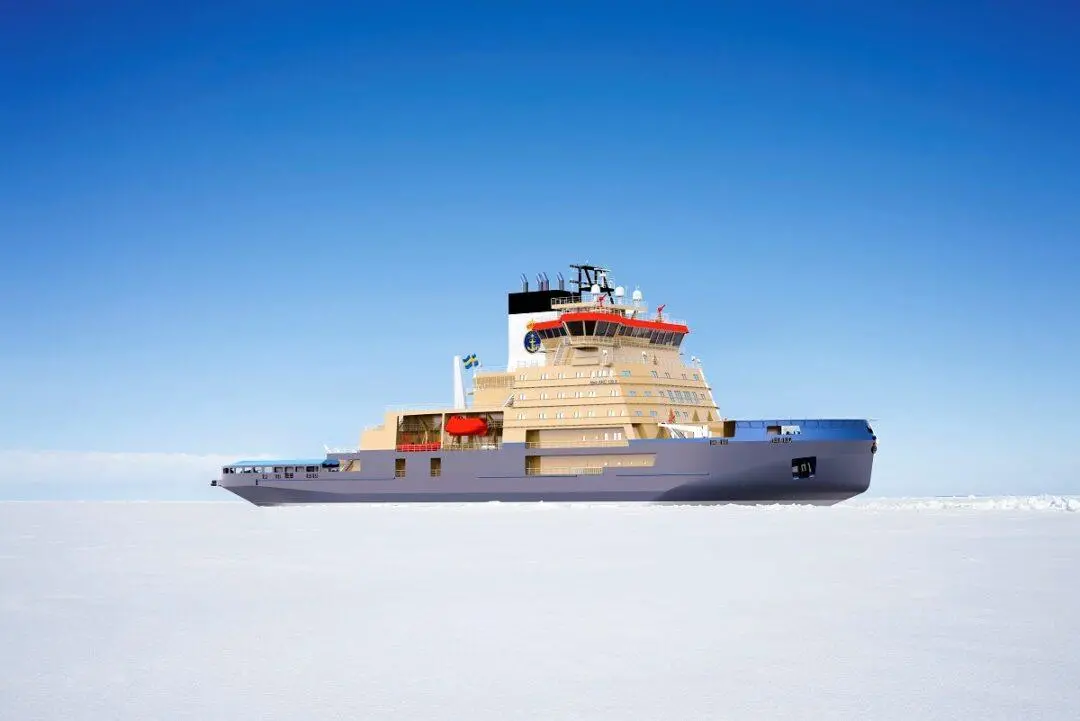
The project is being expedited through its technical phases in anticipation of Sweden’s parliament approving a national budget for the scheme this spring to cover newbuild costs. According to industry sources, each vessel could command around SEK1.72bn ($165m), and the SMA is looking to be able to award newbuild contracts by September 2023, with a view to delivery of the first of class in 2026 and the second a year later.
Development work has progressed to the stage where the design has been finalised by the SMA with Finland’s Aker Arctic Technology. The nominated Aker ARC 130S type will have the capability to keep Baltic fairways open and assist ships up to 32m in beam through ice masses in the most difficult conditions and areas, notably the Gulf of Bothnia. The triple azimuthing propulsion layout will afford the requisite steering and manoeuvring standards, including rapid astern/forward handling to overcome ice ridges.
The current plan is to build and engineer the icebreakers initially for operation on fossil-free renewable diesel oil(hydro-treated vegetable oil, HVO) with readiness to adopt methanol as soon as the technology has matured and fuel availability is secured. The harbour generators will use methanol-based MD97 fuel from the outset. Moreover, the ships are likely to incorporate an energy storage system, to keep engine hours down, cutting service costs and emissions.
These provisions in toto accord with the stipulations laid down by Swedish authorities whereby, over-and-above the expectation of reduced CO2 emissions, the design must allow for adaptation to various alternative fuels, in acknowledgement of a national environmental agenda calling for a transition to fossil-free fuel by 2030 at the latest.
Although a methanol-ready condition is presently the aim, the team involved in the project consider that it may prove feasible to build the icebreakers directly for biomethanol, given the pace of technological progress by engine manufacturers coupled with the roll-out of bio- and e-methanol plant schemes in Sweden. Besides its environmental attributes, methanol is seen, in an alternative fuel context, as offering the longest autonomous running time crucial to escort icebreaking activities.
The Aker ARC 130 family of icebreakers already in service includes Finland’s 2016-built, 110m Polaris, the world’s first LNG-fuelled escort icebreaker. In many respects as regards engineering, propulsion and hull form, Polaris informs the Swedish project. The Finnish vessel’s dual-fuel electric installation is founded on five Wartsila medium-speed DF engines and three Azipod propulsion units, two at the stern and one at the bow.
The key features of the new ARC 130S variant have already been tested in Aker Arctic’s ice laboratory near Helsinki as well as in SSPA’s open-water basins at its Gothenburg research centre to compare options and confirm results. Overall efficiency was evaluated with extensive life cycle cost assessment calculations, and model tests for the concept alternatives were conducted to verify both open-water and icebreaking performance and the ability to escort ships in the close-coupled towing mode characteristic of Baltic work.
The new PC4-class icebreakers will allow the SMA to begin retiring the oldest units of its five-vessel Baltic fleet. Swedish industry is dependent on icebreakers for keeping ports and fairways in the upper Gulf of Bothnia ice-free for up to five months of the year.
Sweden launched its escort icebreaker renewal technical programme in conjunction with Finland during 2020. Finland presently has nine active icebreakers, including a number of advanced age, and its economy is even more reliant on keeping channels open year-round, as 90% of the country’s foreign trade goes by sea.
Related Articles
 METHANOL
 METHANOL
 2-STROKE & 4-STROKE