



More Atomic Icebreakers For Russia
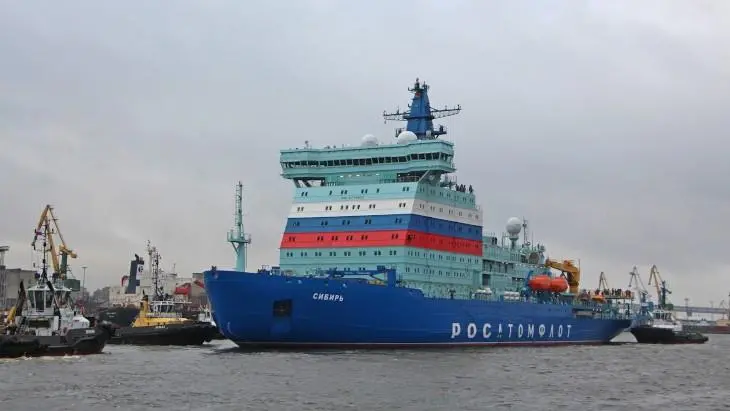
The government has authorised funding towards the construction of sixth and seventh newbuilds of the Project 22220 class for FSUE Atomflot. Also designated the LK-60 type, each of the new 173m generation has a triple-screw installation with a combined propulsive force of 60,000kW.
The first Project 22220 escort icebreaker, Arktika, was completed by Baltijskiy Zavod (Baltic Shipyard) in St Petersburg during 2020, and was followed into service by Sibir in 2021 and by Ural in the closing stages of last year. Fourth and fifth sisters, Yakutia and Chukotka, are in hand and due for handover in 2024 and 2026. The envisaged sixth and seventh vessels are expected to be completed by the end of 2028 and December 2030, respectively.
The design is powered by two RITM-200 pressurised water reactors, mounted side by side, producing up to 350MW of thermal energy. Two main turbo generators each produce 36MW of electrical power, and propulsive effect is delivered through three shaft lines driven in each case by a 20MW electric motor.
As a science that ensures years of continuous service without refuelling, nuclear power applied to marine propulsion overcomes the considerable logistic challenges presented to an icebreaker fleet deployed in the remote, environmentally hazardous waters off Siberia. The 22220/LK-60 design has the form and potency to overcome solid ice up to 2.9m in thickness, while maintaining a speed of some 1.5 to two knots, opening channels for transiting ships, with the potency to tackle high ice ridges and recover vessels trapped in the frozen waste. Open water maximum speed is in the order of 22 knots.
The dual-draught allows operation throughout the NSR regime, both the 3,500 mile (5,600km)-long seaway and its most arduous eastern channels, and the shallow bights and estuaries along its course, including the Gulf of Ob and the Yenisei River to Dudinka.
The NSR is Russia’s Arctic conduit for energy and metal exports, and was used by ships carrying 34m tons of cargo in 2022. Although westbound traffic and also international transits by foreign ships have been hit by sanctions imposed since the Russian invasion of the Ukraine, the more difficult eastern passage has grown in importance and utilisation as a transport corridor, particularly for gas and oil from the Yamal and Gyda peninsulas to large parts of Asia which retain open trading links with Russia. Moreover, resource development is continuing and leading to increased shipments, as exemplified by Rosneft’s huge Vostock Oil project in the Taimyr and Gyda regions.
The nuclear icebreaker fleet run by Rosatom subsidiary Atomflot is instrumental in maintaining navigation and realising the broader national strategies relating to the NSR.
Russian investment in atomic icebreakers also encompasses the considerably more powerful (120MW) Project 10510 Leader-class, the first of which was laid down in July 2021 at the Zvezda Shipbuilding Complex near Vladivostock in the Russian Far East. It is claimed that the 209m Leader behemoth will be able to navigate ice of 4.5m thickness.
Russia’s knowledge and experience in operating and engineering nuclear-powered, non-naval vessels is unsurpassed worldwide. Further investment is clearly positive for the technological standing of the Russian shipbuilding and allied industries, and at a time when nuclear propulsion is attracting renewed interest elsewhere as a potential environmentally sustainable application for commercial shipping.
Related Articles
 AMMONIA
 AMMONIA
 OTHER ALTERNATIVE FUELS