



Retrofit challenges could hamper timely reduction of emissions

There are practical challenges when it comes to the testing and certification of the exhaust gas emissions of engines after they have been retrofitted, says Dr Fabian Kock, Head of Section at DNV, citing Regulation 13 of MARPOL Annex VI (Nitrogen oxides (NOx)) and the NOx Technical Code 2008.
“These regulations do not cover a detailed procedure for how to improve the performance of existing marine diesel engines that are installed onboard a ship and which cannot be tested on test beds retroactively. One could say that the requirements of the NOx Technical code are somehow hindering the development of new technologies when retrofitting already certified engines on board of existing vessels,” he says. “This dilemma has just recently been addressed to IMO MEPC80.”
Additionally, the conditions on board a ship are not optimal for conducting a parent engine emission test according to the procedures and requirements as outlined in chapter 5 of the NOx Technical Code. Kock cites some practical challenges:
- Weather and sea conditions, vessel draught and other conditions prevent the engine from running constantly at 100% power. Each wave, change in rudder angle, etc has repercussions for the torque the engine provides to the propeller.
- A dedicated dynamometer (water break) cannot be installed or connected onboard a ship which leads to compromises in the accuracy of power measurements.
- Weather and sea conditions, vessel draught, vessel hull, propeller and other conditions prevent the engine from running on the ideal (theoretical) propeller curve on board at a test run.
DNV is working closely with engine manufacturers, equipment makers, ship designers and yards to ensure safe ship operation on individual retrofit projects. One recent project is its collaboration with BW LPG, the Isle of Man Ship Registry, Wärtsilä Gas Solutions and MAN Energy Solutions on a fleet of vessels retrofitted for LPG fuel. The last of 12 retrofitted vessels successfully left the repair yard earlier this year, and the conversions are a first for very large gas carriers.
Case-by-case certification
Mark Penfold, LR’s Technical Specialist for Power Generation, says that the broad range of potential modifications, and the specific implications for each ship, means that LR will assess all proposals on a case-by-case basis.
“The reality is that conversions are difficult, particularly for cryogenic gaseous fuels. Onboard emissions testing is usually one of the more difficult aspects to verify. The issues (and our requirements) are relatively straightforward for a synthetic fuel (as in synthetic diesel, or a biofuel such as HVO) which may be considered as direct drop-in fuels. That is very different to hydrogen or ammonia as alternative fuels. Our approach is therefore case-by-case and requires compliance with the rules.”
He says that while LR is well practiced in undertaking sea trials as part of the process for issuance of ship and equipment class and statutory certification, there are additional parts of equipment and system testing undertaken at type tests or factory acceptance tests that can be challenging if these have to be undertaken onboard. “In the case of modifications or conversions involving changes to internal combustion engines the statutory NOx implications can also be one of the more challenging aspects and the difficulties with undertaking emissions measurements onboard are well known.”
Julien Boulland, Global market leader for sustainable shipping at Bureau Veritas Marine & Offshore, says one of the critical aspects of engine retrofitting is the certification process. “Due to the limited number of cases, approval will always be, for the moment, on a case-by-case basis, and the process depends on whether the new engine is already type-approved or not.”
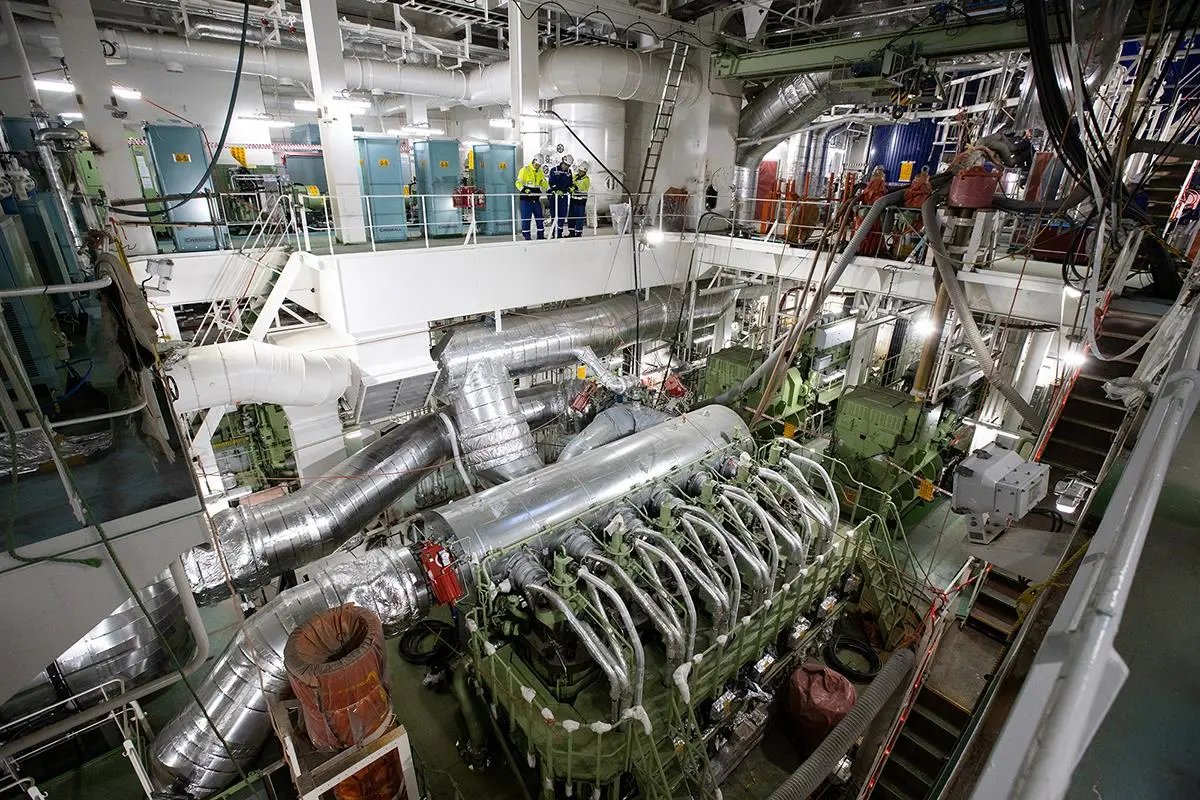
In the case where the new engine is already type-approved, BV follows a two-fold procedure consisting of a review of engineering drawings, sanctioned with a review attestation, and a subsequent onboard survey, leading to the final certification. The survey is based on an approved tests program that is thoroughly discussed and approved by class.
Project experience
In the past, BV has collaborated with engine manufacturers on significant projects such as the 1,000 TEU Wes Amelie, now named the ElbBlue, which was the first container ship to undergo a dual-fuel LNG conversion in 2017. This retrofit served as a pioneering effort to test the viability of LNG technology in a container ship setting.
Another notable project is the conversion of some ships in the Spanish ferry operator Balearia’s fleet to LNG. The conversion works were carried out at Portugal’s West Sea yard where the engines were adapted to dual-fuel LNG propulsion.
Currently, BV is working with a leading engine maker and a large container ship operator on the retrofit of engines in several phases. This ongoing project involves the development and implementation of a two-stroke future fuels conversion solution. The retrofit conversion initially allows for operation with LNG fuel and is designed to be adaptable to ammonia in the future. The first commercial conversion project is expected to be completed in 2025 at the earliest, and it will contribute to making existing fleets ready to meet future emission requirements.
Changing demand
Boulland sees changes ahead for the market. “In terms of retrofitting, we have observed varying levels of interest based on different factors. For example, in the case of LNG, retrofitting with LNG technology has been conducted on a few projects in the past to test the viability of the technology. However, nowadays, ships can be ordered with full dual fuel technology, making costly LNG retrofits less common.”
He says it is important to note that beyond engine retrofits, the scope of retrofitting can extend beyond the engine itself: from total engine replacement or conversion, to complete replacement of machinery spaces, or more extensive modifications of the hull (jumboisation, bulbous bow).
“At BV, we actively collaborate with yards and manufacturers on engine retrofit projects. We have worked with engine manufacturers on various initiatives in the past, and we continue to engage in partnerships for ongoing and upcoming projects,” says Boulland.
“These collaborations with shipyards and manufacturers are essential to ensure the successful execution of retrofit projects, leveraging their expertise and resources to achieve the desired outcomes. Close cooperation between all stakeholders, including owners, classification societies, and flag states, is crucial for the seamless integration of retrofitted components and compliance with applicable regulations.”
New fuel ready

Boulland notes strong interest for fuel-prepared notations for new fuels such as methanol and ammonia. However, he says it is important to distinguish between the concept of retrofit and the notion of fuel-prepared notations. “The fuel-prepared notation can be seen as the initial step towards an actual retrofit and certifies that a ship has been designed and constructed to later be converted to use a different fuel. Furthermore, it is important to refer to the specific class rules to determine the applicability and degree of preparation required for each ship system.”
For BV’s Boulland, the most significant factor influencing the decision to carry out retrofit operations remains the cost of conversion, as ship operators need to evaluate the economic feasibility. Some projects may involve subsidies or other forms of support to encourage and facilitate conversion projects.
Retrofits at scale
MAN Energy Solutions and DNV summarised the technical issues for engine retrofits in a recent white paper Potential for dual-fuel conversions of marine engines that current technical IMO regulations present a challenge for fast implementation of retrofitting to dual-fuel at scale. At issue is that a parent engine test of exactly the same electronically controlled engine type is required for a dual-fuel conversion to be NOX compliant. This is a problem for the pace and cost of decarbonisation.
The paper states: “Imagine relatively new engine technologies such as methanol and ammonia that are not available for all bore sizes. Today shipping needs to wait for a newbuild test before the new technology can be implemented as retrofit. But certain historical engine types are not made for newbuilds anymore. So there are engines in operation running on HFO where shipowners want to retrofit to dual-fuel based on a positive business case, but where a test of a newbuild engine – a parent engine test – is not possible.”
DNV and MAN have supported IMO member states as they raise attention to the issues at IMO level. They have also proposed new procedures for certifying the NOx exhaust emissions of existing engines on board of ships which have undergone a retrofit.
Related Articles
 2-STROKE & 4-STROKE
 2-STROKE & 4-STROKE
 2-STROKE & 4-STROKE