



Electrification takes shipping further along its decarbonisation path
Some recent Wärtsilä projects demonstrate the variety of hybridisation solutions available to shipowners. Three new Finnlines roros have 2-stroke engines, shaft generators, PTO/PTI, thrusters with controllable pitch propeller as well as an energy management system, power management system and automation system. The vessel can manoeuvre on battery power, avoiding emissions close to port.
Four new SAL Heavy Lift vessels will feature variable-speed 4-stroke Wärtsilä 32 twin main engines capable of operating with methanol fuel. The hybrid system includes energy storage, PTO/PTI, and a multi-drive converter driving a controllable pitch propeller. The energy storage will significantly reduce fuel consumption during crane operations, as this is done by batteries.
Total power demand is an important consideration, and the more flexibility plays a role, the more hybridisation is a benefit, says Grant Gassner – Director, Integrated Systems and Solutions at Wärtsilä. Electrical systems onboard make it possible to use smarter propulsion control systems, and he says the market is continuously shifting towards more hybridisation and therefore more electrification.
The variety of solutions can include a basic 2-stroke engine with PTO/PTI and a small battery, single or multiple four stroke engine in a mechanical CPP arrangement with a PTO/PTI and battery or complete electric propulsion with multiple four-stroke generating sets and battery. “New decarbonization technologies, including future fuels, new energy sources and energy saving devices can greatly influence both the power demanded from the engines and power production characteristics of the system, leading to a significant uptake in interest for more flexible propulsion power systems that can more easily be integrated with future decarbonization technologies and maintain high system efficiency across a wide range of operational conditions.”
Torsten Büssow, Director for Ship Electrification at Wärtsilä, adds that total separation of electricity production and consumption obtained in a fully-electric power system is very good for staying flexible for future power sources like new fuel engines, fuel cells or bigger batteries. Electric propulsion systems are also sailing efficiently at a range of speeds, including slow steaming, and for catering for energy saving devices such as wind-assist technologies.
“Electric propulsion will perform better than mechanical propulsion in many scenarios, because the engine load factors when applying traditional single main engine mechanical propulsion become extremely low when combined with new decarbonisation technologies and operating conditions,” he says. “Electric propulsion with four stroke generating sets has a very flat efficiency curve across the entire vessel speed and power spectrum.”
Electrical systems including shaft generators and shore power connection represent the first phase towards electrification for deepsea vessels and are already commonly included in orders today. Future concepts are investigating increasingly electrified and hybridised solutions to ensure the needed flexibility in introducing new decarbonization technologies. Büssow predicts that eventually every vessel will be hybrid and will have multiple power sources.
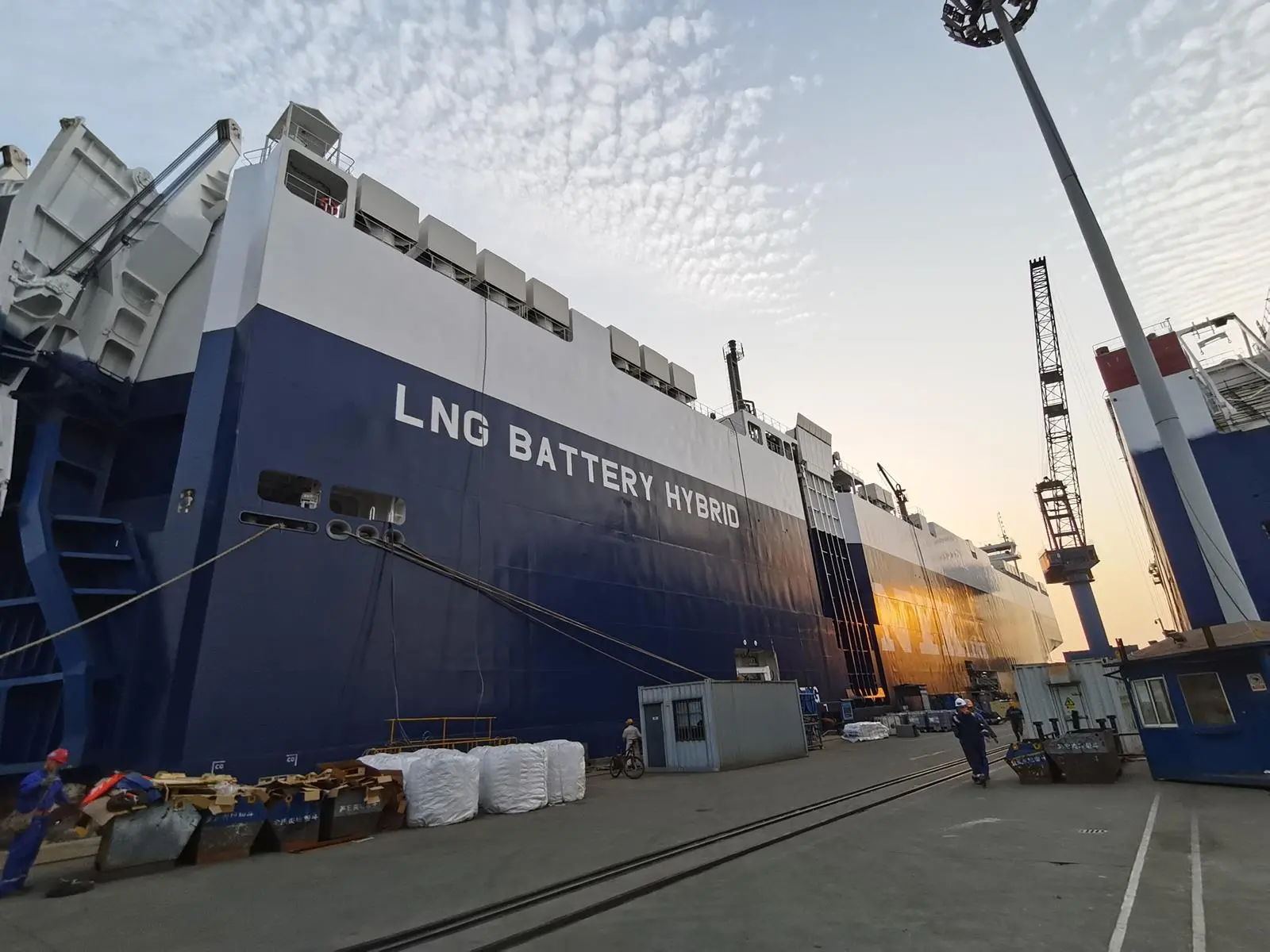
A series of new LNG-hybrid car carriers for NYK Line showcase WinGD’s advanced battery-hybrid system to date. The configuration comprises WinGD’s latest 7X62DF-2.1 two-stroke engines coupled with shaft generator, DC-link, batteries and bow thruster drive. The vessels also feature the most comprehensive installation to date of WinGD’s ecosystem of solutions including WinGD’s X-DF2.1 iCER (Intelligent Control by Exhaust Recycling), WiDE (WinGD integrated Digital Expert) and X-EL Energy Manager.
By integrating the two-stroke main engine control into the electrified vessel power system, X-EL Energy Manager widens the range of vessels that can benefit from electrification as shipping seeks to improve efficiency and reduce emissions.
X-EL Energy Manager steers the operation of all energy resources onboard to achieve optimum system efficiency as a whole. Based on its in-depth knowledge and access to data of main engine performance, WinGD optimises the energy flow, running the main engine at its optimal point, avoiding suboptimal energy production. WinGD General Manager, Sustainability Solutions, Stefan Goranov, says that it’s important factor in the engine control in the overall system energy management. “Knowing the limits of the engine we can extend its efficient operational range with shaft generator without triggering undesired behaviour, such as, such as knocking, preignition, or even tripping,” he says. The X-EL energy manager can also maintain optimum load sharing between the shaft generator and the gensets so that system efficiency is maximised. “These vessels highlight our most comprehensive representation to date of our ecosystem of solutions. They represent significant firsts and milestones for WinGD.”
Related Articles
 2-STROKE & 4-STROKE
 2-STROKE & 4-STROKE
 2-STROKE & 4-STROKE