



Hanshin Gas Engine Thermal Efficiency Exceeds Diesel
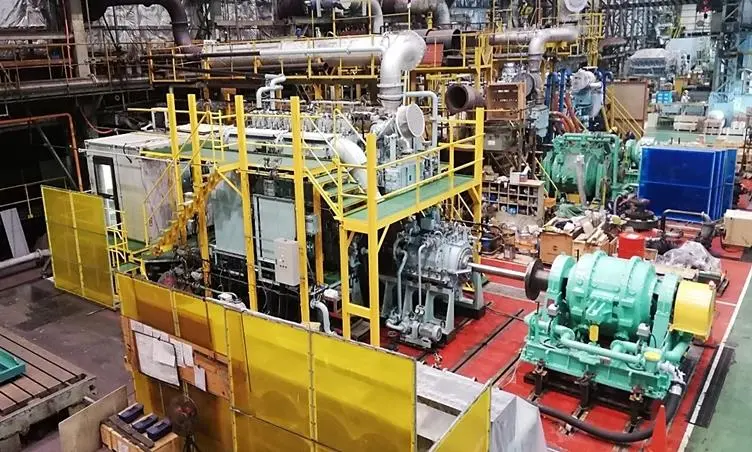
Hanshin Diesel’s low speed 4-stroke engines are designed to provide power for main propulsion use, and they complete one cycle (intake, compression, combustion, and exhaust) for two crankshaft revolutions or four piston strokes.
Although larger in external dimension than medium or high speed engines, the low speed engine is easy to handle and reliable, says Hanshin Diesel, and the trend towards high efficiency propellers has enabled the advantages of having a longer stroke. And unlike medium speed engines, there is generally no need for a gearbox.
According to Hanshin Diesel, high thermal efficiency is achieved by the lower revolution speed which provides a sufficient combustion period, and the longer stroke which provides a larger combustion space. The engine has a low running cost which counters the higher initial CAPEX.
The six cylinder Hanshin Gas Engine G30 was completed in 2018, and the CIMAC presenters compared in-cylinder performance between it and the existing diesel engine. Maximum firing pressure is same but the gas engine has lower compressive pressure and earlier firing time. As the maximum temperature in cylinder of the gas engine is higher, they conclude that the thermal efficiency of the gas engine is greater.
Gas is pre-mixed with intake air and enters the combustion chamber through a gas injector nozzle. Ignition in the pre-chamber results from two spark plugs. A pressure sensor in each cylinder enables control of the ignition timing to avoid knocking.
“The most prominent feature of Hanshin Gas Engine is the stability,” says Satoru. “It has two plugs in one cylinder which supports redundancy. Other features are strong torch from prechamber and moderate swirl that assists flame propagation. Thanks to these, it has stable combustion from low load to high load. The engine can be loaded up solely by gas without misfire even from no load.”
Testing of the Hanshin Gas Engine G30 was done with the fuel gas whose methane number is about 66. Stable combustion was achieved under very lean conditions, and a thermal efficiency of 48.5% was achieved, which corresponds to the fuel consumption 151g/kWh with the assumption of fuel being 49200 kJ/kg.
The gas engine has the same size, configuration and shafting system as the original low speed diesel engine and can replace existing installations. Output and speed are also within the same layout range. Further tests have been carried out to improve the transient response of the gas engine to ensure easy operation during ship manoeuvring.
Hanshin Diesel plans to expand the engine lineup and is using the experience gained from the development of the gas engine to investigate future fuel solutions.
Related Articles
 2-STROKE & 4-STROKE
 2-STROKE & 4-STROKE
 2-STROKE & 4-STROKE