



WinGD plans next updates to X-DF engine
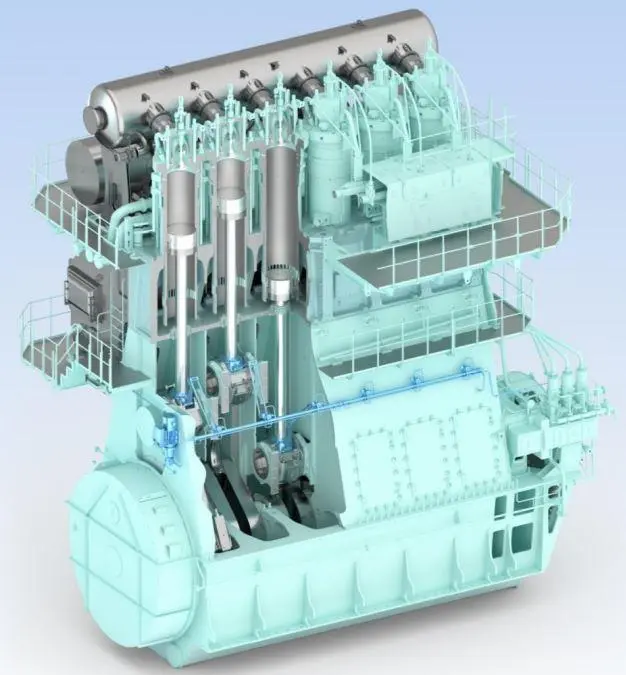
The research was presented at CIMAC 2023 by Fridolin Unfug, Senior Expert Combustion Development at WinGD. Three design packages could be released before 2025, and will include increases to BMEP in two stages. Increasing BMEP enables several new measures to be implemented that will reduce wall heat loss while providing efficiency improvements. Prior to this, the advantage of keeping BMEP and engine speed unchanged was to guarantee X-DF2.0 engine applicability to current ship designs without necessitating changes.
With the latest engine improvements, WinGD says it is reducing engine size and cost as well as methane emissions. The first package of measures will reduce wall heat losses by heat flux optimisation. This is expected to increase energy efficiency by 1-2%. Cylinder wall quenching will also reduce CH4 emissions.
The second and third design releases will include the closing of combustion chamber gaps/crevices as well as the use of the low-pressure EGR system already introduced, among other changes not yet made public. Together, these changes are predicted to increase engine efficiency by 4% and reduce CH4 emissions to about 0.6 g/kWh.
Incorporation of EGR
They will be in addition to the 2% increase in efficiency that was achieved by X-DF2.0. These achievements were the result of exploiting the superior efficiency of pre-mixed combustion (Otto cycle) concepts and overcoming pre-ignition limitations by recirculating exhaust gas via a low-pressure EGR to reduce flame speed. This enabled quenching of lube oil ignited hot spots in the cylinder, enabling the compression ratio to be increased to maximum cylinder pressure.
Research was undertaken on the X-DF1.0, which operates without EGR, using optical in-cylinder measurements to characterise chemical reaction kinetics during a temporary cut in lube oil to simulate pre-ignition.
The EGR solution developed allows up to half of the exhaust gas flow to be returned so that hydrocarbons that were initially unburned hydrocarbons are potentially burnt to both reduce methane slip and improve engine efficiency. The EGR was developed in partnership with Alfa Laval as part of its iCER technology. Short for Intelligent Control by Exhaust gas Recycling, iCER was first presented in 2020, and in May 2022 an on-engine version was introduced, enabling the emissions reduction technology to be installed without impact on engine footprint.
The improvement of the thermodynamic efficiency of the engine cycle together with the improvement of the combustion efficiency in gas mode led to a reduction of the IMO weighted fuel consumption by 5.5g_gas/kWh, says WinGD, which is “a remarkable improvement of the total engine efficiency by about 2% points. Significant improvements could as well be gained on the emission side: The IMO weighted CH4 and NOx emissions could be reduced by 45% and 35% respectively.” The result is a reduction in greenhouse gas emissions of about 10%. Running on diesel, iCER improves the emissions performance of X-DF engines by 6%.
Optimal compression for multiple fuels
In June 2023, WinGD introduced its Variable Compression Ratio (VCR) concept, jointly developed with Mitsui E&S. With VCR, the engine adjusts to each fuel’s optimal compression.
In trials on a 6X72DF test engine, VCR reduced fuel consumption and CO2 emissions by 6% when running on diesel mode. Although the engine had previously been optimised for gas mode, improvements were also evident when using LNG, with fuel consumption and emissions reduced by 3%. The improvement was achieved because the engine was originally configured to a compression ratio that favoured LNG while still offering good diesel performance. With VCR, this compromise is no longer required.
As well as optimising compression ratios for different fuels, VCR can also benefit engines operating under different ambient conditions and intake air compositions, such as when using EGR.
Compression ratio is altered by changing the piston position to adjust combustion chamber volume. The simple mechanical configuration has no impact on engine footprint or installation requirements. VCR can also be adjusted for part load operation. It will initially be installed on a vessel powered by an X62DF engine and then rolled out across selected engines of the X-DF engine portfolio.
Related Articles
 2-STROKE & 4-STROKE
 2-STROKE & 4-STROKE
 2-STROKE & 4-STROKE